Let VLMs Do Only Perception: Multi-View Planning Success Rate Jumps from 1% to 97%

New research proposes the BW-PO benchmark and VLM-as-perceiver paradigm, limiting VLMs to local perception and raising multi-view planning success rates from 1% to 97%.
Vision-language models approach saturation on standard visual planning benchmarks but cannot resolve depth ambiguity under occlusion-induced partial observability, causing sharp performance drops. The study identifies two entangled bottlenecks in end-to-end VLM planners: cross-view evidence reconciliation under depth ambiguity and visual extraction completeness in dense scenes. The authors build the Blocksworld-based multi-view benchmark BW-PO and propose VLM-as-perceiver, limiting the VLM to single-view local perception while delegating cross-view reconciliation and plan generation to an external solver. On challenging subsets, Gemma-4-31B rises from 1% to 97%, Qwen3.5-122B-A10B from 0% to 95%, and Gemini-3.1-Pro from 3% to 84%. The method decouples and diagnoses bottlenecks but relies on an external solver and its generalization remains unverified.
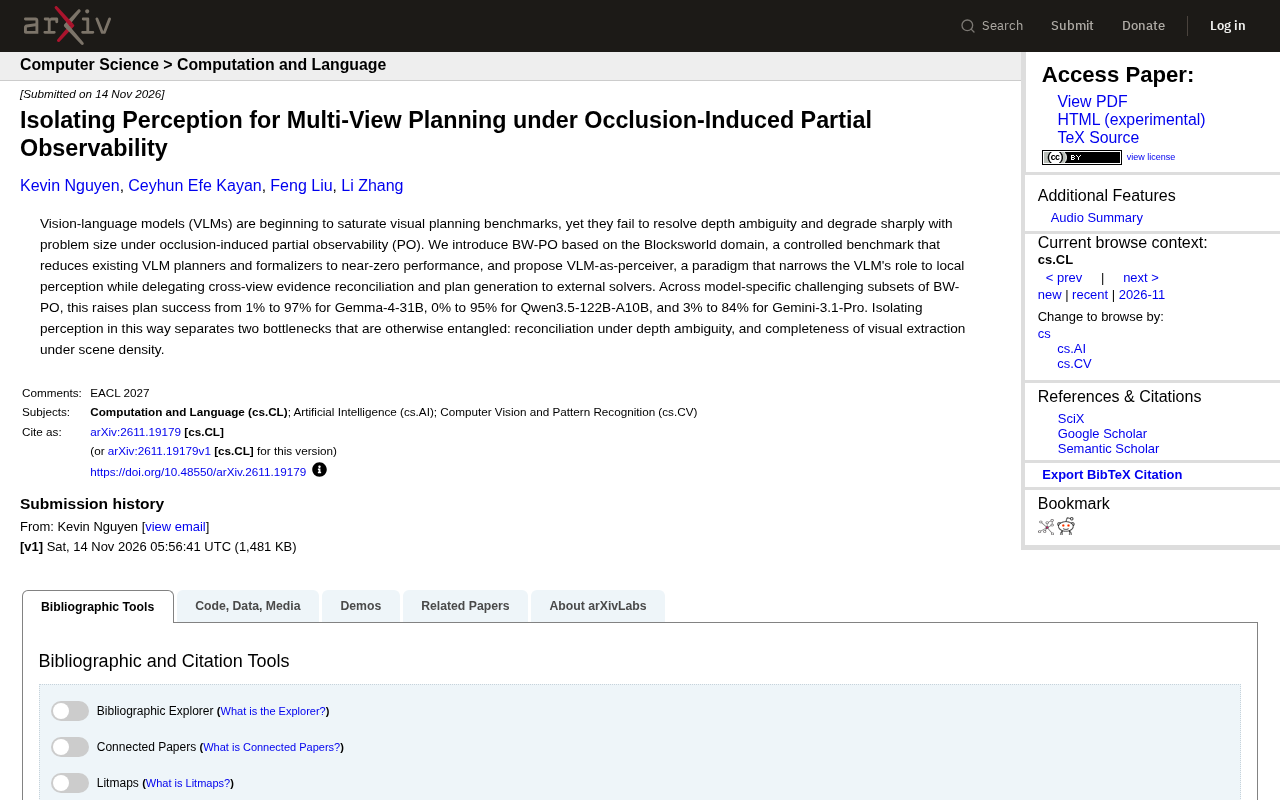
Vision-language models (VLMs) are approaching saturation on visual planning benchmarks, but when faced with partial observability (PO) caused by occlusion, they cannot resolve depth ambiguity, and performance degrades sharply as problem scale increases. A new study proposes the BW-PO benchmark and the "VLM-as-perceiver" paradigm, which narrows the VLM's role to local perception and delegates cross-view evidence reconciliation and plan generation to an external solver, thereby raising planning success rates from 1% to 97% on challenging subsets.
Problem: Two Entangled Bottlenecks in VLM Planners
Existing VLM planners perform well on standard visual planning tasks, but once partial observability caused by occlusion is introduced, performance degrades substantially. The study points out that behind this lie two entangled bottlenecks: first, evidence reconciliation under depth ambiguity, and second, the completeness of visual extraction as scene density increases. Traditional end-to-end methods have the VLM simultaneously handle perception, reconciliation, and planning, making errors hard to attribute and hard to improve in a targeted way.
To systematically expose this problem, the authors build the BW-PO benchmark based on the Blocksworld domain. This benchmark introduces partial observability through multi-view settings and occlusion, and can drive the performance of existing VLM planners and formalizers down to near zero. This means that current models have fundamental flaws when they need to integrate information across views.
Partial Observability (PO) is a classic setting in planning and reinforcement learning: the agent can only obtain part of the information about the environment state, rather than the global ground truth. In visual planning tasks, occlusion, viewpoint limitations, or sensor field of view all cause PO. In this case, the positional relationships of the same object across different views may produce depth ambiguity—for example, two objects overlap in the image, but their actual front-back order cannot be determined from a single frame. The standard approach to solving PO problems is to maintain a belief state and gradually eliminate uncertainty by fusing multi-source observations. End-to-end VLM planners attempt to perform this fusion implicitly, but lack an explicit belief update mechanism, and thus are prone to collapse in occluded scenes.
Blocksworld is a classic benchmark domain in the field of AI planning, consisting of a series of blocks and stacking operations. Its state space is discrete and its action rules are clear (such as pick-up, put-down, and stack), making it convenient for formal verification and planning solutions. Researchers often extend it into a multi-view version, simulating partial observability by introducing occlusion. BW-PO is built precisely on this basis: each view exposes only some blocks and their spatial relationships, and the model needs to integrate information across views to recover the complete world state. Because Blocksworld's rules are clear, any planning failure can be attributed to perception or reconciliation rather than ambiguity in the task itself, making it suitable as a diagnostic benchmark.
Method: The VLM-as-perceiver Paradigm
The core idea of the study is "isolating perception": rather than requiring the VLM to directly output a complete plan, its responsibility is limited to local perception—extracting visible objects, spatial relationships, and other information from each view. Cross-view evidence reconciliation and final plan generation are left to an external solver. This division of labor decouples the two originally entangled bottlenecks: the VLM only needs to ensure the completeness of single-view visual extraction, while reconciliation under depth ambiguity is handled by a symbolic solver.
This paradigm does not depend on a specific model architecture and has good generality. The authors validated this idea on multiple models, including Gemma-4-31B, Qwen3.5-122B-A10B, and Gemini-3.1-Pro.
A formalizer in such systems refers to a module that converts natural language or visual input into a symbolic planning problem description, typically outputting a PDDL (Planning Domain Definition Language)-style state and goal. Traditional end-to-end VLM planners often implicitly take on the formalization role, but their outputs are difficult to verify. In the VLM-as-perceiver paradigm, the VLM is only responsible for extracting local observations from each view (objects, attributes, spatial relationships); these local observations are then merged by an external formalizer into a global symbolic state, and finally handed to a classical planner (such as a search-based solver) to generate an action sequence. This division of labor makes the output of each stage independently checkable, and error attribution clearer.
Experimental Results: A Sharp Rise in Success Rate
On the model-specific challenging subsets of BW-PO, VLM-as-perceiver brings significant improvements:
- Gemma-4-31B: planning success rate rises from 1% to 97%
- Qwen3.5-122B-A10B: from 0% to 95%
- Gemini-3.1-Pro: from 3% to 84%
These results show that when the VLM is no longer required to simultaneously resolve depth ambiguity and planning problems, its local perception capability is sufficient to support high-performance multi-view planning. The magnitude of the improvement also inversely confirms the severity of the bottleneck under the end-to-end paradigm.
You may not have noticed that the magnitude of improvement differs across models. Gemini-3.1-Pro's final success rate is slightly lower, possibly related to its visual extraction completeness in dense scenes, but the original text does not analyze this in depth.
Significance and Limitations
The value of this work lies in providing a diagnosable paradigm: by isolating perception, researchers can separately evaluate "whether visual extraction is complete" and "whether cross-view reconciliation is effective," thereby locating the root cause of failure. The BW-PO benchmark also provides a controllable test environment for subsequent research.
In terms of limitations, the current method relies on an external solver, making the system more complex than end-to-end solutions; in addition, BW-PO is based on the Blocksworld domain, and its generalization ability to more open scenarios still needs verification. But regardless, narrowing the VLM's role from "all-purpose planner" to "perceiver" provides a pragmatic and effective path for multi-view planning.
One-line Summary
A new study proposes the BW-PO benchmark and the VLM-as-perceiver paradigm, limiting VLMs to local perception and raising multi-view planning success rates from 1% to 97%.
Paragraph Summary
Vision-language models are approaching saturation on standard visual planning benchmarks, but under partial observability caused by occlusion they cannot resolve depth ambiguity, and performance drops sharply. The study points out that end-to-end VLM planners have two entangled bottlenecks: cross-view evidence reconciliation under depth ambiguity, and visual extraction completeness in dense scenes. To address this, the authors build the multi-view benchmark BW-PO based on Blocksworld and propose the VLM-as-perceiver paradigm, narrowing the VLM's responsibility to single-view local perception while delegating cross-view reconciliation and plan generation to an external solver. On challenging subsets, Gemma-4-31B's success rate rises from 1% to 97%, Qwen3.5-122B-A10B from 0% to 95%, and Gemini-3.1-Pro from 3% to 84%. This method can decouple and diagnose bottlenecks, but relies on an external solver and its generalization remains to be verified.
Related articles

Jensen Huang Returns to Nvidia: The Power Game Behind an "Aggro Reset"
Nvidia's board reappointed Jensen Huang as CEO less than two weeks after his scandal-driven resignation. This analysis explores the board's decision-making, Trump's political intervention, media power failure, and market reaction behind the dramatic return.

Why Voice AI Can't Understand Kenyans' Everyday Conversations
Swahili speech recognition hits 3.24% error on read text, but everyday Kenyan speech mixes English, Sheng slang, and accents—leaving mainstream voice AI struggling.

Data Centers Build Their Own Natural Gas Plants: AI Compute's Breakout Around a Decade-Long Grid Wait
Grid interconnection approvals can take a decade, so xAI and others are building off-grid natural gas plants to power AI clusters. This article analyzes the drivers, costs, and impact of behind-the-meter generation on AI infrastructure.