Letting AI Design a Better nnU-Net: An Architecture Discovery Loop That Learns from Failure

An LLM agent discovers two 3D medical image segmentation design principles through failure diagnosis, hypothesis generation, and counterfactual experiments.
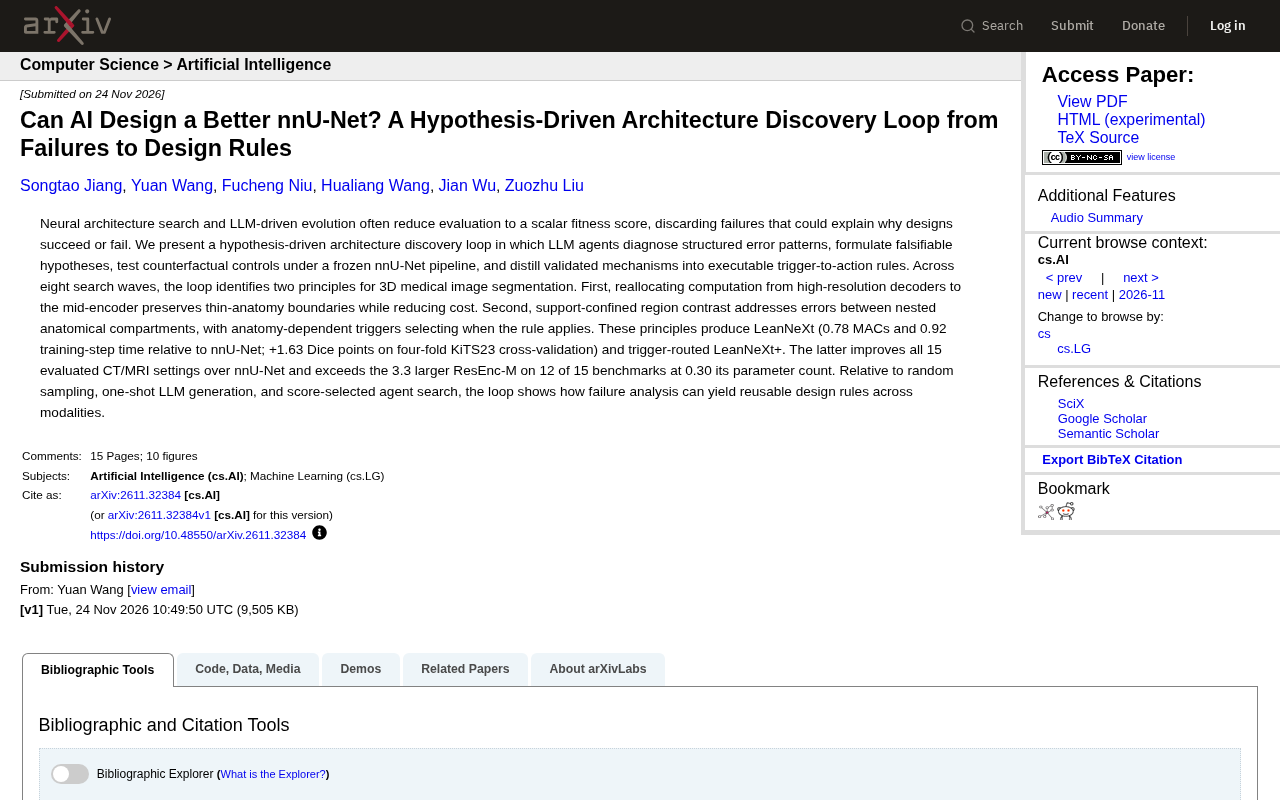
This study proposes a hypothesis-driven architecture discovery loop in which an LLM agent diagnoses structured error patterns, proposes falsifiable hypotheses, and runs counterfactual control experiments under a frozen nnU-Net pipeline, distilling validated mechanisms into reusable "trigger-action" rules. Over eight rounds, the loop found two design principles for 3D medical image segmentation: reallocating computation from the high-resolution decoder to the intermediate encoder, yielding LeanNeXt (Dice +1.63 on KiTS23 cross-validation with lower compute than nnU-Net); and support-confined region contrast, yielding trigger-routed LeanNeXt+ (outperforming nnU-Net on all 15 CT/MRI settings and beating ResEnc-M, which has 3.3× more parameters, on 12 benchmarks). Compared with random sampling and score-selection baselines, the loop shows how failure analysis can yield design rules that transfer across modalities, pushing NAS from "score-and-select" toward "hypothesize-and-test."
Neural architecture search and LLM-driven evolution often reduce evaluation to a single scalar fitness score, discarding the failure cases that explain why a design succeeded or failed. A recent study proposes a hypothesis-driven architecture discovery loop in which an LLM agent diagnoses structured error patterns, proposes falsifiable hypotheses, tests counterfactual controls under a frozen nnU-Net pipeline, and distills validated mechanisms into executable "trigger-action" rules. After eight rounds of search, the loop found two design principles for 3D medical image segmentation.
Distilling design rules from failure: the core of the method
Conventional NAS and LLM-evolution methods compress each candidate architecture into a score and then select the best one based on that score. The problem with this approach is that failed designs are simply discarded—yet they are precisely the ones that contain information about why something doesn't work. The loop proposed in this study treats failure as a signal. The LLM agent first diagnoses error patterns—for example, on which anatomical structures the segmentation results go wrong and how the errors are spatially distributed—and then proposes testable hypotheses, such as "can reallocating computation from the high-resolution decoder to the intermediate encoder improve the boundaries of thin anatomical structures?" Next, counterfactual control experiments are run under a frozen nnU-Net training pipeline to validate or refute the hypothesis. Finally, validated mechanisms are written as "trigger-action" rules that can be reused across modalities and tasks.
According to the paper, the loop identified two effective principles for 3D medical image segmentation over eight rounds of search, yielding two architectures: LeanNeXt and trigger-routed LeanNeXt+.
Counterfactual control is a core method in causal inference: holding all other variables constant, deliberately changing one factor to observe how the outcome changes. In this study, it takes the form of fixing the nnU-Net training pipeline (data augmentation, loss function, optimizer, etc.) and changing only one specific architectural design (such as where computation is allocated), thereby ruling out confounding factors and determining whether that design truly caused the performance change. This approach is more convincing than simply comparing final scores across architectures, because it directly tests the causal relationship in the hypothesis rather than merely observing correlation.
Two principles: reallocating computation and support-confined region contrast
The first principle focuses on reallocating computational resources. The study found that shifting computation from the high-resolution decoder to the intermediate encoder can preserve the boundaries of thin anatomical structures while reducing computational cost. Specifically, relative to nnU-Net, LeanNeXt has 0.78× the MACs and 0.92× the training step time, while improving the Dice score by 1.63 points on four-fold KiTS23 cross-validation. In other words, less computation buys better segmentation accuracy.
The second principle targets errors between nested anatomical chambers and proposes "support-confined region contrast." This mechanism decides when a rule takes effect based on trigger conditions that depend on anatomical structure, hence the name trigger-routed LeanNeXt+. According to the paper, the latter outperforms nnU-Net on all 15 evaluated CT/MRI settings and surpasses ResEnc-M—which has 3.3× more parameters—on 12 of the 15 benchmarks, despite having only 0.30× the parameters of ResEnc-M.
MACs (Multiply-Accumulate Operations) is a common metric for measuring the computational complexity of neural networks, representing the total number of multiplication and addition operations required for one forward pass. Unlike parameter count, MACs more directly reflect inference-time computational cost, making it especially suitable for evaluating model efficiency in resource-constrained settings. In this article, LeanNeXt's MACs being 0.78× that of nnU-Net means its computation is reduced by 22%, while the Dice score improves—demonstrating a better trade-off between computational efficiency and segmentation accuracy. The Dice score is the most commonly used overlap metric in medical image segmentation, ranging from 0 to 1, where 1 means the prediction perfectly overlaps the ground-truth annotation; it is computed as twice the intersection divided by the sum of the two areas.
Comparative experiments: the value of failure analysis
The study compared the proposed loop with random sampling, one-shot LLM generation, and a score-selection-based agent search. Although the original text does not provide specific comparison numbers, the conclusion clearly states that relative to these baselines, the loop demonstrates how failure analysis can produce reusable design rules and that these rules transfer across modalities. This suggests that selection based solely on scalar scores may miss mechanisms that require deeper diagnosis to discover.
From a methodological perspective, the contribution of this work lies not in any single architecture but in an actionable discovery process: diagnose error patterns → propose falsifiable hypotheses → run counterfactual control experiments → distill into trigger-action rules. This process shifts the LLM's role from "generating candidate architectures" to "proposing and testing scientific hypotheses," making the search process itself interpretable.
nnU-Net is a strong baseline framework in the field of medical image segmentation, whose core idea is "automatic configuration without manual tuning": based on the modality, spatial dimensionality, and voxel spacing of the input data, it automatically determines the network topology, preprocessing, training strategy, and post-processing pipeline. It does not pursue novel architectural components; rather, through systematic pipeline adaptation, it matches or exceeds specially designed models on a large number of medical segmentation benchmarks. Therefore, conducting counterfactual experiments under nnU-Net's frozen pipeline can effectively control for differences introduced by training strategies, making architecture-level comparisons more pure. ResEnc-M is an extended variant of nnU-Net that uses a residual encoder and increased model capacity, with significantly more parameters, and is often used as a stronger baseline.
Implications for medical image segmentation
3D medical image segmentation has long relied on nnU-Net as a strong baseline, with many improvement attempts focused on adjusting training strategies or adding data augmentation. This study suggests that architecture-level computation reallocation and contrast mechanisms targeting specific anatomical relationships still have room for exploration. In particular, the trigger-action rule format allows the same architecture to switch behavior across different anatomical contexts, making it more adaptable to the diversity of medical images than a one-size-fits-all architecture.
However, the generality of the loop still requires more independent validation. The paper demonstrates results only on CT/MRI segmentation tasks, and it is unclear whether it applies to other modalities or non-medical domains. In addition, the quality of the hypotheses proposed by the LLM agent depends on the reliability of the diagnostic step, and diagnosis itself may introduce bias.
Conclusion
This study pushes neural architecture search from "score-and-select" toward "hypothesize-and-test," using failure cases to drive the discovery of design rules. The performance of LeanNeXt and LeanNeXt+ on multiple benchmarks shows that this loop can produce competitive architectures while keeping computational cost low. For researchers interested in medical image segmentation and automated architecture design, its core value lies in providing a reusable discovery methodology, not just two new models.
One-line Summary
An LLM agent discovers two 3D medical image segmentation design principles by diagnosing failures, proposing hypotheses, and running counterfactual experiments.
Paragraph Summary
This study proposes a hypothesis-driven architecture discovery loop in which an LLM agent diagnoses structured error patterns, proposes falsifiable hypotheses, and runs counterfactual control experiments under a frozen nnU-Net pipeline, ultimately distilling validated mechanisms into reusable "trigger-action" rules. Over eight rounds of search, the loop discovered two design principles for 3D medical image segmentation: first, reallocating computation from the high-resolution decoder to the intermediate encoder, yielding LeanNeXt, which improves Dice by 1.63 points on KiTS23 cross-validation with lower computation than nnU-Net; second, support-confined region contrast, yielding trigger-routed LeanNeXt+, which outperforms nnU-Net on all 15 CT/MRI settings and surpasses ResEnc-M—which has 3.3× more parameters—on 12 benchmarks. Compared with random sampling and score-selection baselines, the loop demonstrates how failure analysis can produce design rules that transfer across modalities, pushing NAS from "score-and-select" toward "hypothesize-and-test."
Related articles

S&P Weighs Downgrading Nvidia's Credit Rating: Governance and Key Man Risk in Focus
S&P is considering downgrading Nvidia's credit rating to AA-, citing corporate governance and key man risk rather than financial performance. We analyze the drivers, potential impact, and the broader trend of governance scrutiny for large tech companies in the AI era.

Generating a 3D Stacking Game from a Few Prompts: Hands-on with the Playground Experimental Platform
Playground lets users generate the 3D stacking game One More Pie from a few text prompts. This article examines the capabilities and limits of prompt-based web game generation.

AI Math Proofs Are Exploding: Humans Can't Read Fast Enough
AI math proof output now outpaces human reading speed. AINews roundup covers Erdős problems, new matrix multiplication bounds, and Fourier transform bounds—verification is the new bottleneck.