Lexfall: Advanced Vocabulary Tool for Professionals Breaking Through English Barriers
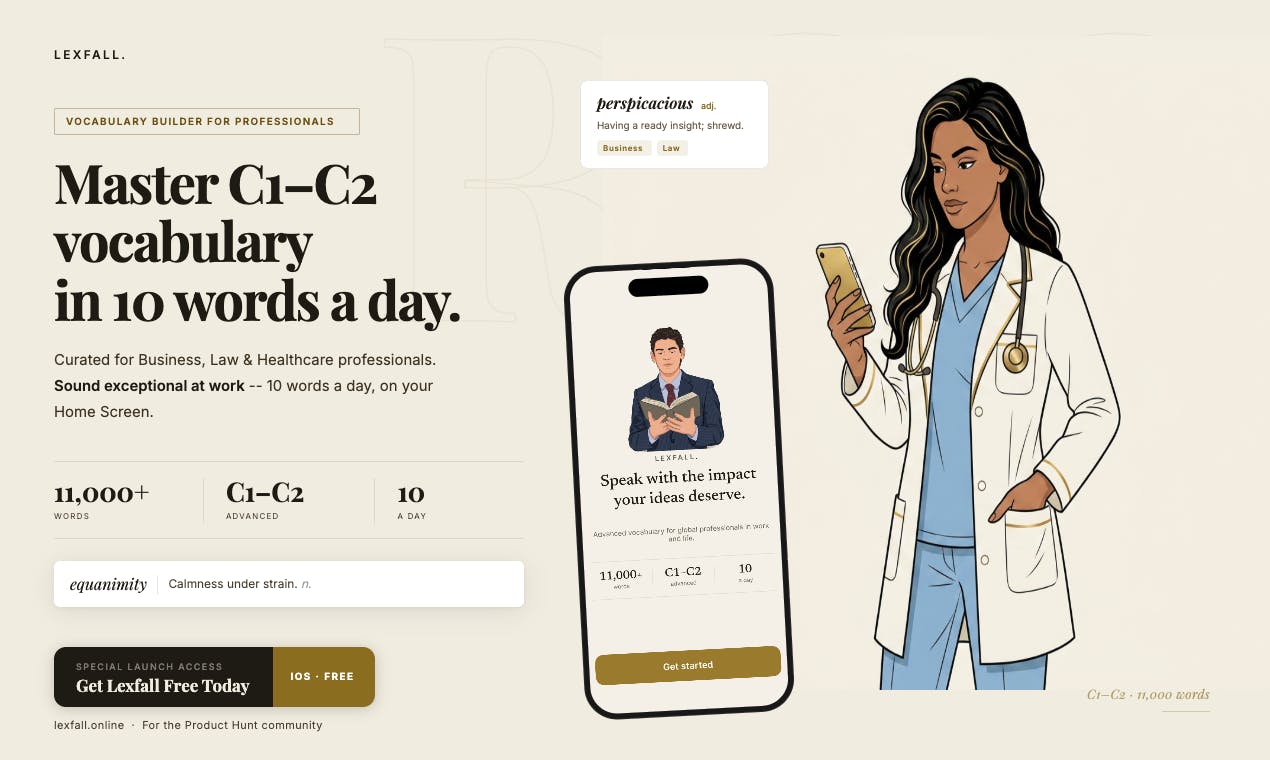
Lexfall helps professionals master advanced industry vocabulary through minimalist home-screen widget delivery.
Lexfall is a vocabulary app targeting professionals with solid English foundations who need to master B2-C2 level industry-specific terminology. Through home-screen widget delivery every few hours, it provides low-friction micro-learning for medical, legal, business, and general advanced vocabulary, helping users enhance professional expression in high-stakes scenarios.
In professional fields, language proficiency often determines your authority. A minimalist vocabulary app called Lexfall is transforming how professionals learn languages, focusing on helping users with solid English foundations master industry-specific advanced vocabulary.
Precise Positioning: An Advanced Vocabulary Tool Designed for Professionals
Lexfall's core philosophy is "Speak like you belong in the room." The app addresses a critical pain point: everyday English communication skills are entirely different from language expression in professional domains. When you're in high-stakes decision-making scenarios, the precision of your word choice often directly impacts outcomes.
This philosophy touches on an important concept in sociolinguistics—linguistic capital. French sociologist Pierre Bourdieu proposed that language is not merely a communication tool but a carrier of social power. In professional fields, mastering industry terminology means being recognized as an "insider" by peers, while inability to use precise terms may mark you as an outsider. Research shows that in high-stakes scenarios like doctor-patient communication, legal debates, and business negotiations, vocabulary choice directly affects power dynamics and trust-building between parties. For non-native English-speaking professionals, the gap between general English proficiency and professional English proficiency essentially constitutes a hidden career ceiling.
The app specifically targets professionals who already have solid English foundations, offering B2 to C2 level advanced vocabulary training. These B2 to C2 levels come from the Common European Framework of Reference for Languages (CEFR), the most widely used language proficiency standard globally. B2 level means users can understand the main content of complex texts and communicate fluently on professional topics; C1 represents the ability to use language flexibly for academic and professional communication and understand implicit meanings; C2 approaches native speaker level, capable of expressing precisely and fluently in any scenario. The leap from B2 to C2 is precisely the bottleneck most non-native professionals find hardest to break through—daily communication is barrier-free, but high-pressure professional scenarios still feel challenging.
Lexfall's positioning is crystal clear—it's not a basic English learning tool for beginners, but an advanced weapon helping professionals break through language barriers. When you can only express complex concepts with basic vocabulary, your professional depth easily gets discounted, and Lexfall aims to solve exactly this problem.
Vertical Vocabulary Database Covering Four Major Professional Fields
Lexfall currently covers professional vocabulary in four core areas:
- Medicine: Precise medical terminology gives doctors greater authority in academic exchanges and clinical communication. Medical professional vocabulary is vast and highly Latinized—the difference between "myocardial infarction" and the everyday "heart attack" isn't just lexical, but represents depth of professional cognition.
- Law: The legal field demands extremely high language precision; a single word difference can change an entire contract's meaning. For example, "shall" versus "may" in legal documents represents entirely different obligation intensities, while "indemnify" and "compensate" have subtle distinctions in liability definition.
- Business: In business negotiations and strategic discussions, appropriate business terminology significantly enhances credibility. Mastering and correctly using terms like "synergy," "due diligence," and "scalability" often linguistically distinguishes core decision-makers from ordinary participants.
- General English: Advanced general vocabulary suitable for speeches, writing, and various formal occasions. This category covers high-level vocabulary like "perspicacious" and "equanimity" that's common in academic writing and formal speeches but rarely used in everyday conversation.
This vertical segmentation strategy makes vocabulary learning more targeted. Unlike traditional vocabulary apps pursuing breadth, Lexfall chooses to focus on professional depth, ensuring every word is highly relevant to users' actual work scenarios. This strategy is known as "Vertical SaaS" in the software industry, contrasting sharply with "Horizontal SaaS" targeting broad markets. The core logic of vertical products lies in establishing competitive barriers and high user stickiness through deep cultivation of specific industries or user groups.
Home-Screen Widget Delivery: Zero-Barrier Micro-Learning
Lexfall employs an extremely simple learning method—pushing a new word every few hours through a home-screen widget. Since their introduction in iOS 14 and early Android versions, home-screen widgets have become important carriers of the "ambient computing" concept. Unlike traditional apps requiring active opening, widgets "push" key information to users' visual focus areas, achieving a fundamental shift from "pull interaction" to "push interaction." Several noteworthy product strategies underlie this design:
Nearly zero learning initiation cost: No need to open an app, log into an account, or select a course—vocabulary automatically appears on your phone's home screen, visible at a glance. In behavioral design theory, this mode corresponds to the "lowering ability threshold" strategy in Stanford University Professor BJ Fogg's behavior model: when the effort required for a behavior approaches zero, action can be triggered even with low motivation. This "environmental immersion" learning method significantly reduces resistance to sustained learning.
Perfectly suited for fragmented time: Professionals have very tight schedules; dedicating large blocks of time daily to English study isn't realistic. Learning one word every few hours fits perfectly into scattered moments like waiting for elevators, coffee breaks, or medical appointments. This microlearning mode has been widely validated in educational technology; research shows that breaking learning content into segments under 5 minutes yields better completion rates and memory retention than traditional long-duration learning.
Avoiding cognitive overload: Learning just one word at a time, with appropriate time intervals, aligns with the memory principle of spaced repetition and works far better than cramming large amounts of vocabulary at once. Spaced repetition is a memory optimization strategy extensively validated in cognitive psychology, with theoretical foundations traceable to German psychologist Hermann Ebbinghaus's 1885 discovery of the forgetting curve—human memory of new information decays exponentially over time, but if reviewed at critical points before forgetting occurs, memory retention significantly extends. Modern spaced repetition systems (like Anki, SuperMemo) systematize this principle through algorithms that dynamically adjust review intervals. Lexfall's design of pushing a new word every few hours is essentially a simplified spaced exposure mechanism that, while not implementing a complete algorithm-driven review cycle, has rhythm design aligned with basic cognitive science principles.
Product Positioning and Business Logic Analysis
Judging from its Product Hunt performance, Lexfall received 8 upvotes, ranking 15th. This data reflects typical characteristics of vertical domain tools—precise audience but limited scale. Its target users aren't the broad English learner population, but those who have already established themselves professionally and hope to further refine language precision.
This niche positioning has inherent business logic: high-end professionals have stronger willingness and ability to pay, and better identify with the value proposition that "language details determine professional image." In SaaS, vertically segmented products typically have higher customer lifetime value (LTV) and lower customer acquisition cost (CAC) because target user groups are concentrated and word-of-mouth spreads efficiently. Typical success cases include lawyer-focused Clio (reaching multibillion-dollar valuation) and physician-focused Doximity (NASDAQ-listed). Compared to freemium models for mass markets, focusing on high-value segmented user groups may be a more sustainable commercialization path. For Lexfall, professionals in medicine, law, and business not only have strong payment capacity but also naturally high requirements for tool professionalism, providing solid foundation for differentiated pricing and sustained subscriptions.
Areas Worth Exploring for Improvement
While Lexfall's design philosophy deserves recognition, from a user learning effectiveness perspective, several directions merit deeper exploration:
Adding contextual learning in real situations: Simply displaying words and definitions may not be robust enough. Providing use cases of words in actual professional scenarios—such as real sentences from medical papers, legal documents, or business reports—would qualitatively improve learning outcomes. Cognitive linguistics research shows that vocabulary memory and comprehension depth correlates with contextual richness; isolated memorization is far less effective than learning in meaningful contexts.
Introducing personalized vocabulary recommendations: Intelligently recommend vocabulary that users need to prioritize learning based on their mastered vocabulary level and specific professional background, rather than simple fixed-order delivery. Using natural language processing (NLP) technology and adaptive learning algorithms, the app could construct users' vocabulary knowledge graphs, identify knowledge gaps, and deliver precisely targeted content.
Adding review and testing mechanisms: Regular spaced reviews and quizzes help users truly internalize vocabulary into active vocabulary, avoiding the "forget after seeing" problem. Here we need to distinguish two key concepts: passive vocabulary refers to words understood when reading or hearing, while active vocabulary refers to words that can be freely used in writing and speaking. Research shows adult native speakers' passive vocabulary is typically 3-5 times their active vocabulary, and this gap is even more significant for non-native speakers. Many professionals can understand terminology in English papers but cannot naturally use it in meeting discussions. The transition from passive recognition to active use requires repeated practice and output in real contexts, which is why simple vocabulary display needs to be paired with active recall testing to achieve deep learning.
Conclusion: A Minimalist Learning Tool for Professional Vertical Segments
Lexfall represents a noteworthy direction for professional education tools: not pursuing broad coverage but deeply cultivating vertical segments; not piling on complex features but insisting on minimal usability. For users with solid English foundations hoping to gain more authority in professional settings, this app provides a low-friction, highly targeted vocabulary improvement solution.
In today's era of increasingly prevalent AI tools, the value of professional language expression has not weakened but become more important—because true professional expression doesn't just convey information, it builds trust and demonstrates professional depth. When AI can help everyone generate fluent English text, true differentiated competitiveness manifests in real-time language expression during face-to-face communication: whether you can spontaneously use appropriate terminology in board meetings, precisely respond to challenges in academic defenses, or win respect with authentic industry language in international negotiations. Language ability in these scenarios cannot rely on real-time AI assistance—only internalized vocabulary reserves. Lexfall captures this core need, using the simplest product form to help professionals enhance their most critical competitive advantage.
Related articles
TiVo Charging for Ad-Skipping? DVR User Rights and the Digital Ownership Debate Explained
TiVo plans to charge DVR users for ad-skipping, sparking debate over digital ownership and consumer rights. A deep dive into subscription trends and their implications.
Batch Generating Ad Creatives from a Single Product Image: Real Bottlenecks and Solutions for Scaled Workflows
From one product photo to multi-platform ad assets—brand consistency, text rendering, and cross-platform adaptation collapse first. Deep dive into AIGC marketing workflow bottlenecks with template-driven and layered composition solutions.
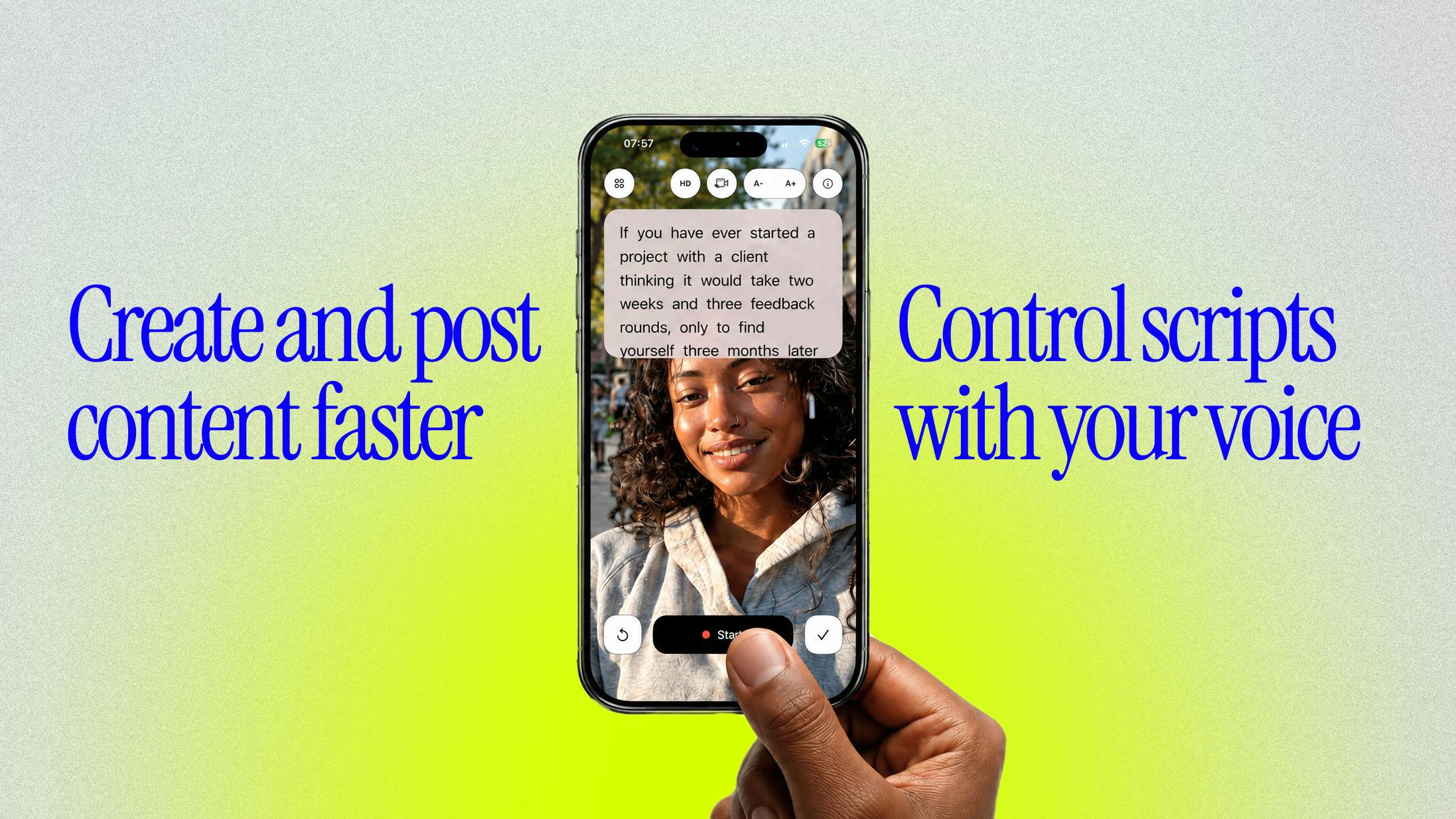
Scriptly: AI Voice-Following iOS Teleprompter That Eliminates Pace-Chasing
Scriptly is an iOS voice teleprompter using AI real-time voice-following technology to auto-match speaking pace. Supports local storage for privacy, integrates writing, script management & video recording workflow for content creators.