Liam Fedus Congratulates Periodic Labs, Sparking Interest

A brief tweet hints at results from OpenAI researcher Liam Fedus and low-profile Periodic Labs, reflecting the AI for Science trend.
Starting from a short tweet on X congratulating Liam Fedus and Periodic Labs on "exciting results," the article analyzes why it matters. Fedus is an OpenAI core researcher involved in RLHF, LLM training, and MoE work, and his moves are often viewed as an AI frontier bellwether. Periodic Labs has limited public information; "Periodic" may suggest links to the Periodic Table, materials science, or chemistry, or a focus on AI in scientific discovery. The tweet, though lacking technical details, signals that Fedus's direction is worth tracking and that AI-basic science intersections are accelerating. It also lists open questions and suggests watching for future papers or official announcements.
A Tweet That Drew Attention
Recently, a brief congratulatory tweet appeared on X (formerly Twitter), yet it drew notice because of the people and organization it pointed to. The tweet read: "Exciting results, @LiamFedus! Congrats to the whole team at Periodic Labs!"
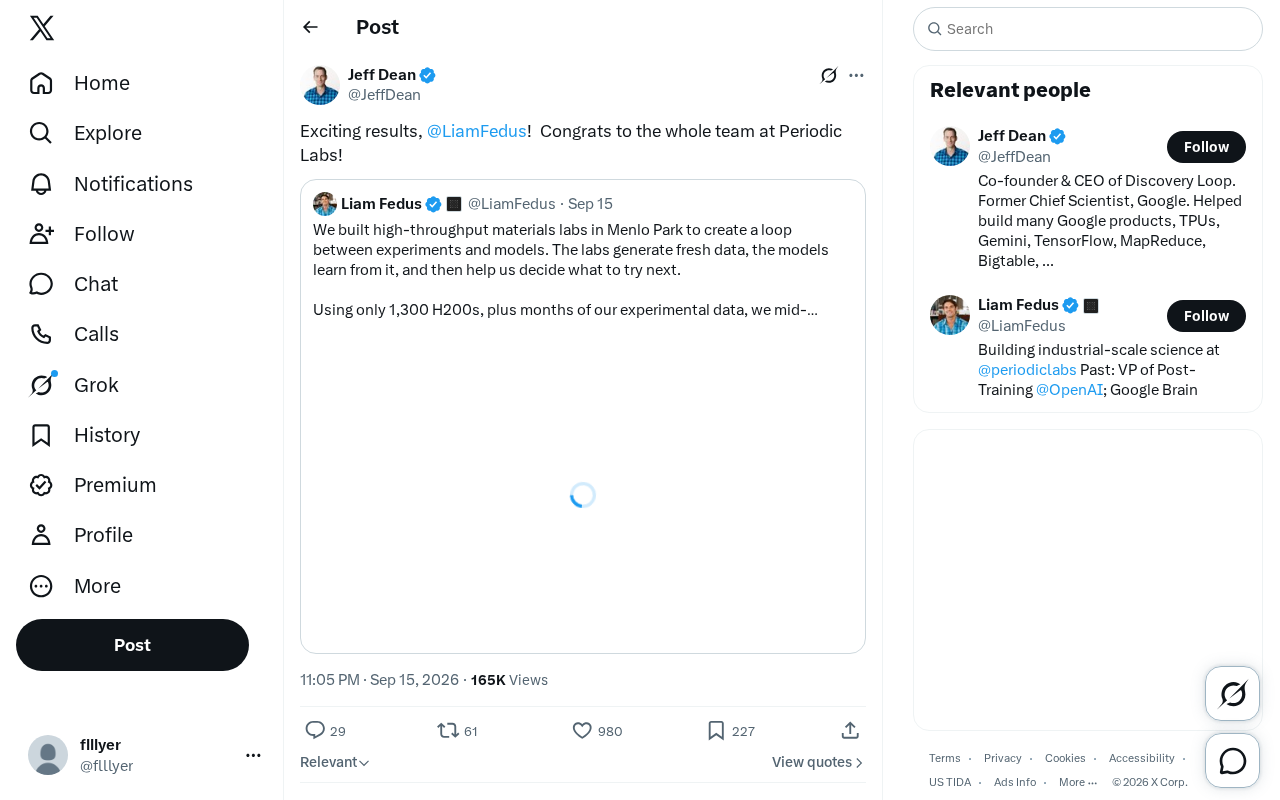
The message itself is extremely short, disclosing no specific technical details, paper links, or product information. But the combination of the two keywords "Liam Fedus" and "Periodic Labs" is enough to spark curiosity among those following the AI space: Liam Fedus is one of OpenAI's core researchers, having worked on ChatGPT post-training, reinforcement learning, and other key efforts; Periodic Labs, meanwhile, is a relatively low-profile organization.
Who Is Liam Fedus
Liam Fedus has a certain level of recognition within the AI research community. During his time at OpenAI, he was involved in multiple important projects, including work related to reinforcement learning from human feedback (RLHF), as well as research on training and alignment of large language models. His research interests cover reinforcement learning, sparse models (such as Mixture of Experts, MoE), and training efficiency for large-scale language models.
Because of this, when he becomes associated with a new institution or project, external attention naturally rises. The phrase "exciting results" in the tweet suggests that Periodic Labs may recently have achieved a noteworthy research or product advance.
RLHF (Reinforcement Learning from Human Feedback) is one of the core techniques for aligning large language models with human intent. Its basic process has three steps: first, supervised fine-tuning teaches the model basic instruction following; then human annotators rank multiple model outputs by preference, and a reward model is trained to simulate human preferences; finally, a reinforcement learning algorithm (usually PPO) optimizes the language model so that its outputs receive higher reward scores. The reason ChatGPT could leap from GPT-3's "can continue text" to "can converse and understand instructions" is that RLHF was a key ingredient. Liam Fedus participated precisely in this post-training stage. RLHF's limitations are also obvious: the reward model is prone to being "gamed," and human annotation is costly, which drove the rise of later alternatives such as DPO and RLAIF.
Mixture of Experts (MoE) is another efficient architecture closely tied to Fedus's research. Its core idea is to split a large model into multiple "expert" subnetworks, activating only a few of them in each forward computation (for example, choosing 2 out of 8), thereby keeping computational overhead relatively low while maintaining a huge total parameter count. MoE's advantage is that it can achieve stronger capabilities with less compute, but its challenges lie in load balancing, training stability, and communication overhead. Fedus is one of the important researchers in sparsification and MoE, and this technical route was later widely adopted by models such as DeepSeekAd and Mixtral, becoming a mainstream approach for reducing costs and improving efficiency in large models.
Possible Positioning of Periodic Labs
Public information about Periodic Labs is limited. Judging by the name, the word "Periodic" in a scientific context is often associated with the Periodic Table, which may suggest that the organization has some connection to basic scientific fields such as materials science, chemistry, or physics.
Another possibility is that Periodic Labs focuses on applications of AI in scientific research, such as using machine learning to accelerate new materials discovery, molecular design, or experiment automation. This aligns with the recent surge of AI for Science—projects such as DeepMind's AlphaFold and GNoME have already demonstrated AI's potential in basic science.
It should be noted that the positioning above is speculation based on limited information and has not yet been confirmed by official information or detailed reporting.
AI for Science refers to applying machine learning methods to natural science discovery, rather than only to language or image tasks. Landmark achievements in this direction in recent years include: DeepMind's AlphaFold predicting the three-dimensional structures of proteins, solving a 50-year-old biology problem; GNoME discovering hundreds of thousands of potentially stable crystal materials through graph neural networks; and cases such as using AI to control fusion plasma and accelerate drug molecule screening. Their common logic is that scientific problems often correspond to search spaces with high dimensionality and scarce labeled data, while AI excels at learning patterns from limited data and screening candidates at scale. This approach is attracting large amounts of capital and top researchers, which also explains why a low-profile institution could be seen as a noteworthy signal if it can combine AI with basic science.
Why This Tweet Is Worth Noting
In terms of information content alone, this tweet hardly constitutes a complete piece of "news." It provides no paper, code, or product link, nor does it disclose any technical details. But it conveys two signals worth noting:
First, Liam Fedus's movements are worth tracking. As an important OpenAI researcher, his research direction and collaborators often reflect frontier trends in AI. If he is deeply involved in Periodic Labs' work, the organization's research direction may be closely related to the experience he accumulated during his time at OpenAI.
Second, the intersection of AI and basic science is accelerating. Regardless of what exactly Periodic Labs does, the phrase "exciting results" means the team may already have achieved a stage-by-stage breakthrough on some specific problem. AI-driven scientific discovery is becoming another rapidly warming direction after large language models.
Questions Still to Be Confirmed
At present, information about Periodic Labs remains fragmented. The following questions await follow-up information:
- Periodic Labs' specific research direction and team composition
- Liam Fedus's relationship to the organization (advisor, founder, collaborator?)
- The specific results referred to by "exciting results" in the tweet
- Whether the results have already been published or open-sourced
Summary
The tweet itself carries limited information, but it reflects a broader trend: researchers in AI are shifting their gaze from a pure race on model scale toward using AI to solve specific scientific problems. Whether Periodic Labs will deliver substantive breakthroughs in this direction is worth continued attention.
For readers following AI for Science, reinforcement learning, and Liam Fedus's individual research updates, it is advisable to watch for subsequent paper releases or official announcements.
One-line Summary
A brief tweet hints that OpenAI core researcher Liam Fedus and low-profile organization Periodic Labs have achieved results, reflecting the AI for Science trend.
Paragraph Summary
Starting from a brief tweet on X congratulating Liam Fedus and Periodic Labs on "exciting results," the article analyzes why it is worth noting. Liam Fedus is an OpenAI core researcher who has worked on RLHF, large language model training, and Mixture of Experts models, and his movements are often seen as a bellwether for the AI frontier. Public information on Periodic Labs is limited; "Periodic" in the name may suggest a connection to the Periodic Table, materials science, or chemistry, or it may focus on AI applications in scientific discovery. The article notes that although the tweet contains no technical details, it conveys two signals: Fedus's movements are worth tracking, and the intersection of AI and basic science is accelerating. Finally, it lists questions still to be confirmed, including research direction, team composition, and the form of the results, and recommends watching for subsequent papers or official announcements.
Related articles

AI New Grad Resume Diagnosis: How to Stand Out for ML/CV Roles?
How can AI/ML new grads optimize their resumes to get interviews? Based on a real Reddit case, this article analyzes project selection, depth display, and structure for ML/CV roles, with actionable revision advice.

OpenAI Opens Up Decision Models as Competition with Jev Heats Up
OpenAI makes its decision model widely available, directly challenging first mover Jev. We analyze the impact on the decision model competitive landscape and key considerations for developers and enterprises.

Startup Growth Secrets: Early Sales Are Not the Key
At Disrupt, experts from Lovable, Polska, and Theory Ventures said early startup growth depends not on early sales but on a repeatable sales process, a clear ICP, team development, and data-driven iteration.