Liang Wenfeng's 4-Hour Internal Talk: DeepSeek's Philosophy of Restraint and Its Path to AGI

DeepSeek's Liang Wenfeng reveals a philosophy of restraint, open source, and long-termism on the path to AGI.
In a candid 4-hour internal investor talk, DeepSeek founder Liang Wenfeng explains the company's philosophy of restraint: pricing APIs to only recoup costs in 10 months, embracing open source as its core intent, navigating the computing power gap, and outlining a five-stage roadmap to AGI—all driven by vision rather than profit maximization.
Article
Recently, an audio recording of a conversation between DeepSeek founder Liang Wenfeng and internal investors has been widely circulated online. Although this four-hour dialogue was an internal communication aimed at investors, its content was candid and logically rigorous, offering an extremely valuable perspective for understanding the underlying logic of this wave of AI. Based on the key points compiled by a Bilibili content creator, this article summarizes Liang Wenfeng's core thoughts on open source, pricing, computing power, organization, and the path to AGI.
Founding Intent: Driven by Goodwill, Not Profit Maximization
The strongest impression from the entire conversation can be summed up in one word—restraint. And this restraint is not deliberately packaged, but something embedded in the very DNA of the company.
Liang Wenfeng put it bluntly: the few dozen people who started the company at the very beginning never thought about how much money they would make or when they would go public. In his view, the logic of truly building a business is to first become sufficiently professional, and making money is merely a byproduct. "As long as you become sufficiently professional, making money becomes a matter of course."
He admitted that the starting point for the venture was "goodwill toward the world"—the belief that this endeavor would be useful to humanity, something beyond money. Although he later discovered that the AI market held enormous financial interests, with temptations following, the starting point was never about maximizing commercial gain. It was precisely this original intent that ultimately led to the choice of open source.
A Vision-Driven Organizational Culture
Liang Wenfeng repeatedly spoke of "vision." He mentioned that 20 years ago, the manager he admired most was former GE CEO Jack Welch, who had a famous saying: managing a large company relies not on charters and systems, but on vision.
"We don't really have an organization; we're just driven by vision," Liang said. This vision isn't even written down—there's no black-and-white document—but is embodied in how things are done and in the attitude toward the world. Everyone's understanding of the vision may not be exactly the same, but the general direction is consistent.
This management philosophy is not unique among tech companies, but it is extremely rare to see it implemented so thoroughly. Perhaps the closest historical case is Bell Labs—where researchers freely explored directions, unbound by short-term product goals, ultimately giving birth to world-changing inventions such as the transistor, information theory, and the Unix operating system. Cognitive science also supports this model: psychologist Edward Deci's "Self-Determination Theory" demonstrates that external reward-and-punishment mechanisms undermine intrinsic motivation (the "overjustification effect"), while creative thinking requires a state of "cognitive relaxation," and excessive performance pressure narrows the breadth of thought. For an AI company whose core competitiveness lies in algorithm research, protecting researchers' intrinsic drive may be more valuable than any incentive system.
Open Source Is the Original Intent: Not Forced, but an Inevitable Choice
Liang Wenfeng's answer to "why insist on open source" is quite interesting. He believes that the vision itself demands open source.
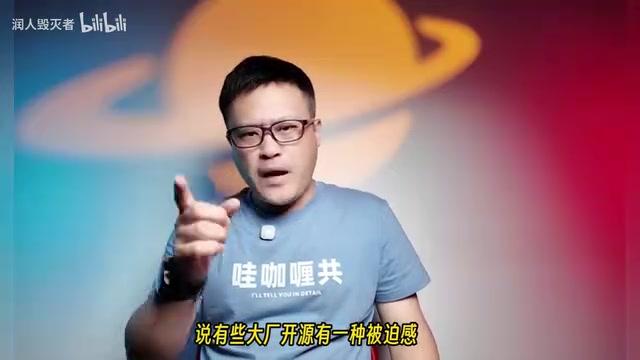
He specifically contrasted this with the practices of other companies: "For some big companies, open sourcing is something they're forced into—it feels like it's not their true intent. But for us, open source is the original intent."
More importantly, he believes that making AI open source commercially is actually beneficial. This sounds counterintuitive—historically, open source and commercialization have often been in conflict. But the history of open-source software commercialization provides an important reference for understanding DeepSeek's strategy: cases like the Linux Foundation, Red Hat (acquired by IBM for $34 billion after surpassing $3 billion in annual revenue), and MongoDB prove that open source does not necessarily mean giving up commercial value. Its core logic lies in—lowering user migration costs through open code, rapidly expanding the ecosystem's scale, and then monetizing through enterprise services, API calls, or cloud deployment. In the AI field, Meta's LLaMA series of models quickly became an industry infrastructure standard after being open sourced, which in turn strengthened Meta's voice within the AI ecosystem.
Liang Wenfeng believes AI is different because the AI market is large enough that it may ultimately account for 10% or even more of human society's GDP. "With a market this big, you can't possibly monopolize it. If you try to swallow everything yourself, you'll surely be abandoned by history."
This is not just sentiment, but also an objective law in his eyes: the more you try to monopolize, the less you'll succeed.
Pricing Logic: Only Earning Enough Profit to Recoup Costs in 10 Months
DeepSeek's restraint is most directly reflected in its API pricing. Large-model APIs are typically priced by "Token"—a Token is the basic unit through which a model processes text, roughly corresponding to 0.75 English words or about 1.5 Chinese characters. Pricing is divided into input Tokens and output Tokens, with output usually being more expensive because generation requires far more computation than reading. When OpenAI's GPT-4 was released, its pricing was about $30 per million Tokens, while DeepSeek's API pricing was only one-tenth of that or even lower.
Liang Wenfeng stated that the company had never considered profit maximization, but merely set its profit to the standard of "recouping equipment costs in 10 months." He revealed a detail: in this price range, user demand is inelastic—in economic terms, the "price elasticity of demand" approaches zero, meaning that raising prices would not reduce usage, and in theory prices could be raised indefinitely. Even if the price doubled, Token consumption would remain roughly the same, and revenue could nearly double. But they didn't do this.
He also told a story: at first, worried about having too many users, they set the price relatively high, and the team was not too happy about it; later, when he directly lowered the price to a quarter, the company group chat erupted in cheers. "This is our true intention—to make this thing useful to people, not to make the most money. At a reasonable profit, everyone can afford it, and that is the motivation, the cohesion."
Regarding the question of whether "restraint is strategy or sentiment," Liang Wenfeng believes that restraint itself is a strategy: in the short term, high prices mean more revenue, but in the long term, giving up some interests can bring back much more. Open source concessions, a happy team, and a happy society—this cohesion in turn increases the probability of achieving AGI.
The Five-Stage Roadmap to AGI: From Chain-of-Thought to Embodied Intelligence
In the conversation, Liang Wenfeng clearly outlined five stages of AI development, and this roadmap aligns closely with mainstream academic frameworks:
- Stage One: Chain-of-Thought—teaching AI to think like humans; it has already surpassed humans in coding and mathematics. Chain-of-Thought (CoT) was systematically introduced by Google researchers in a 2022 paper, referring to guiding models to reason step by step rather than directly output answers to improve performance on complex tasks. DeepSeek-R1 is a representative work in this direction.
- Stage Two: Agents—the current stage of AI, enabling AI to call external tools, browse the web, and execute code to autonomously complete multi-step tasks. Currently, both OpenAI's Operator and Anthropic's Claude are actively working in this direction.
- Stage Three: Continuous Learning—today's AI has no memory and doesn't understand background knowledge, like a new employee; future AI must be like a veteran employee, continuously learning on the job and possessing long-term memory. This corresponds to the challenge of "Continual Learning" in machine learning—how to update knowledge in real time during inference and avoid "catastrophic forgetting"—which remains an unsolved problem.
- Stage Four: Self-Evolution—AI can write its own code and update itself, i.e., AI for AI Research, with early practices such as AlphaCode already emerging.
- Stage Five: Embodied Intelligence—AI possessing a body, entering the physical world, and helping humans do things in physical form. Combining language models with robotic physical control, companies such as Figure AI and Boston Dynamics are actively exploring this direction.

The Computing Power Gap and Opportunities for Domestic Chips
When it comes to the unavoidable topic of computing power, one must first understand its policy background: in October 2022, the U.S. Department of Commerce added NVIDIA's A100 and H100 to the export control list; in October 2023, controls were further tightened to include "downgraded" versions such as the H800 and A800; and in 2024, the scope of controls expanded again to cover nearly all high-performance AI chips. Liang Wenfeng's assessment is quite pragmatic. He believes the gap between China and the U.S. actually comes down to just one thing—resources. There is almost no gap in human resources, because China's talent pool is quite abundant.
He revealed that DeepSeek currently has roughly 20,000 H-series equivalent units of computing power (i.e., the previously procured H800s or equivalent computing capacity), most of which only arrived in the past month or two. The strategy is to "buy as many cards as possible at a reasonable price," and they are even willing to pay a certain premium, because the cost-performance ratio still makes sense. But the problem is, even with money, you can't buy that many cards. By comparison, Microsoft committed to deploying over 100,000 H100s for OpenAI—the disparity in computing power is clear.
He did the math: the largest U.S. model has roughly 80 billion activated parameters, while domestic models are still in the billions range—an order of magnitude behind. To train an 80-billion model, you'd need 50,000 GB300s or 200,000 of Huawei's latest cards, and that's just for training, not research. It is precisely this resource constraint that has forced DeepSeek to optimize algorithm efficiency to the extreme, developing innovative memory-saving techniques such as MLA (Multi-head Latent Attention), which have attracted widespread attention in the international academic community. Their strategy is to first thoroughly conduct experiments at the billions scale, and then scale up once they have more resources.
Three Key Factors in the Endgame of Large-Model Competition
Regarding the competitive endgame, Liang Wenfeng believes the gap is reflected across three dimensions:
- Cost—ranked first: can you deliver the same quality of service more cheaply than others.
- Time—being a few months earlier or later makes all the difference.
- User Experience—ranked third.

For domestic chips, Liang Wenfeng believes now is a "historic opportunity." In the past, the moat of NVIDIA and CUDA was very strong—CUDA (Compute Unified Device Architecture) is not merely a driver, but a complete technology stack spanning from hardware instruction sets, compilers, and math libraries (cuBLAS, cuDNN) to the developer ecosystem. Over 4 million developers have written vast amounts of low-level deep learning framework code based on CUDA, and the core operators of PyTorch and TensorFlow deeply depend on CUDA. This "ecosystem lock-in" effect means that even if a competitor's chip hardware performance comes close, the lack of software compatibility would greatly reduce its actual usability.
But Liang Wenfeng believes this moat is now rapidly crumbling, for three reasons: First, AI code assistants have significantly reduced the human cost of rewriting low-level operators. Second, high-level languages such as Triton allow developers to bypass CUDA and directly write hardware-agnostic GPU kernels, so new technologies can quickly rewrite the entire CUDA ecosystem in high-level languages. Third, the AI computing market is now larger than the gaming card market, and dedicated chips are no longer bound to CUDA, so manufacturers such as Huawei Ascend, Cambricon, and Enflame have ample motivation to invest in building software ecosystems, forming a positive flywheel.
He estimates there's no problem seeing a domestic chip ecosystem within a year; the only bottleneck is production capacity. Currently they mainly collaborate with Huawei, whose CloudMatrix 950 super-node can substitute for NVIDIA's GB200/GB300 in terms of performance and price, at the cost of four Huawei cards to match one NVIDIA card, and lagging two years behind in time. But he believes that once the ecosystem problem is solved, only production capacity remains, and in five years it should no longer be constrained by capacity.
Organizational Management: No KPIs, No Encouraging Overtime
DeepSeek's organizational approach is also quite unique. Liang Wenfeng described it as "two lines": one runs top-down, called "doing the real work," where everyone divides tasks and collaborates; the other runs bottom-up, where everyone works on whatever they want, with no KPIs.
He has a clear standard: the real work should not occupy more than half of an employee's time, leaving the other half for free exploration. This is also why they don't do much overtime—first, research requires a relaxed environment, and second, the work they do is focused enough that each person's workload is naturally smaller.
This KPI-free management approach has a deep theoretical foundation. Google was famous in its early days for OKR (Objectives and Key Results), but in essence it's still a quantitative assessment system; whereas Bell Labs is the historical case closest to DeepSeek's model—it was precisely this culture of free exploration that gave birth to epoch-making inventions such as the transistor and information theory. Psychological research also provides corroboration: external reward-and-punishment mechanisms produce an "overjustification effect," undermining researchers' originally strong intrinsic curiosity—which is exactly what fundamental AI research most needs to protect.
The Philosophy of Profit Distribution: Take More and You'll Lose
When asked about the eventual profit distribution landscape of AI, Liang Wenfeng gave a rather philosophical answer:
"If OpenAI wants to take 5% of global GDP, it will surely be defeated by a company that only wants to take 1%; and the one taking 1% will be defeated by one that only wants to take 0.1%. Those who take more will be defeated by those who take less. Even if your vision is to take more, you've already lost from the start."
He believes there will ultimately be a balance point: those who take too little can't survive, and those who take too much will be challenged, so they only earn a reasonable profit. This is consistent with the "10-month payback" pricing logic—"it's not calculated, it's determined by vision."

The Core Interest Is Only One: Keeping the Team Stable
At the end of the conversation, Liang Wenfeng mentioned a very sincere point: the company's core interest is only one—keeping the team stable. "As long as the core team doesn't leave, we can definitely achieve AGI; money and resources are not the problem."
He admitted that the biggest risk is staff turnover. Although talent turnover has always been lower than that of peers, it remains the biggest challenge. The most recent round of financing gave the team fairly substantial equity options, greatly easing stability concerns.
Regarding long-termism, he repeatedly emphasized that DeepSeek does the opposite: many companies are scrambling for consumer (C-end) users, hoping to build the next WeChat or Douyin, while DeepSeek believes that C-end and B-end revenue are merely byproducts on the path to pursuing AGI. "If technology is pushed to the extreme, users naturally come, and revenue naturally follows." They don't want to compete with internet giants for traffic; instead, they hope to build a solid foundation and let partners make money.
"AI is such a big thing that even a small slice is more than enough, so there's no need to rush, no need to want everything." Liang Wenfeng concluded with a smile: "We're really just a group of ordinary people who happened to do something extraordinary."
Conclusion: A Path to AGI with Chinese Characteristics
Taken together, Liang Wenfeng's remarks convey a clear signal: DeepSeek is in no rush to monetize, but is playing a very big game of chess. Through extreme cost control, an open-source ecosystem strategy, and a focus on core AGI technologies, they are attempting to forge a path to AGI with Chinese characteristics under resource constraints.
Interestingly, this open-source strategy has also stirred controversy in the West. Recently, some U.S. politicians and Silicon Valley figures have called China's open-source AI "AI communism," which indirectly reflects that Chinese open-source models are having a substantial impact on the existing landscape. Regardless of how it is judged, the business philosophy of "restraint, vision, and long-termism" demonstrated by Liang Wenfeng indeed provides a unique sample for observing this round of AI competition—one distinct from the Silicon Valley narrative.
Key Takeaways
Related articles

Go Microservices in Practice: Detailed Architecture for E-Commerce, AI Agent, and IM System Integration
Deep dive into integrating e-commerce, AI Agent, and IM systems under Go microservices architecture, covering unified auth, gRPC, componentized Agent engines, and group chat bots.

X Platform's Recommendation Algorithm Caught Filtering Brazilian Election Content, Reigniting Algorithm Transparency Debate
X (formerly Twitter) was found filtering Brazilian election content in its For You feed, sparking debate over algorithm transparency and free speech.

Poison-Resistant Concept Anchoring: A New Approach to Defending Against AI Data Poisoning
Deep dive into Poison-Resistant Concept Anchoring, defending against data poisoning via signed anchors and bounded updates. Experiments show 62% poison isolation with 0% false rejection rate.