Lightmeter: A Real Film Camera App That Doesn't Rely on AI Filters
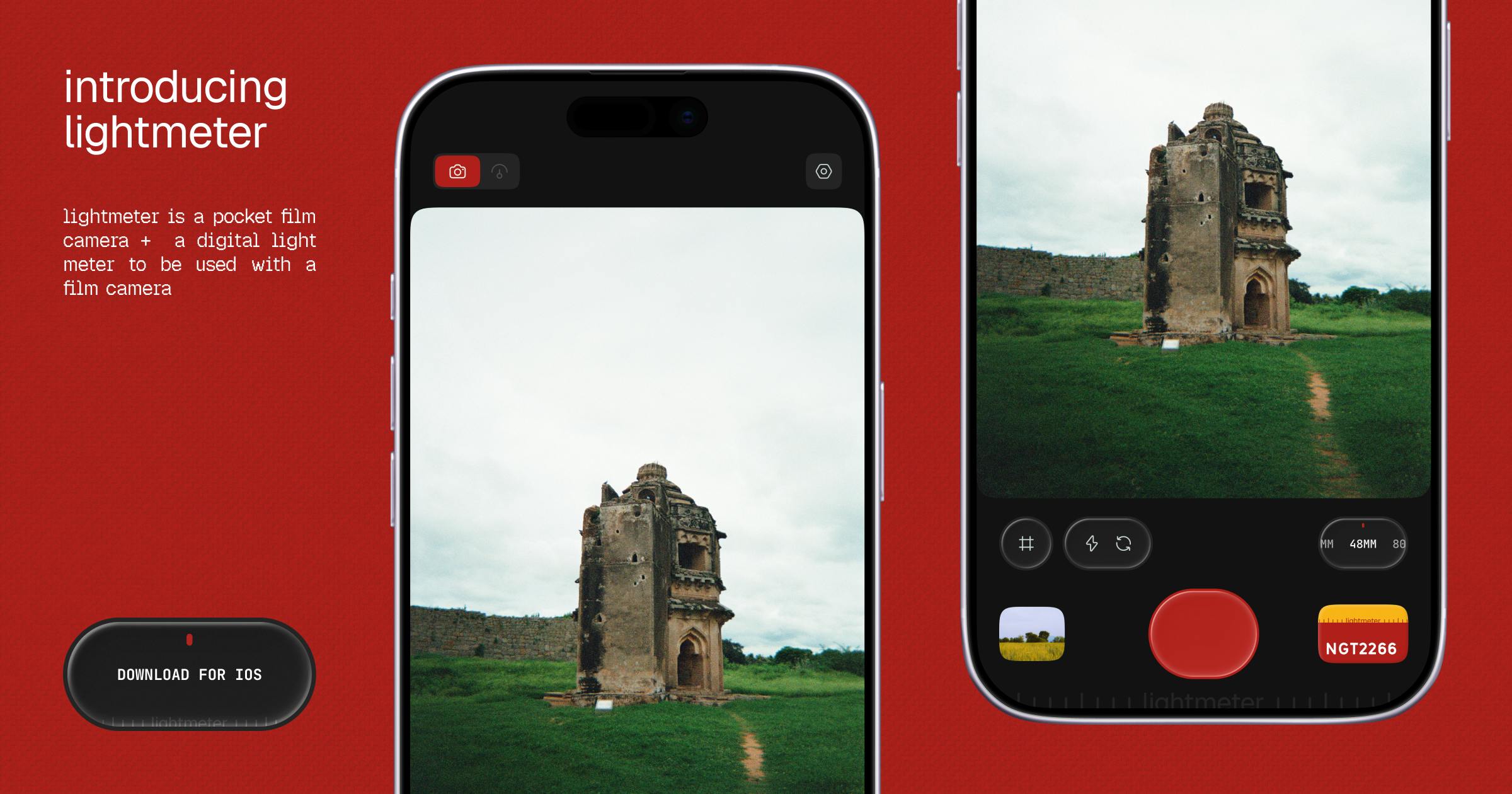
Lightmeter is an iOS film camera app built on RAW capture with no AI, no account, and a real light meter.
Lightmeter is an iOS app positioned at the intersection of film-aesthetic photography and practical light metering. Its core technical claim: film simulation is built on real RAW data, not filters over processed images, enabling authentic grain, halation, and color response. On privacy, it commits to no AI, no account, and fully local data. The built-in light meter makes it useful for traditional film shooters with unmetered bodies. It earned 97 upvotes on Product Hunt, though real-world image quality remains to be verified.
A Film Camera App That Says No to AI
In a mobile photography landscape saturated with filters and AI post-processing, an iOS app called Lightmeter has taken the opposite path. It earned 97 upvotes on Product Hunt and ranked 6th for the day — with a clear, restrained positioning: a film camera built for everyday moments, with a genuine light meter built in.
Developer Aakash Goel sums it up plainly: "When you have film loaded, it's a real light meter. When you don't, it's a film camera." This dual-identity design merges utility and creativity in one package, targeting users who shoot on traditional film cameras and also want their phone photography to carry that same analog feel.

Core Selling Point: Film Aesthetics Built on Real RAW Capture
Lightmeter's biggest technical claim is that its film look is "built on top of real RAW capture" — not a filter layered over an already-processed image.
This distinction is worth unpacking. The majority of "film-style" apps on the market are essentially applying color curves and noise overlays to a finished photo, by which point much of the underlying image data has already been discarded. Lightmeter starts from raw sensor data, letting grain, halation, and color response "work naturally like film" rather than being pasted on as an afterthought.
For quality-conscious photographers, starting from RAW means greater latitude, more authentic highlight rolloff, and more realistic shadow transitions — all prerequisites for truly simulating the physical behavior of film. Halation (the reddish glow that bleeds around bright edges, caused by light reflecting back through the film emulsion) is one of film's most distinctive signatures. Whether a digital tool can faithfully reproduce this detail is often what separates genuine film simulation from just another filter.
RAW format is the uncompressed, unprocessed output directly from a camera sensor, preserving the full dynamic range and color information. In contrast, formats like JPEG or HEIF are "finished" files — the camera or phone system has already applied noise reduction, sharpening, and tone mapping, often clipping highlight and shadow detail in the process. Since iOS 14, Apple has opened ProRAW and native Bayer RAW capture APIs to third-party apps, allowing developers to bypass the system's computational photography pipeline and work directly with sensor data. This is the technical foundation that enables apps like Lightmeter to simulate film's physical response curves in the digital domain — including gradual highlight rolloff, grain buildup in shadows, and the photochemical glow of halation — rather than dressing up an already algorithm-optimized image.
Privacy First: No AI, No Account, Nothing Leaves Your Phone
Beyond its features, Lightmeter puts privacy front and center: "No AI, no account, nothing leaves your phone."
This statement carries three commitments: no AI processing, no account registration required, and all data stays on-device. Against a backdrop of imaging apps that routinely require cloud uploads, account sign-ins, and sometimes use your photos to train models, this "fully local" stance is itself a product philosophy. It reduces user concerns about privacy exposure and sidesteps the subscription dependencies and network reliance that come with cloud services.
Interestingly, "No AI" has become a genuine differentiator in an era where AI is everywhere. While competitors race to pile on AI enhancement and AI retouching features, Lightmeter uses algorithms — not machine learning — to reconstruct film's physical characteristics. The pitch is "authenticity" rather than "smart beautification," which is a precise fit for users who want a purer photographic experience.
Light Meter Functionality: Bridging Digital and Traditional Film
The app's name, Lightmeter, signals its second practical identity. For users shooting on traditional film cameras, many classic bodies have no built-in metering, or their meters have degraded over time, requiring a separate handheld light meter to determine exposure settings.
Lightmeter brings that capability to your phone, letting users read light and determine shutter/aperture combinations when shooting actual film. This moves it beyond a "photo toy" into something that can genuinely slot into a film photography workflow. Bring film, and it's your light meter. Leave the film at home, and it's the camera. This scene-switching elegance is what sets it apart from ordinary filter camera apps.
A light meter converts scene brightness into usable exposure parameters (shutter speed, aperture, ISO). Handheld meters come in two modes: reflective metering, which measures light bouncing off the subject, and incident metering, which measures ambient light falling onto the subject. Incident metering is generally more accurate for film photography because it's unaffected by the subject's own tone or color. Using a smartphone camera as a light meter falls under the reflective principle, which has accuracy limitations — but for non-professional use or as a reference tool, it's more than adequate. Many classic film bodies — the Nikon FM2, early Leica M series, fully manual rangefinders — rely entirely on external metering or the photographer's judgment. The "Sunny 16 rule" is a useful heuristic, but complex lighting still calls for precise measurement. Integrating a light meter into a phone app means carrying one device instead of dedicated hardware.
Quick Take: A Small but Well-Defined Niche Product
Based on what's publicly available, Lightmeter is a focused, restrained product with a clear positioning. It makes no attempt to be an all-encompassing imaging platform. Instead, it anchors itself on three pillars — film aesthetics, light meter utility, and local privacy — serving a well-defined niche.
Its opportunity: the cultural revival of film photography is growing a segment of users willing to pay for "authentic quality" and privacy. Its challenge: how closely Lightmeter's "true RAW film simulation" actually resembles real film can only be judged by looking at actual results, not product copy. With just one review and 97 votes, it's clearly still in early days.
For users who love film photography and are put off by heavy-handed AI intervention, Lightmeter offers a genuinely interesting option worth trying.
Related articles

OpenAI Partners with Shield: How the Astra Agent Revolutionizes IT Troubleshooting
OpenAI and Shield launch the Astra agent, which autonomously logs into computers and legacy systems to fix IT issues in real time, 35-40% faster than traditional models, with humans involved only when judgment is needed.

iPhone Duo Battery Life Tested: One Charge a Day Is Unavoidable, and the Large Screen Is the Culprit
iPhone Duo battery test: heavy use needs at least one charge a day, and about 30% remains after 6.5 hours of screen-on time. How often the large screen is unfolded is key; a MagSafe battery pack helps, and long-term degradation is also worth watching.

Kimi K3.1 Pro Open-Sourced: 2.8 Trillion Parameters Close In on Opus
Moonshot releases the open-source MoE model Kimi K3.1 Pro, with 2.8T total parameters and 104B activated, trailing Opus 5.5 by under 1 point on Terminal Bench 4.0.