Lightness Taken to the Extreme: Japanese Brand Final Launches Porta Single-Wire Headband Wireless Headphones

Final bends a single metal wire into a headband, using structural innovation to make supra-aural wireless headphones extremely lightweight.
Japanese audio brand Final launches the Porta wireless headphones, using a single metal wire to form both the headband and earcup supports and cutting part count to achieve extreme weight reduction. The product targets users who dislike in-ear or ear-clip headphones and find traditional over-head models too heavy. The single-wire structure reduces failure points and aids storage, but limits clamping-force adjustment; battery life is also a likely trade-off. It suits long-wear office users needing ambient awareness, not those seeking strong isolation or heavy bass.
How far can wireless headphones push lightweight design? Japanese audio manufacturer Final's answer is a pair of supra-aural headphones whose headband is bent from a single metal wire—the Porta. Its arrival brings "so light you barely feel it" one step closer to reality.
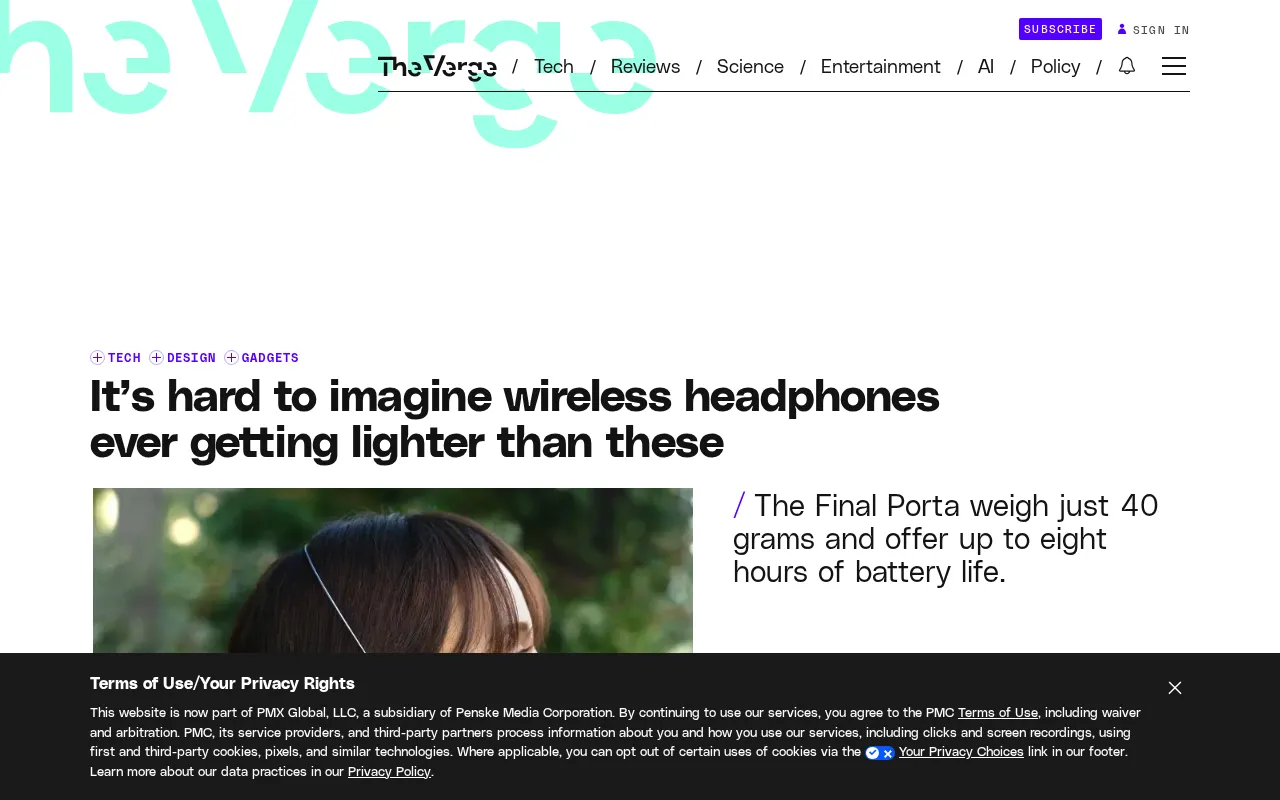
A relatively niche Japanese brand does something uncommon
Final isn't a name you see everywhere in consumer electronics stores, but in audiophile circles it has long been known for dynamic driver design and build detail. The Porta doesn't take the Hi-Fi spec-stacking route; instead, it innovates on structure: a single continuous metal wire forms both the headband and the earcup supports, reducing the part count to an absolute minimum and thereby driving down weight.
For people used to in-ear or ear-clip headphones, this supra-aural design has real relevance. The original article notes that if you've always found earbuds or ear clips "not comfortable enough or not secure enough," an over-head structure may actually suit long listening sessions better—but the weight of traditional over-head headphones often puts some users off. Porta targets exactly this gap.
Dynamic drivers are the most common sound-producing structure in headphones: a coil is fixed to a diaphragm and placed in the magnetic field of a permanent magnet. When audio current passes through the coil, it generates an alternating magnetic field that drives the diaphragm back and forth to produce sound. Its advantages are a mature structure, controllable cost, and natural low-frequency performance, which is why it covers the vast majority of headphones from entry-level to flagship. Final's reputation among audiophiles comes largely from its long-term refinement of diaphragm materials, magnetic circuit design, and cavity tuning for dynamic drivers, rather than relying on multi-driver stacking or digital algorithm compensation. Understanding this helps clarify that Porta's structural innovation is not an isolated move—it stems from an engineering approach centered on physical acoustics and mechanical design, rather than pure consumer-electronics marketing logic.
What the single-wire structure means
Bending a single wire into a headband is not simple engineering. The headband must provide enough clamping force to keep the earcups against the ears, while maintaining its shape and lifespan after repeated bending. Simplifying the structure to a single piece of metal wire essentially uses the material's elasticity and geometry as a "spring."
The direct benefit is weight; the indirect benefits are storage and durability—no complex telescoping joints or plastic connectors means fewer potential failure points. Of course, there are trade-offs: a single-wire structure offers limited room to adjust clamping force, so users with significantly different head shapes may need to try them on to judge fit. The original article doesn't give a specific weight figure, but describes it as "hard to imagine it could be lighter," indicating that weight reduction is the product's core selling point.
Supra-aural refers to a wearing style where the earcups rest directly on the pinna rather than enclosing the whole ear, as distinct from circumaural. Because it doesn't form a sealed cavity, supra-aural headphones are naturally weaker at isolation than circumaural and in-ear designs, and bass leaks more easily—but the trade-off is light weight, no pressure in the ear canal, and the ability to hear some ambient sound. This structure was once widely used in portable over-head headphones before being squeezed out by circumaural designs as demand for noise cancellation and bass grew. Porta's return to supra-aural is essentially a clear trade-off between "isolation" and "comfort/lightness," which also explains why it targets users who can't get used to in-ear designs but need to wear headphones for long periods.
The competitive logic of the lightweight race
Competition over lightweight wireless headphones is nothing new, but most manufacturers take the path of shrinking batteries and optimizing cavity materials. Final chooses to start from structure, a different approach: rather than making each part lighter, it reduces the parts themselves.
The real value to users needs to be viewed in wearing scenarios. During commutes, office work, and long calls, headphones' "sense of presence" often affects the experience more than sound quality specs. The combination of supra-aural design and an extremely light structure is theoretically suited to people who need to wear headphones for long periods without blocking their ear canals. However, lightweight design usually also means limited battery capacity, so battery life will be a question this type of product must face.
Clamping force refers to the inward pressure the headband applies to the earcups, directly determining whether the headphones stay secure and whether they press on the ears. Too little clamping force and the earcups don't seal tightly, causing bass loss and slippage; too much presses on the pinna and temples, causing discomfort or even headaches during long wear. Traditional over-head headphones adapt to different head shapes through multi-stage adjustment with telescoping sliders, hinges, and elastic headbands, whereas a single-wire metal structure compresses the "spring" function into the elastic deformation of the material itself, reducing adjustment margin. This is why the original article emphasizes that users with significantly different head shapes need to try them on—whether the clamping force falls within a comfortable range depends almost entirely on matching the wire's diameter, bend angle, and material elastic modulus.
Who should pay attention to this product
Three types of people are worth noting: first, users who can't get used to in-ear designs and whose ear canals are easily uncomfortable; second, office users who need to listen to music while staying aware of ambient sound; third, users who pursue minimalist structure and prefer the "less is more" design philosophy.
Conversely, if you need strong isolation or heavy bass, the supra-aural structure is inherently at a disadvantage. The original article's positioning is also clear—it solves the conflict between comfort and stability, not the ceiling of sound quality.
At a time when wireless headphones are highly homogenized, rethinking the headband structure with a single metal wire may not be revolutionary, but it does offer a different solution. Extreme lightness may not be a must-have for everyone, but for the users troubled by weight, this type of product deserves serious attention.
One-line Summary
Final bends a single metal wire into a headband, using structural innovation to make supra-aural wireless headphones extremely lightweight.
Paragraph Summary
Japanese audio manufacturer Final has launched the Porta wireless headphones, whose standout feature is a single continuous metal wire forming both the headband and earcup supports, achieving extreme weight reduction by drastically cutting the number of parts. The article notes that the product targets the gap between users who can't get used to in-ear or ear-clip headphones and those who find traditional over-head headphones too heavy. The single-wire structure reduces failure points and is easy to store, but offers limited clamping-force adjustment, so users with significantly different head shapes need to try them on. The author believes that while most manufacturers reduce weight by shrinking batteries and optimizing materials, Final's structural approach offers a different solution; however, lightweight design usually means limited battery capacity, so battery life will be a question this type of product must face. The product suits office users seeking long-term comfortable wear and awareness of ambient sound, rather than those pursuing strong isolation or heavy bass.
Related articles

Agentic Paper Bomb: Using Multi-Agent Systems to Automatically Generate Enterprise Compliance Documents
A Reddit developer shares the Agentic Paper Bomb experiment: five AI agents play executive roles to auto-generate enterprise compliance, security, and DevOps documents. Explores the potential and concerns of multi-agent collaborative document generation.

Building a Sound Source Localization System with Claude Code to Find a Mysterious Beeping Sound
Simon Willison built Beep Locator with Claude Code: multiple devices as microphones, trilateration pinpointed a mysterious beep to ~40cm, showing how to give coding agents hearing.

Rob Roy Classic Dialogue Analysis: The Price of Leadership and the Choice to Survive
An analysis of the classic confrontation dialogue between Rob Roy and Sibbald in *Rob Roy*, exploring the price of leadership, the balance between survival and dignity, and the human insight behind power games.