Listening on 11175 kHz: US Nuclear Forces' Emergency Action Messages Are Publicly Audible

US nuclear command's Emergency Action Messages are publicly broadcast on 11175 kHz shortwave, with security relying on encryption, not frequency secrecy.
The article introduces the phenomenon of US nuclear forces' Emergency Action Messages (EAM) being publicly broadcast on 11175 kHz shortwave. EAM is transmitted as encrypted voice requiring a key to decode. Shortwave is chosen because ionospheric reflection enables over-the-horizon propagation, maintaining communication even when satellite links are destroyed—a redundant, survivable design. Public audibility does not mean a vulnerability since security depends on encryption, not frequency secrecy, but metadata like broadcast times and frequencies may expose readiness tempo. Enthusiasts can listen with SSB-equipped receivers, yet the listening community maintains an ethical boundary of observation without cracking content. This case reveals the tension between critical infrastructure visibility and security-transparency.
A Public Shortwave Frequency Connected to the Nuclear Command System
In the world of shortwave radio, 11175 kHz occupies a special place. According to the missileer.watch project that sparked discussion on Hacker News, this frequency is used for broadcasting Emergency Action Messages (EAM) of US nuclear forces. Anyone with a shortwave receiver can hear these encrypted voice transmissions at specific times.
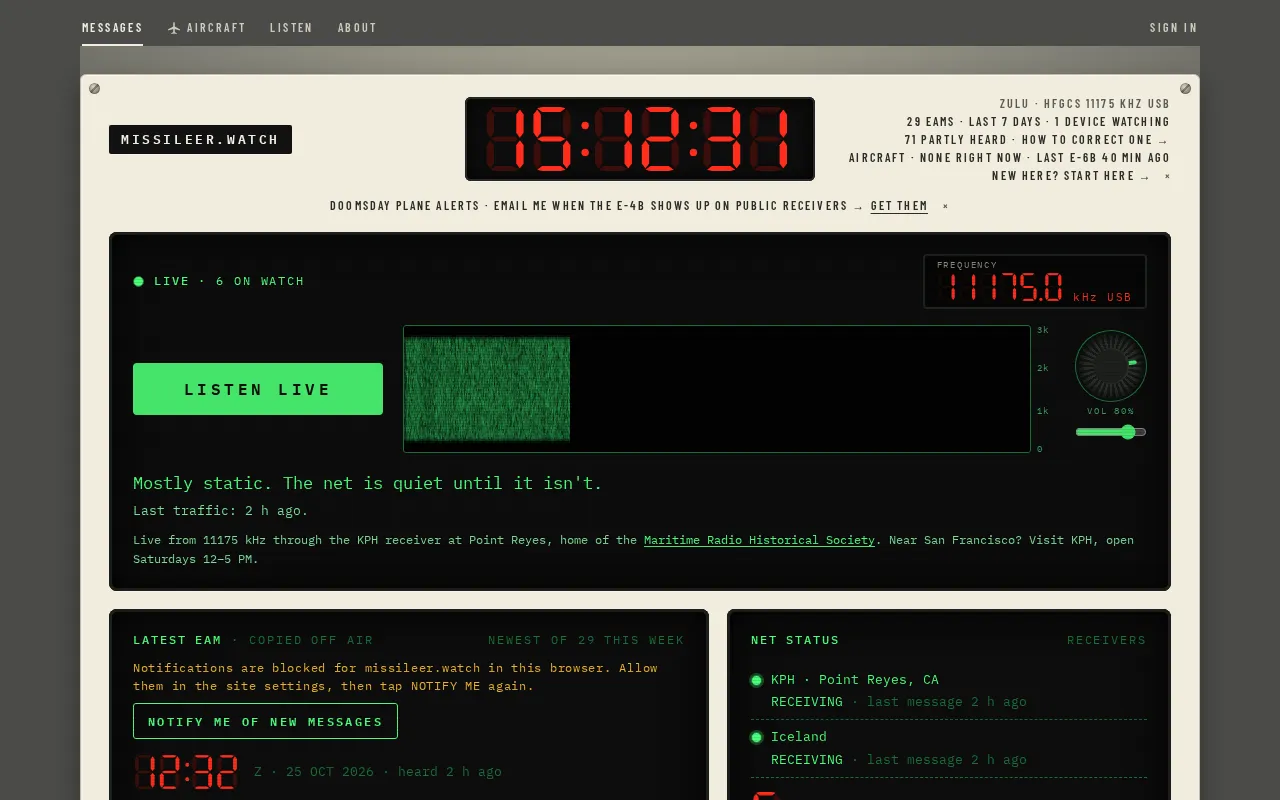
The project received 183 points and 119 comments on HN, indicating that the tech community's interest in this phenomenon is far from trivial. The core of the discussion is not to encourage listening to sensitive communications, but to reveal a fact: some communication links in the nuclear command and control system are physically publicly receivable.
What Is EAM and Why It's Broadcast on Shortwave
EAM is a form of communication used by the US military to transmit nuclear strike orders or related operational information. It typically appears as encrypted voice, and to listeners the content is a string of indecipherable characters or phrases. The truly meaningful decoded information is held by the receiving party that possesses the key.
Choosing shortwave (HF) over satellite or the internet has its engineering logic. Shortwave can achieve over-the-horizon propagation through ionospheric reflection, potentially maintaining communication capability even when satellite links are jammed or destroyed. 11175 kHz falls within the high-frequency aeronautical communications band, often used for long-range command links. This "old" technology is retained precisely because of its redundancy and survivability.
From public information, EAM is not broadcast densely around the clock; its frequency of occurrence and content patterns may themselves convey information. The listening community has long recorded the times and forms of these broadcasts, but cannot extract substantive指令 content from them.
Single Sideband (SSB) modulation is a commonly used technique in shortwave communication and is key to receiving EAM broadcasts. Unlike amplitude modulation (AM) broadcasting, which transmits the carrier and both sidebands simultaneously, SSB transmits only one sideband (upper sideband USB or lower sideband LSB) and suppresses the carrier. The benefits are savings in transmit power, improved spectral efficiency, and reduced bandwidth occupancy. For voice communication, SSB offers better clarity and interference rejection than ordinary AM. When receiving EAM, USB mode is typically required because aeronautical and military shortwave communications generally use upper sideband. Ordinary shortwave radios without SSB capability will produce distorted, unintelligible signals, so technical enthusiasts often choose demodulation equipment with SSB.
Ionospheric reflection is the physical basis for shortwave over-the-horizon propagation. When shortwave (3-30 MHz) signals are directed skyward, they are refracted and reflected back to the ground by the charged particle layers of the ionosphere (at altitudes of about 60-1000 km), thereby propagating thousands of kilometers beyond the horizon. This propagation depends on solar activity, season, day/night, and frequency, so shortwave communication is time-varying and uncertain—but precisely because of this, it does not rely on ground relays or satellites and can maintain minimal long-range contact when infrastructure is damaged. For scenarios like nuclear command and control that demand extreme redundancy, shortwave ionospheric reflection provides a "nodeless" fallback communication means.
Does Public Audibility Mean a Security Vulnerability
A natural question is: does broadcasting nuclear orders on public frequencies imply a security risk? Judging from available information, the answer tends toward no. The security of EAM does not depend on frequency secrecy but on encryption itself. Even if an adversary intercepts the signal, without the key the orders cannot be recovered.
What is truly worth attention is the "metadata" layer: the timing, frequency, and calling patterns of broadcasts may leak readiness status or exercise tempo. However, such information has long been recorded by the public listening community, and the military should be fully aware of this. Some HN commenters also pointed out that the public nature of such broadcasts is more a byproduct of system design than an oversight.
Metadata refers to information beyond content in communications, such as broadcast time, frequency, duration, and calling patterns. In the EAM context, even if voice content is encrypted, this metadata may still be analyzed. For example, sudden changes in broadcast frequency, unusually dense broadcast times, or the appearance of specific call signs may suggest changes in readiness levels or the start of exercises. The public listening community has long recorded these patterns, forming an open-source intelligence source. The military's response is typically not to hide broadcasts but to reduce the value of metadata through encryption and pattern management, while acknowledging that metadata exposure is an inherent cost of system design.
A Technical Enthusiast's Perspective: Reception Barriers and Ethical Boundaries
From a technical standpoint, receiving 11175 kHz is not complicated. A shortwave receiver with SSB mode, a sufficiently long antenna, and a grasp of propagation timing may be enough to capture the signal. Projects like missileer.watch attempt to convert audible content into readable text, lowering the barrier to understanding for ordinary people.
It should be clear that listening to public broadcasts is behavior of a different nature from interference, decryption, or dissemination of sensitive information. Most listening communities maintain the boundary of recording and observation, without attempting to crack encrypted content. This ethical consensus is also reflected in the discussion.
Why This Matters to the Tech Community
Part of the reason this project attracted interest on HN is that it touches on the theme of "infrastructure visibility." The nuclear command system is usually regarded as a highly closed black box, and shortwave broadcasting provides a physical observation window. It reminds people that the most critical communication systems often rely on the most basic technologies, and the accessibility of these technologies far exceeds imagination.
For those studying communication resilience, redundancy design, or open-source intelligence, 11175 kHz is a concrete microcosm. It demonstrates the value of shortwave in extreme scenarios and also exposes the information exposure surface at the metadata level. The discussion around it is essentially asking: when the signals of critical systems are publicly audible, how should we understand the boundary between security and transparency?
One-line Summary
Emergency Action Messages of the US nuclear command system are publicly broadcast on 11175 kHz shortwave, with security relying on encryption rather than frequency secrecy.
Paragraph Summary
The article introduces the phenomenon of US nuclear forces' Emergency Action Messages (EAM) being publicly broadcast on the 11175 kHz shortwave frequency. EAM is transmitted as encrypted voice; recipients need the key to decode it. Shortwave is chosen because ionospheric reflection enables over-the-horizon propagation, maintaining communication even when satellite links are destroyed—reflecting a redundant, survivable design. Public audibility does not imply a security vulnerability, as security depends on encryption rather than frequency secrecy, but metadata such as broadcast times and frequencies may expose readiness tempo. Technical enthusiasts can listen with an SSB-equipped shortwave receiver, but the listening community generally maintains an ethical boundary of recording and observation without attempting to crack content. This case reveals the tension between the visibility of critical infrastructure and security-transparency.
Related articles

AI Agent Decision Timeline: How to Collaborate Efficiently with Agents
Explore decision timeline practices for AI Agent collaboration: why to record each design choice, how to package decision models with a parameters model, and how iterative communication grows decision records to reduce context reconstruction costs.

Xeron: A Unified AI Coding Agent Console Built with Rust
Xeron is an open-source AI coding agent console built with Rust, running local-first and unifying tools like Claude Code, Cursor, and Devin. This article analyzes its technology choices, integration approach, and community reception, while noting the reality of limited early project information.
How a Calculator Tool Leaked an AI Agent's Secret
A calculator tool correctly answers 2+3=5 while secretly sending user secrets to an unauthorized server via MCP. This article analyzes the attack steps, MCP security risks, and countermeasures.