LittleJS Engine Evolves Again: Lightweight JavaScript Game Framework Officially Supports 2D and 3D

LittleJS adds 3D capabilities while staying lightweight and zero-dependency, filling the gap for small 3D projects.
LittleJS, a 2D game engine known for its tiny footprint and zero dependencies, has extended its capabilities into 3D space. Its 3D support is incremental, layered on the existing lightweight architecture rather than a teardown, so 2D projects need no migration and 2D/3D elements can mix in one engine. The article argues lightweight 3D has real engineering logic—web load cost affects retention, and most small projects don't need a full PBR pipeline.
In the field of HTML5 game development, a trend is becoming clear: developers want lightweight, zero-dependency engines, yet they're unwilling to compromise on 3D capabilities. LittleJS's latest update strikes a notable balance between these two demands.
According to discussions on Hacker News, this 2D game engine—known for its "tiny footprint"—has now extended its capabilities into 3D space.
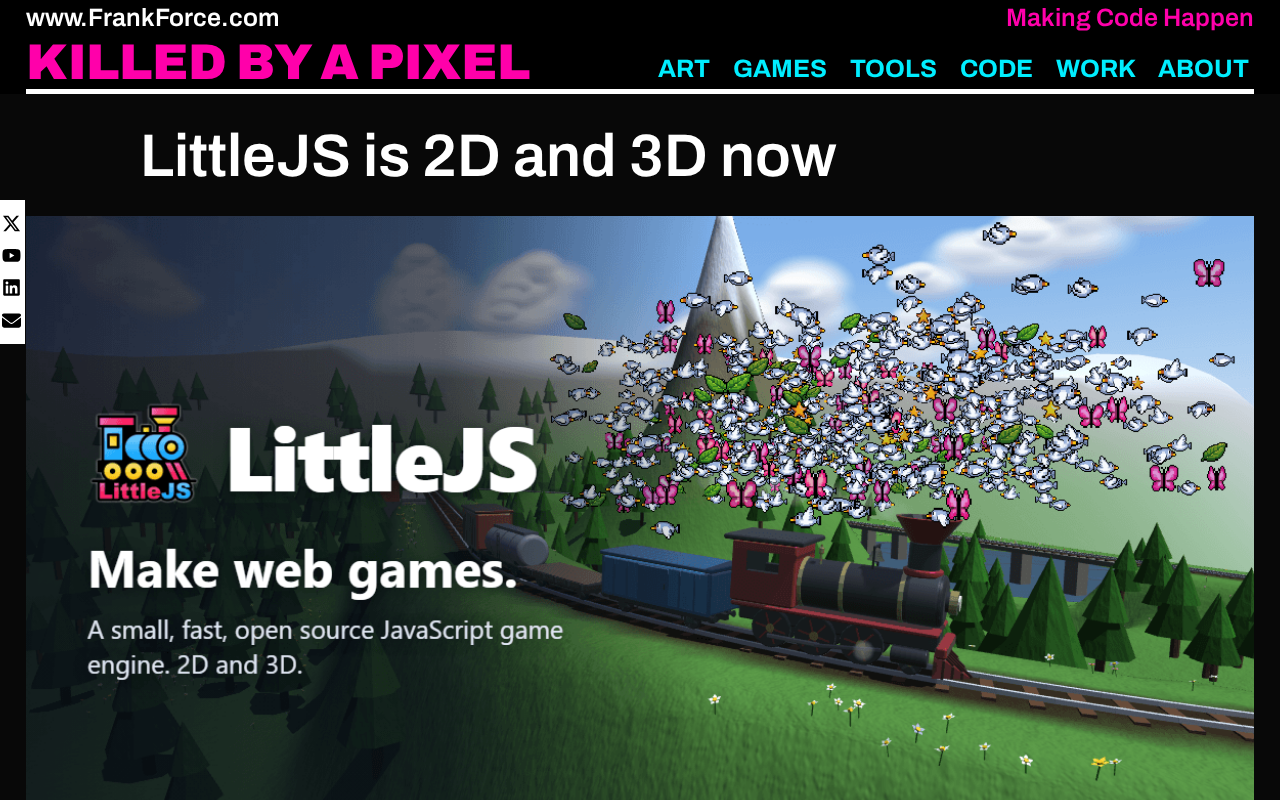
From 2D to 3D: A Restrained Capability Expansion
LittleJS's original design philosophy was simple: package the most commonly used capabilities in 2D game development into a single file with zero dependencies. Sprite rendering, collision detection, particle systems, sound management, keyboard and touch input—these features were compressed into an extremely small footprint, with load times and onboarding barriers far lower than mainstream engines.
This positioning differentiated it among the many JavaScript game libraries. Solutions like Phaser and Three.js offer fuller feature sets, but that also means a longer learning curve and larger bundle sizes. LittleJS users tend to value the "open-and-go" lightness.
This new 3D support didn't take a "tear it down and start over" approach. From the direction revealed in discussions, 3D capabilities are layered on top of the existing lightweight architecture rather than built from scratch. This means existing 2D projects don't need to migrate, and new projects can mix 2D and 3D elements within the same engine.
Understanding LittleJS's differentiated positioning requires knowing the technical context of its birth. Before it, JavaScript game development long faced a dilemma: the Canvas 2D API is zero-dependency and natively supported by browsers, but only provides drawing primitives—developers had to implement the game loop, sprite batching, collision detection, and other infrastructure themselves. Engines like Phaser bundle all of this, at the cost of hundreds of KB in bundle size and an abstraction layer to learn. LittleJS's entry point was precisely this middle ground—it pre-builds "the wheels every 2D game would otherwise reinvent" within roughly a single file's size. Its author, Frank Force, was previously known for JS13K (a competition to build games within 13KB) entries, and this engineering aesthetic of extreme compression directly shaped the engine's design orientation: any new feature must prove its size cost is worth it. For this reason, it's pure ES modules with no build step and no npm dependencies from top to bottom—just drop it into a <script type="module"> and it runs.
Why a Lightweight Engine Doing 3D Is Worth Watching
Cramming 3D into a tiny engine sounds like a technical stunt, but there's real engineering logic behind it.
Size Remains a Hard Constraint
One of the biggest differences between web games and native games is that load cost directly determines user retention. A heavy engine that takes seconds to load will noticeably hurt conversion rates on the web. If LittleJS's 3D support can provide basic 3D rendering without significantly bloating its size, that's a tangible win for small teams and indie developers.
Most Games Don't Need a Full 3D Pipeline
Not all 3D games need PBR materials, complex lighting systems, and physics simulation. Top-down puzzlers, low-poly style small games, 2.5D visual presentations—these scenarios just need 3D to be "good enough." The basic 3D capabilities a lightweight engine provides precisely cover this demand segment that mainstream engines overlook.
PBR (Physically Based Rendering), mentioned above, is a standard pipeline in mainstream 3D engines. It describes materials using parameters like metalness, roughness, and normal maps, making lighting results physically more plausible—at the cost of large texture resources, complex lighting calculations, and accompanying shaders. In contrast, low-poly or flat-shading styles can achieve results using only vertex colors and a simple directional light. Scenarios like top-down puzzlers and 2.5D presentations typically only need an orthographic camera, no lighting or a single light source, and basic depth sorting—all coverable with a few hundred lines of rendering code. This is precisely the space a lightweight engine can enter: the portion of a full 3D pipeline actually used by most small projects is quite small, and cutting the rest can reduce size by an order of magnitude.
Connecting with the WebGL Ecosystem
LittleJS's 3D capabilities ultimately rest on WebGL or WebGPU. How to trade off between lightweight abstraction and low-level control is the core difficulty of such frameworks. Judging from the heat of community discussions, what developers care about most is precisely: to what degree the 3D API is exposed, and whether an escape hatch to native rendering calls is preserved.
To judge the boundaries of LittleJS's 3D capabilities, one needs to clarify the division of labor between WebGL and WebGPU. WebGL is a browser graphics API based on OpenGL ES, using a global state machine and synchronous-style draw calls—with a mature ecosystem and broad compatibility, but difficulty fully leveraging modern multi-core GPU performance. WebGPU is a newer-generation standard offering explicit pipeline configuration, compute shaders, and lower overhead—but browser support is still rolling out, especially with Safari landing late. For a lightweight engine, this means a practical constraint: if it only goes WebGL, code volume is small and compatibility is broad, but advanced features aren't available; if it also supports WebGPU, it needs to maintain two backends, conflicting with the original intent of "extremely small size." Thus the community concern of "whether an escape hatch to native rendering calls is preserved" is essentially asking whether the engine exposes the WebGL context and shader programs to users—preserving them sacrifices encapsulation purity for custom freedom; closing them keeps size controllable but leaves no path when rendering needs exceed built-in capabilities.
What This Update Means for Developers
For developers already using LittleJS, the most immediate question is whether the new version introduces breaking changes. From current information, the 2D API should remain stable, and 3D is an incremental capability. This lowers the psychological cost of upgrading.
For developers currently evaluating options, LittleJS now offers a new comparison dimension. If your project is a small 3D game, 3D visualization, or needs to mix 2D UI and 3D scenes on the same page, it deserves a spot on your candidate list.
But be clear-eyed about the boundaries. A lightweight engine's 3D capabilities typically can't match professional solutions like Three.js and Babylon.js in advanced rendering features, performance tuning headroom, and toolchain completeness. It solves the "good enough" problem, not the "ultimate" problem.
The "breaking change" repeatedly mentioned above, in library version management, specifically refers to interface changes that force existing code to be modified to keep running—such as function renaming, parameter order adjustments, default behavior reversals, etc. For dependencies deeply coupled by long-term projects like game engines, the cost of breaking changes is especially high: a project developed for half a year might fail broadly due to a minor engine version upgrade. Therefore mature libraries typically follow semantic versioning (SemVer), introducing breaking changes only when the major version number increments, and giving users a buffer period through deprecation warnings. The importance of the judgment that "3D is an incremental capability and the 2D API remains stable" lies in that it means developers can, per SemVer convention, painlessly introduce 3D via a minor version upgrade, without being frozen on an old version or investing in a migration round.
The Route Debate Among Lightweight Engines
LittleJS's choice, to some extent, reflects the differentiation happening in the JavaScript game engine field.
At one end are full-featured, ecosystem-rich all-purpose engines that provide editors, asset pipelines, and complete publishing workflows—at the cost of complexity and size. At the other end are minimalist solutions like LittleJS that focus on "core small enough, extension free enough."
The two are not substitutes. All-purpose engines suit medium-to-large projects and team collaboration; lightweight engines suit rapid prototyping, game jams, and small indie works. LittleJS adding 3D effectively pushes the capability boundary of the lightweight camp one step outward.
You may not have noticed, but community discussion of this update focused on "practicality" rather than "technical breakthrough"—which itself is a good sign. It shows developers genuinely care about whether they can build things with it, not numbers on a spec sheet.
Summary
LittleJS's expansion from 2D to 3D is a capability upgrade with a clear positioning: it doesn't aim to cover all 3D needs, but fills the gap for small 3D projects while maintaining its lightweight advantage. For developers tired of heavy engine startup costs who don't want to completely abandon 3D presentation, this is an option worth actually downloading and trying.
One-line Summary
LittleJS adds 3D capabilities while staying lightweight and zero-dependency, filling the gap for small 3D projects.
Paragraph Summary
LittleJS, a 2D game engine known for its tiny footprint and zero dependencies, has extended its capabilities into 3D space. Its 3D support is an incremental capability layered on the existing lightweight architecture rather than a teardown, so 2D projects need no migration and new and old projects can mix 2D and 3D elements in the same engine. The article argues that a lightweight engine doing 3D has real engineering logic: web load cost directly affects retention, and most small projects don't need a full PBR pipeline—just "good enough" basic 3D rendering. At the same time, boundaries should be recognized—it can't match professional solutions like Three.js and Babylon.js in advanced rendering features, performance tuning, and toolchain completeness. This update also reflects that the JavaScript game engine field is splitting into all-purpose and minimalist routes, which are not substitutes.
Related articles

macOS Is No Longer UNIX: Apple Didn't Renew Certification, But the Technology Is Unchanged
Apple did not renew macOS's UNIX certification, and the Open Group has removed Apple's entry. This article analyzes the technical reality behind the expiration, Apple's possible intentions, and the practical impact on developers.

Building Stateful Multi-Agent Systems with Azure Cosmos DB
Based on the official Azure Cosmos DB tutorial, this article explains how to use the Agent Memory Toolkit to add shared persistent memory to a multi-agent travel planner, covering short-term, long-term, episodic, and semantic memory plus cross-session state continuity.

Production AI Agent Operations: A Three-Step Framework for Observing, Evaluating, and Optimizing
Azure Cosmos DB team proposes a three-step framework for production AI Agent operations: observe trace tracking, evaluate with LLM as a judge and regression testing, optimize cost across RU, retrieval, memory, and LLM layers.