LiveNerf Day 8: The Open-Source Tool Tracking Whether Opus 5.5 Is Being Quietly Nerfed

LiveNerf runs daily benchmarks on Claude Opus 5.5 to detect whether it's been quietly nerfed post-launch.
The AI community has long suspected that model providers silently downgrade models after launch, but hard data has been scarce. Open-source project LiveNerf, built by developer ninjahawk, addresses this by running the same evaluation suite against Claude Opus 5.5 every day. After going viral with nearly 1,000 GitHub stars and a Hacker News front-page appearance, the project is now approaching a critical milestone: establishing a stable performance baseline. Only with that foundation can statistical methods reliably detect meaningful performance shifts. The author maintains a neutral stance — no degradation is equally a valid outcome — and welcomes community scrutiny on methodology. LiveNerf's deeper significance is demonstrating how open-source tooling can replace anecdote with verifiable data when AI providers lack transparency.
There's a long-running debate in the AI community: do model providers quietly "nerf" their models after launch? Plenty of users claim a model "got dumber over time," but these observations are largely subjective and lack verifiable data. An open-source project called LiveNerf is trying to change that — by running daily independent benchmarks to answer, with data, whether Opus 5.5 has been quietly downgraded since release.
A Project Born to Replace Gut Feelings with Data
LiveNerf was started by developer ninjahawk with a straightforward premise: run the same evaluation suite against Opus 5.5 every day, track its performance continuously, and see whether anything meaningful changes after the initial release. The project is fully open source, with code hosted on GitHub.
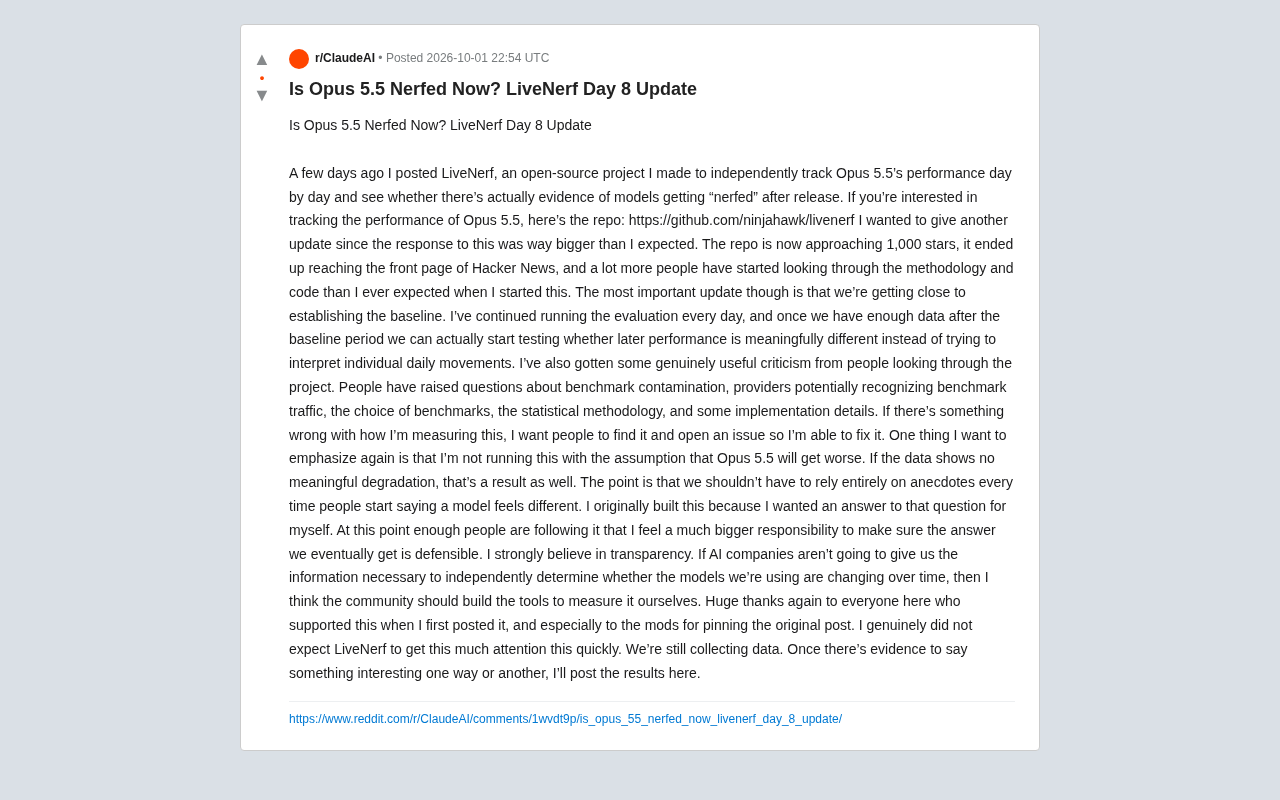
In the Day 8 update, the author admits the response has far exceeded expectations. The repository is approaching 1,000 stars and made it to the Hacker News front page, drawing a wave of developers who started scrutinizing the methodology and code. That level of attention speaks for itself: "models being quietly changed" is a shared anxiety across the entire AI user base, and almost nobody had tried to quantify it in a systematic way — until now.
The Key Milestone: Establishing a Baseline
The most important development in this update is that the evaluation is approaching the point of establishing a performance baseline.
This matters enormously. Looking at day-to-day score fluctuations in isolation doesn't tell you much — model outputs are inherently stochastic, and small swings up or down are completely normal. Only after accumulating enough data during a stable baseline period can you apply statistical methods to determine whether later performance has diverged significantly, rather than over-interpreting daily noise.
In other words, LiveNerf isn't rushing to draw conclusions. It's carefully calibrating the ruler first. Once that reference point is established, any meaningful performance shift can be reliably detected.
Community Scrutiny Is Making the Methodology Stronger
As the project gained visibility, many people dug into the code and raised pointed criticisms — which the author has welcomed. The main challenges raised so far include:
- Benchmark contamination: Are the evaluation questions already in the model's training data, inflating scores artificially?
- Traffic fingerprinting: Can the model provider identify this as benchmark traffic and treat it differently?
- Benchmark selection: Is the chosen evaluation set actually representative?
- Statistical rigor: Are the methods for determining significance sound?
- Implementation bugs: Are there code-level issues that could skew results?
The author has been explicit: "If my measurement approach is flawed, I want people to find that and file issues so I can fix it." This openness is precisely what gives independent evaluation projects their credibility — the conclusions aren't produced by a black box, but through a process the community can repeatedly examine and challenge.
Benchmark contamination is a classic challenge in evaluation: if a question set (such as math competition problems or coding challenges) was ingested heavily during pre-training or fine-tuning, the model is essentially recalling memorized answers rather than genuinely reasoning — leading to inflated scores that don't reflect real capability. For continuous evaluations like LiveNerf, contamination risk has an additional dimension: if a fixed question set is reused daily and the provider knows its contents, they could theoretically include those samples in future training to maintain high scores even as underlying capability degrades. Common mitigation strategies include dynamically generating new questions, keeping the question bank confidential before publication, or mixing multiple evaluation dimensions to reduce reliance on any single dataset. Traffic fingerprinting is another vulnerability for independent evaluations: commercial API providers can infer from request characteristics — fixed prompt templates, regular timestamps, specific user-agent strings — that an account is running benchmarks, and may have an incentive to serve that traffic differently from regular users. These critiques don't undermine LiveNerf's value; they provide the necessary pressure to keep its methodology evolving.
No Predetermined Conclusion: No Degradation Is Also a Valid Result
It's worth emphasizing the author's repeatedly stated neutral stance: the project is not operating under the assumption that Opus 5.5 will get worse.
If the data ultimately shows no meaningful performance degradation, that is equally a valuable finding. The goal isn't to "catch providers doing something wrong" — it's to give the community something to point to besides anecdotes the next time someone says "this model feels different."
"I originally did this because I wanted to find the answer to this question for myself," the author writes. "Now that enough people are watching, I feel a greater responsibility to make sure the answer we eventually arrive at actually holds up."
Transparency: Why Community-Built Tools Matter
LiveNerf reflects a larger philosophical argument. The author's position is direct: if AI companies won't provide enough information for users to independently verify whether the model they're using has changed over time, then the community should build tools to measure it themselves.
This hits a core pain point in the closed-source LLM ecosystem. Users pay for API access but have no way to confirm that the model they're calling today is truly the same one they used last week. Providers routinely adjust model weights or inference configurations for cost or safety reasons — but without transparent changelogs, users are left relying entirely on intuition. Third-party monitoring tools like LiveNerf are, in essence, using open source and data to fill that transparency gap.
Closed-source model versioning is typically opaque to users: a single API endpoint (such as claude-opus-4-5) may point to different underlying versions that have undergone weight updates, quantization, or inference parameter tuning. Quantization is a common cost-optimization technique that compresses model parameters from high-precision floating point (e.g., BF16) to lower-precision formats (e.g., INT8, INT4), significantly reducing memory usage and inference costs — but potentially introducing subtle quality degradation that almost never appears in external release notes. Inference configuration (such as batch size, KV cache strategy, or server-side sampling parameter defaults) may also be silently adjusted. This means the "same model" users see at the API level is actually a black-box service whose internal implementation can be swapped at any time, with no historical snapshots available for comparison. LiveNerf's value lies precisely in building that historical record.
The Verdict Is Still Coming
LiveNerf is still in data collection mode. The author has committed to publishing results — in whichever direction they point — as soon as there's enough evidence to draw a meaningful conclusion.
For developers who care about the stability and reliability of large language models, this project is worth watching. Its real value may not ultimately lie in answering "was Opus 5.5 nerfed" — but in demonstrating a path forward: when faced with opaque AI services, the community is fully capable of turning "vibes" into verifiable data through open-source, reproducible methods.
Related articles

Gemini 4 Argon Hands-On: AI Builds Board Games, Constructs Temples, and Trains Robots Autonomously
Gemini 4 Argon hands-on roundup: AI autonomously builds a desk racetrack and temple in Blender, writes a ray tracing engine, trains a humanoid robot to sink 7 shots, plus API pricing and developer access.

The Magic Octagonal Coin: Why Only 9% of People Can Predict Its Flip?
Only 9% of people can correctly predict the Magic Octagon coin flip. This article explains its spatial rotation mechanism, common cognitive pitfalls, and a new hypothesis based on Relevance Theory, exploring the limits of human spatial reasoning.

Sam Altman: AI Is Entering the Era of Scientific Discovery — Math Breakthroughs Will Replicate in Biology and Energy
Sam Altman says AI is entering the era of scientific discovery — math breakthroughs will replicate in biology, materials science, and energy to help develop new drugs and energy sources.