llama.cpp Version Update: v0.40.15-rc1 Analysis

llama.cpp releases v0.40.15-rc1, bumping the upstream version and removing a Metal patch already fixed upstream.
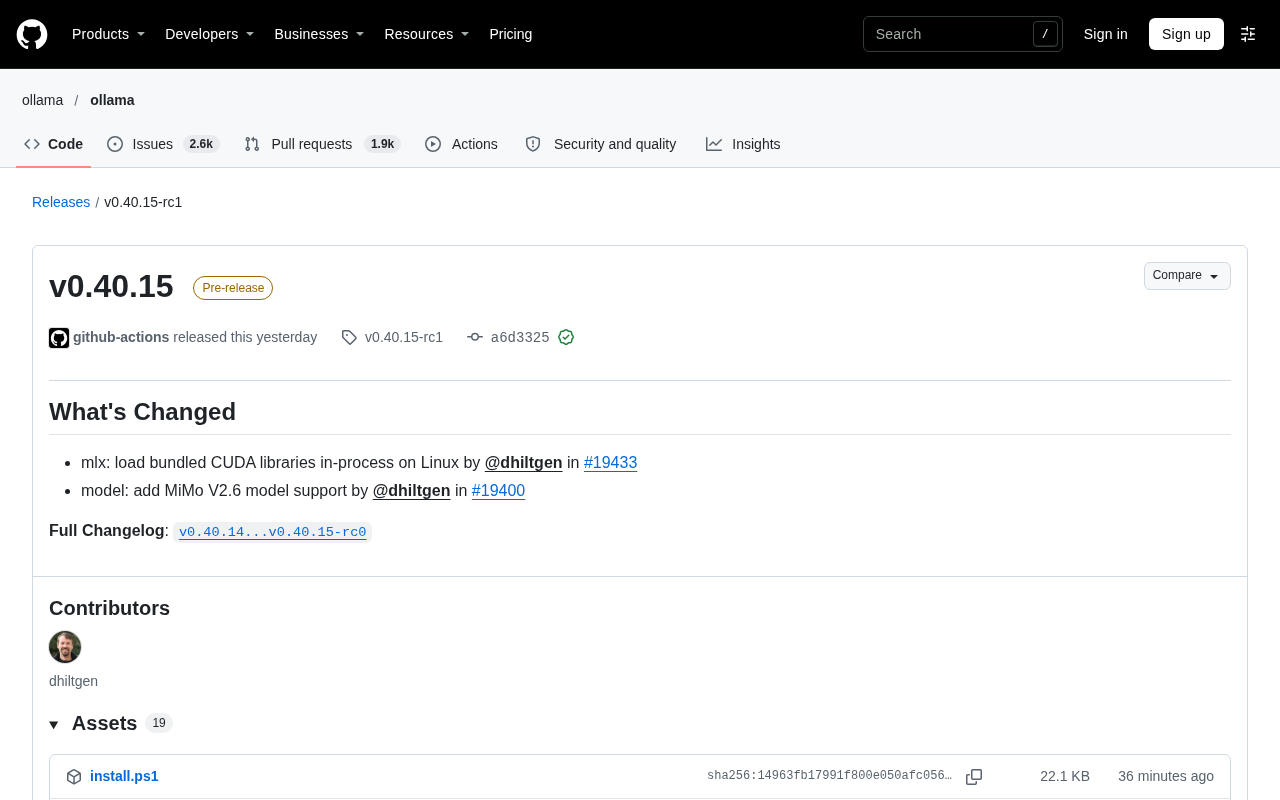
llama.cpp has released v0.40.15-rc1 (commit a6d3325), tagged by developer dhiltgen on November 5, with a verified signature on GitHub. There are two core changes: first, bumping the llama.cpp submodule version to build number b12111 to synchronize upstream changes; second, removing the 002-metal-unary-cast-constexpr.patch because upstream has already provided a fix. The former means introducing all upstream commits between the two build numbers at once, while the latter reduces local divergence from upstream, lowers merge conflict risk, and improves maintainability. The article recommends that developers focus on verifying Metal backend inference in a test environment, confirm that builds previously relying on the patch still work after upgrading, and keep watching for subsequent official releases and complete changelogs.
Version Update Overview
According to RSS sources, llama.cpp has released version v0.40.15-rc1 (commit a6d3325). The core change is a version bump of llama.cpp (bump b12111), and this commit carries a verified signature on GitHub (GPG key ID: B5690EEEBB952194). This update was tagged by developer dhiltgen on November 5.
The version bump itself may seem simple, but in a rapidly iterating open-source inference framework like llama.cpp, every version bump means synchronization of underlying dependencies or upstream code. For developers who rely on llama.cpp for local inference, keeping up with version changes in a timely manner is key to ensuring compatibility and performance.
Main Changes Analysis
Version Number Bump
The commit title is explicitly "llama.cpp: version bump b12111," indicating this is a version update of the llama.cpp submodule or dependency. In llama.cpp's release process, a version bump is usually accompanied by upstream code merges, performance optimizations, or bug fixes. Although currently available public information is limited, it can be inferred that this upgrade aims to synchronize the latest upstream changes and lay the foundation for subsequent feature iterations.
In the context of llama.cpp, "bump b12111" adopts a build number/revision number system similar to that of Chromium or LLVM: "b" plus a number usually refers to a specific build or commit sequence identifier in the upstream repository. Many downstream projects (such as various container images, desktop inference tools, and Docker runtime wrappers) introduce llama.cpp as a git submodule and pin the dependency with a fixed build number. Therefore, the "version bump" here is not merely a change in semantic version number, but rather advancing the submodule pointer from the old build number to b12111, thereby introducing all upstream merged commits in that range at once. This also explains why the diff of such commits often contains only a one-line pointer change, yet may bring substantive behavioral differences. For downstream maintainers, when following up on a bump, it is necessary to review the upstream commit log between the two build numbers, focusing on API/ABI changes and backend-related changes, rather than judging risk solely by the version number.
Patch Cleanup: Removing the Metal-Related Patch
One noteworthy change in this update is: "Drop 002-metal-unary-cast-constexpr.patch: superseded by upstream fix." This means that the previously added unary type cast constexpr patch for the Metal backend has been removed because upstream has already provided a fix.
For macOS users, the Metal backend is an important path for GPU-accelerated inference. The removal of the patch indicates that the upstream code has already incorporated the relevant fix, which usually means improved code stability and maintainability. Developers no longer need to maintain an additional patch, reducing the risk of merge conflicts.
constexpr is a keyword introduced in C++11 for declaring expressions or functions that can be evaluated at compile time. In GPU backend kernel code, marking type casts as constexpr allows the compiler to perform constant folding and type checking at compile time, reducing runtime overhead and avoiding certain compiler restrictions on non-constant expressions participating in template instantiation. The patch name unary-cast-constexpr indicates that it targets constexpr handling of unary casts in the Metal shader/kernel code path. Such patches are usually temporary local modifications introduced to work around older toolchains or compile errors not yet fixed upstream. When upstream fixes the same issue in an equivalent or more complete way, the local patch loses its reason to exist; keeping it would instead cause conflicts with upstream code or semantic duplication. Therefore, deleting it together with the version bump is standard practice.
Technical Background and Impact
llama.cpp, as a popular open-source large language model inference framework, is known for its efficient C/C++ implementation and support for multiple hardware backends. The Metal backend is a key component for achieving GPU acceleration on Apple Silicon devices. The patch removed this time involves constexpr handling of unary type casts, which falls under compile-time optimization and may affect the compilation behavior of Metal kernels.
After the upstream fix was merged, the project chose to discard the local patch directly, which aligns with open-source collaboration best practices—minimizing divergence from upstream. For users, this means a cleaner codebase and a smoother upgrade path.
Metal is the graphics and compute API provided by Apple for its own GPUs. On Apple Silicon (M-series chips), it uses a unified memory architecture that lets the CPU and GPU share the same memory, thereby reducing data copy overhead, which is particularly beneficial for tensor movement in large language model inference. llama.cpp's Metal backend uses Metal Shading Language (MSL, based on a C++14 subset) to write compute kernels, which are compiled at build time by the system toolchain. Precisely because MSL's C++ subset differs from standard C++ in constexpr support scope and semantics, code involving compile-time evaluation is more likely to trigger toolchain compatibility issues on the Metal path. This is also one reason why patches and upstream fixes alternate frequently on this backend.
Developer Recommendations
- Follow this version tag and verify in a test environment whether Metal inference scenarios work properly.
- If you previously relied on this patch for builds, confirm after upgrading that the upstream fix has taken effect.
- Watch for subsequent official releases to obtain more complete changelogs.
Summary
v0.40.15-rc1 is a routine but important version update that both synchronizes llama.cpp's upstream version and cleans up a Metal patch already fixed upstream. For developers using llama.cpp, it is recommended to follow up on this change and ensure local builds remain consistent with upstream.
Related articles

Gemini 4 Neon Leak: A Potential Strong Contender Against Opus 5.5
A Hacker News thread suggests Gemini 4 Neon looks like an Opus 5.5 competitor. This article unpacks the product positioning behind this community signal, shifts in the top-model competitive landscape, and what it means for developers' model selection strategy.

Claude Fable 5.2's Self-Authored Short Film 'Fable' Sparks Discussion
A short film 'Fable,' credited to Claude Fable 5.2 for script, visuals, and directing, appears on Hacker News. This article analyzes the significance of full-pipeline AI creation, community reactions, and what it means for content creators.

Anthropic IPO Pricing: A Signal of AI Giants Going Public
Anthropic's IPO pricing draws attention. This article analyzes its potential impact on AI industry valuation, commercialization paths, and the competitive landscape, and highlights public-market expectations and challenges for AI companies.