Llama-modchip: Running a 284B DeepSeek Model Without a GPU

Llama-modchip claims to run a 284B DeepSeek model on a 64GB GPU-free machine, testing the boundaries of feasibility.
The Llama-modchip project claims it can run the 284B-parameter DeepSeek large model on consumer-grade hardware with only 64GB of RAM and no GPU, challenging conventional deployment assumptions. Its core approach may involve aggressive quantization, on-demand paged loading, and CPU multi-core parallelism to replace scarce GPU VRAM with system memory and lower the barrier to running large models. The solution is expected to be far slower at inference than GPU deployments, with its value lying more in validating the boundaries of feasibility. Project details are limited—quantization format, measured speed, and dependencies still need to be disclosed—so readers should treat it as a technical validation rather than a production-ready solution. For developers, it suggests there is still considerable room to optimize quantization and memory management strategies.
Llama-modchip: Running a 284B DeepSeek Model Without a GPU
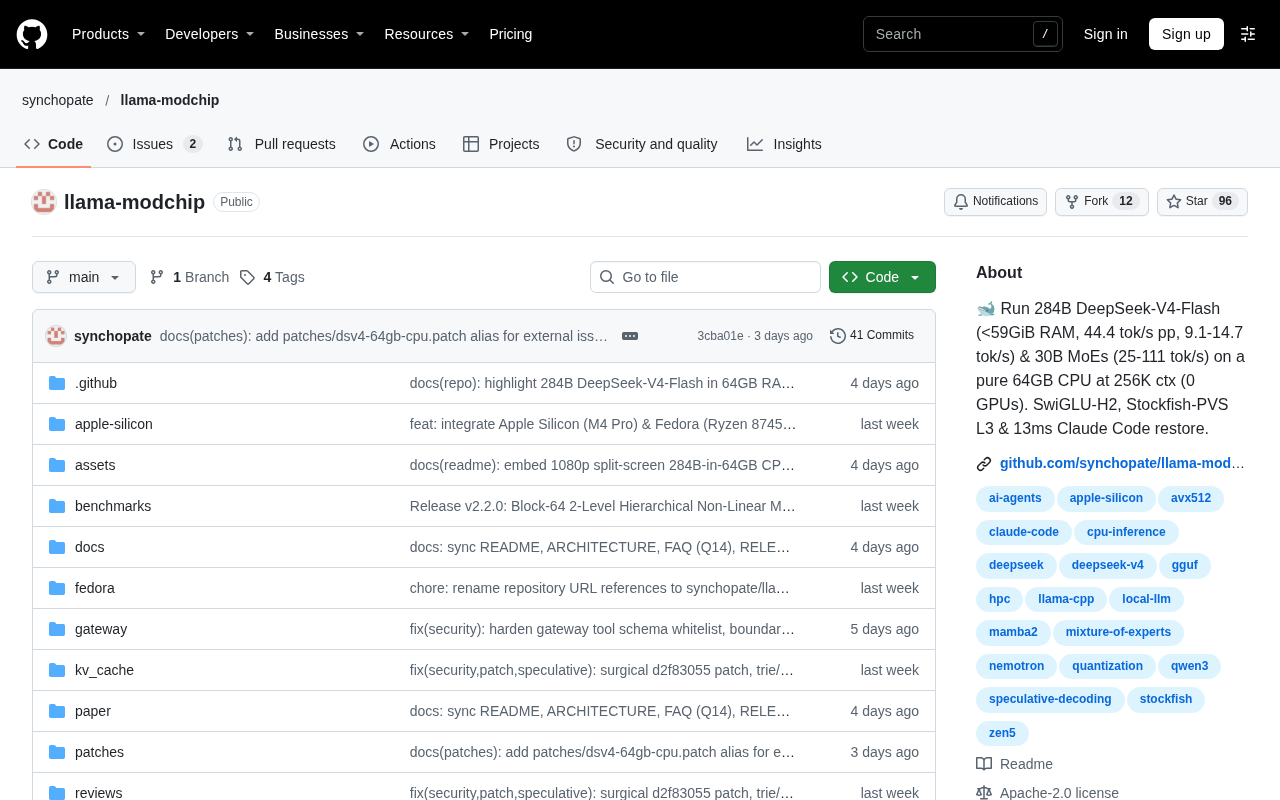
Running hundred-billion-parameter large models on consumer-grade hardware has long been one of the most challenging goals in AI engineering. A project recently surfaced on Hacker News—Llama-modchip—claims it can run the 284B-parameter DeepSeekAd model on an ordinary machine with just 64GB of RAM and no GPU. At first glance, this combination of numbers almost defies hardware common sense, which is exactly why it has drawn attention and discussion from the technical community.
A Counterintuitive Engineering Proposition
DeepSeek's 284B-parameter model belongs to the ultra-large category. Under conventional deployment thinking, even a quantized version would require multiple high-end GPUs or a large pool of VRAM to carry the inference process. The configuration Llama-modchip offers is 64GB of system memory and zero GPUs. This means the project's core is not about "stacking hardware" but about reorganizing how the model is loaded and computed.
Judging from the publicly available discussion threads, solutions of this kind usually involve several directions: more aggressive model quantization, on-demand paging of parameters from storage, and using the CPU's multi-core parallelism to share the matrix computation workload. The specific combination Llama-modchip adopts has only been disclosed in limited detail so far, but the very result of "running 284B on 64GB RAM" already shows that it has made trade-offs in memory footprint control that differ from conventional inference frameworks.
Why GPU-Free Inference Deserves Serious Attention
Liberating large models from the GPU is not just geeky showmanship. GPU VRAM is currently one of the scarcest and most expensive resources in large-model deployment, while the memory capacity of ordinary servers and workstations is often far greater than their VRAM. If memory can be traded for VRAM and engineering optimization for hardware cost, then a large number of small and mid-sized teams—even individual developers—would have the chance to run locally the large models they previously dared only to call from the cloud.
This path also has obvious costs. The compute density of CPUs is far lower than that of GPUs, and repeatedly moving model parameters out of memory also creates bandwidth bottlenecks, so GPU-free solutions typically cannot match GPU deployments in inference speed. The value of Llama-modchip lies more in "whether it can run at all" than in "how fast it runs"—what it validates is the boundary of feasibility.
The memory bandwidth bottleneck is key to understanding GPU-free inference. The data transfer rate between the CPU and memory (typically on the order of tens of GB/s) is far lower than GPU VRAM bandwidth (high-end GPUs can reach hundreds of GB/s or even TB/s). During large-model inference, generating each token requires traversing a large number of parameters; if the parameters cannot all reside in fast storage, data movement is triggered frequently, forming a "memory wall." As a result, the actual throughput of GPU-free solutions is often limited by memory bandwidth rather than CPU compute. This also explains why techniques that reduce the volume of data movement—such as paged loading and quantization compression—are crucial in such projects.
Model quantization refers to converting model weights from high-precision floating point (such as FP16) to lower-precision formats (such as INT8, INT4, or even lower) to significantly reduce memory footprint and bandwidth requirements. A 284B model stored in FP16 would require about 568GB, far exceeding 64GB of RAM; 4-bit quantization could compress it to about 142GB, still above 64GB, so it must also be combined with on-demand loading or sparsification strategies. The higher the degree of quantization, the greater the risk of accuracy loss, and a calibration dataset is usually needed to balance compression rate against model quality.
The Project's Technical Implications and Community Signal
That Llama-modchip appeared on Hacker News and was discussed is itself a noteworthy signal. The Hacker News community has always been sensitive to projects that "squeeze more capability out of limited hardware," and discussion tends to focus on concrete issues such as memory bandwidth, quantization accuracy loss, and practical usability. Although interaction on the thread is still fairly limited, it represents a steadily heating direction of exploration: lowering the barrier to running large models from "data-center grade" to "workstation grade."
That said, projects like this in their early stages often come with incomplete information—for example, the model's specific quantization format, measured inference-speed data, and whether there are specific hardware or software dependencies all still need to be disclosed further by the project team. In the absence of complete benchmarks, readers should treat it as an interesting technical validation rather than a deployment solution ready for production.
On-demand paged loading (paging/offloading) is a technique that stores model parameters on disk or in slow memory and brings them into fast memory only when computation needs them. It borrows from the operating system's virtual-memory paging mechanism, but the cost is introduced storage I/O latency. For a 284B model, even after quantization, a single forward pass may involve hundreds of GB of parameter access; if the hit rate is insufficient, inference speed will drop sharply. Such solutions are therefore often combined with prefetching and caching strategies to mask part of the latency.
Hacker News is a tech-news community under Y Combinator, known for high-quality technical discussion and geek culture. Its front-page posts often invite rigorous scrutiny of emerging projects, and community members tend to engage in critical discussion based on engineering details, reproducibility, and actual benchmarks. A project making it onto Hacker News often means it has struck a shared interest in some class of problems within the technical community—but it also means facing detailed questioning from seasoned engineers.
Practical Takeaways for Developers
For developers interested in local deployment, the most direct inspiration Llama-modchip offers is: don't treat hardware configuration as an insurmountable precondition. There is still a lot of room for combining model quantization and memory management strategies, and a mainstream workstation configuration like 64GB of RAM may have more potential than one imagines. On the other hand, keep rational expectations about speed and practicality—between feasibility and usability there is often a considerable engineering gap.
What is worth watching next is whether the project publishes detailed implementation notes and performance data, and how it reproduces on more hardware configurations. If that information can be filled in, the path of GPU-free large-model inference will become clearer and easier for ordinary developers to evaluate and adopt.
One-line Summary
Llama-modchip claims to run a 284B DeepSeek model on a 64GB GPU-free machine, testing the boundaries of feasibility.
Paragraph Summary
The Llama-modchip project claims it can run the 284B-parameter DeepSeek large model on consumer-grade hardware with only 64GB of RAM and no GPU, challenging conventional deployment assumptions. Its core approach may involve aggressive quantization, on-demand paged loading, and CPU multi-core parallelism to replace scarce GPU VRAM with system memory and lower the barrier to running large models. The solution is expected to be far slower at inference than GPU deployments, with its value lying more in validating the boundaries of feasibility. Project details are limited—quantization format, measured speed, and dependencies still need to be disclosed—so readers should treat it as a technical validation rather than a production-ready solution. For developers, it suggests there is still considerable room to optimize quantization and memory management strategies.
Related articles
 Tech Frontiers
Edge AI on Microcontrollers: When Is It Actually Worth Deploying?
Drawing on Reddit discussions and Arm case studies, this article analyzes the real-world use cases for edge AI on microcontrollers: when each device needs independent inference, when a gateway or cloud is more reasonable, and the costs and boundaries of specialized hardware.
 Tech Frontiers
Pushing the Limits of Extreme Sudoku on a 16GB GPU: Insights from Depth and Flow Matching
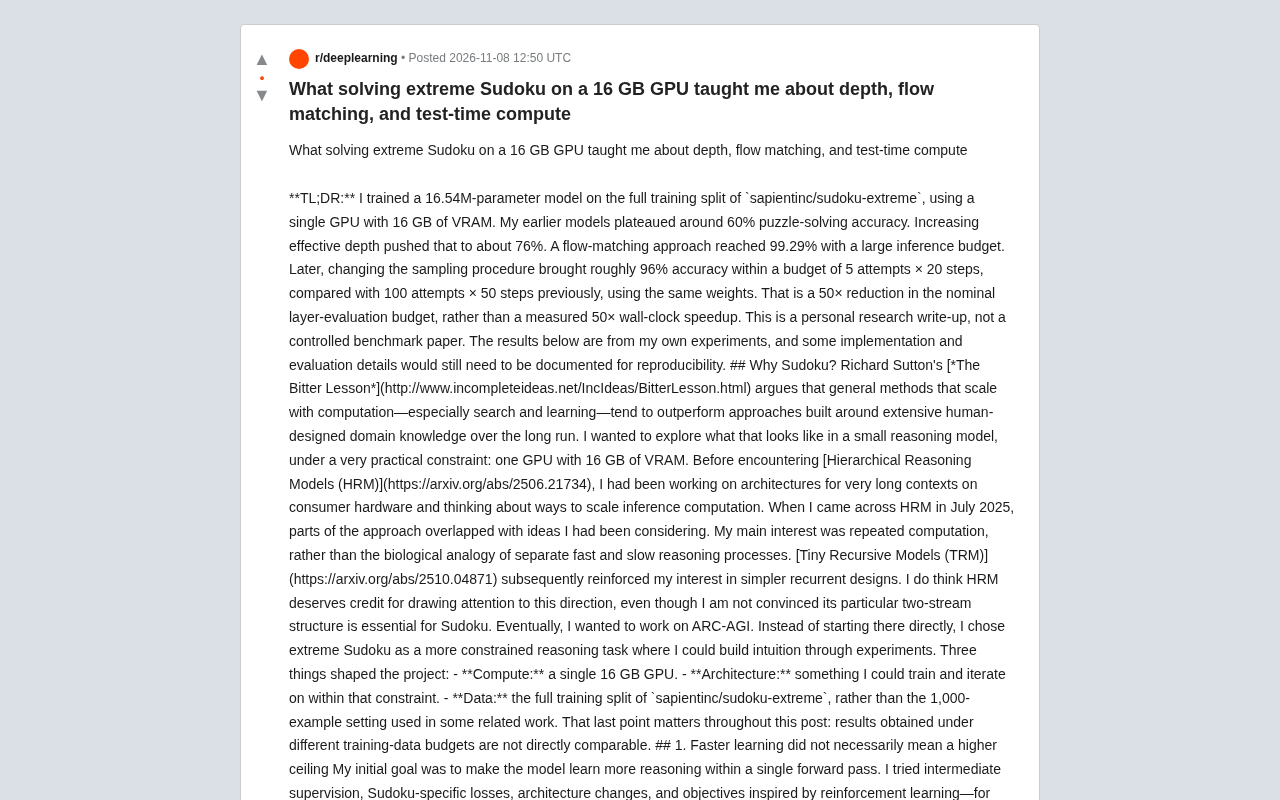
A researcher trained a 16.54M-parameter model on a 16GB GPU to solve extreme Sudoku, finding effective depth breaks the 60% plateau and flow matching with improved sampling pushes accuracy past 99% with ~50× lower layer-evaluation budget.
 Tech Frontiers
AI Agent Approval Workflows: Why Human Confirmations Always Get Mindlessly Clicked
Why do AI agent approval workflows always get mindlessly clicked? A Reddit discussion shows that separating rules from keys, low-frequency high-risk approvals, and GitHub Environments-style gates are the keys to effective approvals.