LLM Agent Probability Simulation: Why True and False Don't Add Up to 1

LLM-agent probability reports fail complementary consistency, undermining the legitimacy of interpreting simulations as beliefs.
This study tested complementary consistency in LLM-agent opinion simulations: after rewriting statements as negations and replacing p with 1-p, reports should sum to 1. But on Qwen3-4B, Llama-3.2-3B, and Gemma-3-4B the check failed universally, with average sums of 1.18 and bias 2-10x paraphrase variation, persisting across sampling and group sizes. Two populations starting from complementary states diverged after five rounds. Averaging complementary answers enforces consistency but beats the better original phrasing on only one model in the final round. Fixed-phrasing scheduling-targeting experiments show only small effects, so fixed-phrasing results cannot prove probabilities reflect stable beliefs. Complementary consistency is recommended as a standard quality-control step.
When LLM agents report probabilities in social networks, a seemingly simple mathematical consistency check—rewriting "true" as "false" and replacing each probability p with 1-p—reveals a systematic bias. A recent study on small-scale open-source models found that agents' answers to complementary questions fail to satisfy the basic requirement that they sum to 1, directly undermining the legitimacy of interpreting simulated probabilities as "beliefs."
Key Finding: Failure of the Complementary Consistency Check
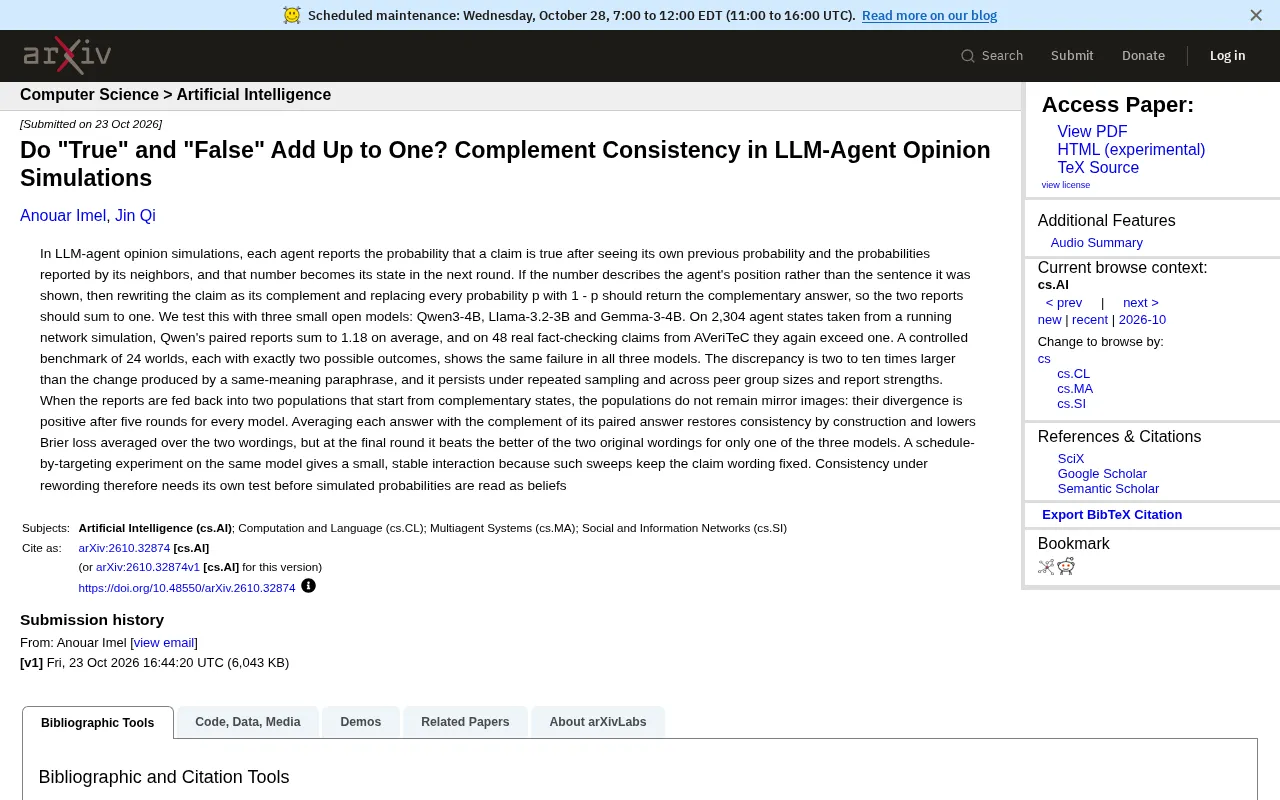
The study designed a direct test: in an LLM-agent opinion simulation, each agent sees its own probability from the previous round and the probabilities reported by its neighbors, then outputs a probability claiming that "a certain statement is true," and this number becomes the state for the next round. If this number describes the agent's stance rather than the sentence shown to it, then rewriting the statement as its negation and replacing all probabilities p with 1-p should yield complementary answers, and the two reports should sum to 1.
However, on three small open-source models (Qwen3-4B, Llama-3.2-3B, and Gemma-3-4B), this check failed universally. The 2,304 agent states extracted from running network simulations showed that Qwen's paired reports summed to an average of 1.18; on the 48 real fact-checking claims from the AVeriTeC dataset, the sums likewise exceeded 1. A controlled benchmark containing 24 worlds (each with exactly two possible outcomes) reproduced the same failure on all three models.
The magnitude of this bias is 2 to 10 times the variation produced by paraphrases with the same meaning, and it persists under repeated sampling, different peer-group sizes, and report intensities.
Brier loss is a classic scoring rule for evaluating the accuracy of probabilistic predictions, defined as the average squared error between predicted probabilities and true outcomes (0 or 1). For a binary outcome, if the model gives probability p and the actual outcome is y ∈ {0,1}, the Brier score for a single prediction is (p - y)². Lower values are better: a perfectly accurate deterministic prediction scores 0, while an "uninformative" prediction that always outputs 0.5 scores 0.25 on balanced data. Brier loss penalizes both overconfidence and underconfidence, and it is a strictly proper scoring rule—the true probability is the unique optimal strategy. In this article, the researchers use Brier loss to compare the quality of probability estimates across different phrasings and after averaging-based corrections, precisely exploiting its sensitivity to calibration quality to test whether repairing complementary consistency yields real gains rather than merely mathematical self-consistency.
Mirror-Symmetry Breaking in Simulation Dynamics
When these reports are fed back into two populations starting from complementary states, the two populations fail to maintain a mirror relationship. For each model, after five rounds, their divergence is positive. This means that even when initial conditions are perfectly symmetric, the simulation process spontaneously produces systematic deviation rather than fluctuating symmetrically around the center.
This finding raises fundamental questions about opinion-dynamics simulations based on LLM agents. If agents' probability reports are inconsistent under semantically complementary transformations, then the "consensus" or "polarization" phenomena emerging in the simulation may partly stem from the model's phrasing bias rather than from the social process being modeled.
Opinion-dynamics simulation is a modeling framework in computational social science for studying how group attitudes evolve through interaction; common models include bounded confidence, the voter model, and the DeWG model. Such simulations typically have each agent hold a continuous or discrete opinion value and exchange opinions with neighbors according to rules, updating its own stance, so as to observe whether macro patterns such as consensus, polarization, or fragmentation emerge. Traditionally, the agent's update rule is an explicit mathematical function; LLM-agent simulation replaces this function with a language model, letting the model read neighbors' opinions and then generate a new probability or stance. This substitution introduces a new validity precondition: the model's output must map stably onto the opinion variable being modeled. If the model gives systematically different numerical values for semantically equivalent but differently worded inputs, then the macro dynamics observed in the simulation may conflate language-generation bias with the pure mechanism of social influence.
Averaging Complementary Answers: The Cost of Repairing Consistency
The researchers tested a natural correction method: averaging each answer with the complement of its paired answer. This method restores complementary consistency by construction and reduces the Brier loss averaged over the two phrasings. However, in the final round, it outperforms the better of the two original phrasings on only one of the three models.
In other words, forcing consistency does not guarantee more accurate probability estimates. Averaging may correct one bias while introducing another.
Why Do Scheduling–Targeting Experiments Differ?
Scheduling–targeting experiments on the same models yield a small but stable interaction effect, because such sweeps keep the statement phrasing fixed. This suggests a key distinction: when phrasing is fixed, model outputs are fairly consistent; inconsistency is exposed only when phrasing changes while meaning stays the same. Therefore, reporting simulation results under fixed phrasing alone is insufficient to prove that simulated probabilities reflect a stable belief structure.
Scheduling–targeting experiment is a controlled experimental design used to isolate different influencing factors. In such experiments, researchers systematically manipulate "scheduling" variables (such as agent update order or interaction-round arrangement) and "targeting" variables (such as the objects or propagation paths that information is aimed at), while keeping other conditions—including the phrasing used to describe statements—fixed, in order to observe whether a particular manipulation produces a stable interaction effect. Because phrasing does not change during the sweep, consistency of model outputs is maintained, and thus the observed effect is relatively small and stable. This design logic precisely highlights the value of the complementary consistency check: the latter actively changes phrasing while keeping meaning unchanged, thereby exposing phrasing sensitivity that fixed-phrasing experiments cannot detect. Only by combining the two can one distinguish between two very different explanations: "the model is sensitive to semantic content" and "the model is sensitive to linguistic form."
Implications for LLM-Agent Simulation
This study conveys a methodological warning: before interpreting simulated probabilities as beliefs, rewrite consistency must be tested separately. Specific recommendations include:
- Incorporate complementary consistency as a standard diagnostic metric in agent simulations;
- Conduct phrasing-robustness checks on key conclusions rather than relying on a single formulation;
- Interpret emergent group dynamics in simulations with caution, distinguishing model artifacts from social mechanisms;
- When reporting metrics such as Brier loss, also disclose performance differences across phrasings.
The complementary consistency check is simple, cheap, and informative, and it should become a standard quality-control step for LLM-agent opinion simulations. Ignoring it may lead to misreading the model's linguistic phrasing bias as a simulation of human beliefs.
One-line Summary
LLM-agent probability reports fail complementary consistency, undermining the legitimacy of interpreting simulations as beliefs.
Paragraph Summary
This study tested the complementary consistency of probabilities reported by LLM agents in opinion simulations: after rewriting a statement as its negation and replacing probability p with 1-p, the two reports should sum to 1. However, on the three small open-source models Qwen3-4B, Llama-3.2-3B, and Gemma-3-4B, this check failed universally, with average sums reaching 1.18; the bias magnitude is 2 to 10 times the variation produced by paraphrases with the same meaning, and it persists under repeated sampling and different group sizes. Two simulated populations starting from complementary states no longer maintain a mirror relationship after five rounds, with positive divergence. Although averaging complementary answers can enforce consistency, only on one model does it yield a final-round Brier loss better than the better original phrasing. Scheduling–targeting experiments show only a small interaction effect because phrasing is fixed, suggesting that simulation results under fixed phrasing are insufficient to prove that probabilities reflect stable beliefs. The study recommends making complementary consistency a standard quality-control step for LLM-agent opinion simulations.
Related articles

A New Paradigm for Text Editing in Compose: TextFieldState Replaces the Old API
Jetpack Compose introduces the TextFieldState API to fix dropped characters and cursor jumps from async input. The old value/onValueChange callbacks will be deprecated in 1.13. This article covers InputTransformation, OutputTransformation, four state hoisting patterns, and new formatted text editing capabilities.

Remote Compose: A New Document-Driven Paradigm for Cross-Platform UI on Android
Remote Compose transmits compact binary documents instead of screen pixels, enabling efficient UI rendering on remote surfaces like Wear OS and widgets. This article covers its document creation API, expression animations, size optimization techniques, and Wear OS progress.

How Crashlytics Eliminates Android Memory and Responsiveness Issues
Through the Chroma Clip case study, this article explains how Firebase Crashlytics uses Application Exit Info, Profiling Manager, GWP ASAN, and ARM MTE to pinpoint ANRs, OOMs, memory limit terminations, and native memory corruption—solving the challenge of stack traces that don't point to the real culprit.