LLM Agents Simulate Emotional Responses: Capability and Bias Coexist

Hierarchical prompting lets LLM agents reproduce population emotional patterns, but anger expression shows systematic deficiencies.
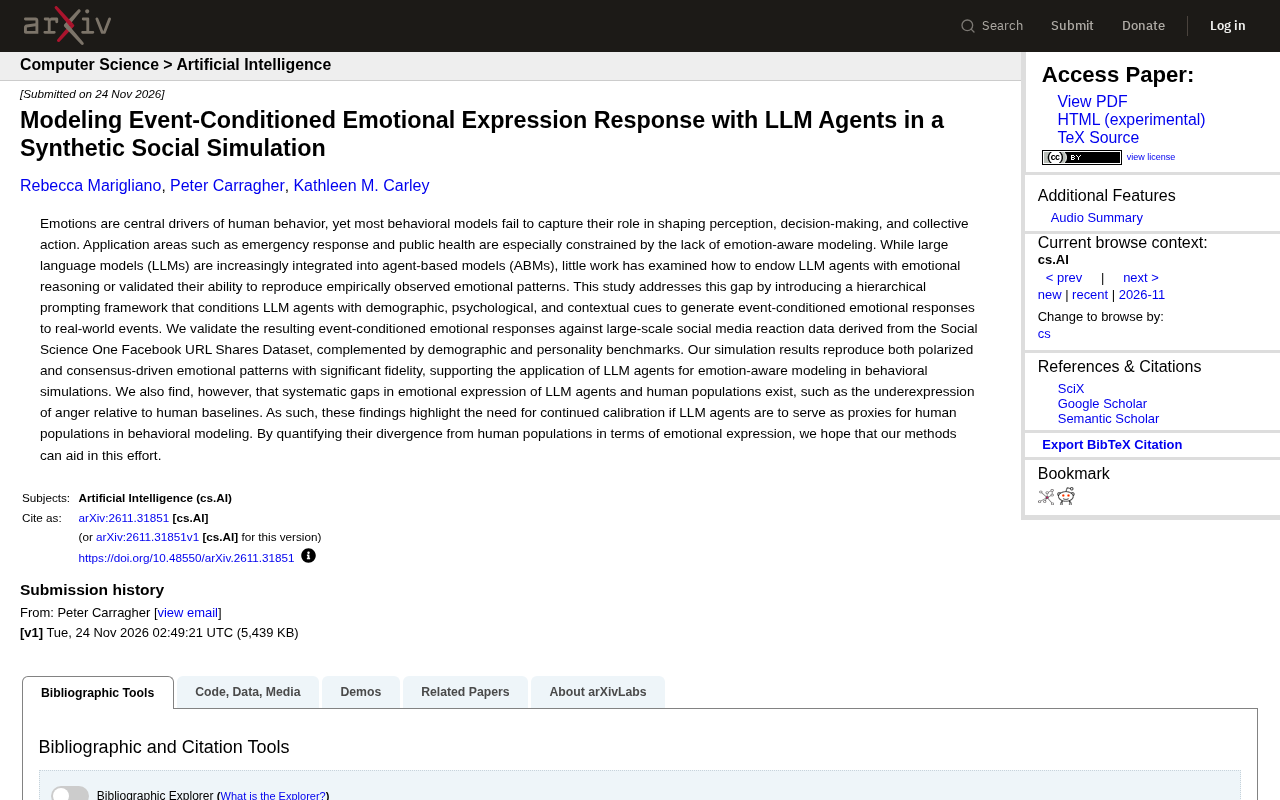
This study proposes a hierarchical prompting framework that encodes demographic features, psychological traits, and event contexts into prompts, enabling LLM agents to generate conditioned emotional responses to real events, cross-validated against Social Science One's Facebook URL Share data and demographic/personality baselines. Results show agents can reproduce both polarized and consensus-driven emotional patterns with notable fidelity, supporting applications in emergency response and public health. However, systematic biases emerge—agent anger expression is significantly lower than human baselines. The authors stress that continuous calibration is essential before LLM agents can serve as reliable proxies for human populations.
Large language models (LLMs) are increasingly being embedded into agent-based models (ABMs), but how to equip these agents with emotional reasoning capabilities and verify whether they can reproduce the emotional patterns of real populations has remained an open question. A recent study uses a hierarchical prompting framework to inject demographic, psychological, and situational cues into LLM agents, enabling them to generate emotionally conditioned responses to real-world events, and cross-validates these against large-scale social media data.
Hierarchical Prompting Framework: Letting Agents "Feel" Their Responses
The core method proposed by the study is a hierarchical prompting framework. Rather than simply asking the model "how do you feel," it encodes demographic features (such as age and gender), psychological traits (such as personality baselines), and specific event contexts layer by layer into the prompt, guiding LLM agents to generate emotional expressions tied to particular events. This conditional design ensures that agent responses are not generic but carry clear social identities and situational anchors.
The validation data for this framework comes from the Social Science One Facebook URL Share dataset, supplemented by demographic and personality baselines. This means the researchers not only tested whether agents could produce emotions, but also compared their outputs against the reactions of large-scale real populations on social media.
Agent-Based Model (ABM) is a bottom-up computational modeling approach: researchers define behavioral rules and interaction mechanisms for a large number of heterogeneous individuals (agents), then observe through simulation how macro-level social phenomena emerge from micro-level interactions. Agents in traditional ABMs typically rely on hand-coded rules or simplified utility functions, making it difficult to express complex cognitive processes such as language and emotion. Using LLMs as the "decision kernel" of agents allows them to understand situations and generate responses in natural language, thereby overcoming the expressive limitations of rule-driven approaches—but it also introduces new challenges around controllability, reproducibility, and validation cost.
Reproducing Polarization and Consensus: Notable Simulation Fidelity
The simulation results demonstrate significant fidelity in reproducing emotional patterns. Agents are able to generate emotional response patterns that include both polarized opposition and consensus-driven reactions, aligning with structural features found in real data. This finding supports the feasibility of using LLM agents for emotion-aware behavioral simulation, particularly in domains with urgent needs for emotional modeling, such as emergency response and public health.
Traditional behavioral models often struggle to capture the role of emotion in perception, decision-making, and collective action, and this capability of LLM agents offers a new pathway to fill that gap.
Affective polarization refers to the increasing emotional antagonism between "in-group" and "out-group" members, typically manifested as negative emotions toward the opposing camp significantly outweighing positive emotions. In contrast, the "consensus-driven" pattern refers to the convergence of emotional responses across different populations on specific events. Both tend to exhibit distinctive structural distributions in social media data, and are therefore often used as criteria for testing whether a simulation "looks like a real population": if the emotional distributions generated by agents can simultaneously reproduce both polarization and consensus structures, it indicates that they capture not only average sentiment levels but also the way emotions diverge across social groups.
Insufficient Anger Expression: Systematic Bias Still Requires Calibration
The study also reveals systematic gaps that cannot be overlooked. LLM agents deviate from real populations in emotional expression—for example, anger expression is notably lower relative to the human baseline. This bias is not random noise but structural—meaning that directly using LLM agents as proxies for human populations could produce misleading conclusions in scenarios involving strong negative emotions.
The authors therefore emphasize that continuous calibration is a necessary prerequisite. By quantifying the divergence between agents and humans in emotional expression, the study provides an actionable measurement basis for subsequent calibration efforts.
The "human baseline" here refers to the reference distribution of emotional expression statistically derived from real social media data, serving as the comparison standard for evaluating agent bias. It should be noted that emotional expression on social media is itself not an unbiased sample of a population's true emotions: platform user composition, posting motivations, and expressive norms all introduce selection bias. Therefore, when comparing LLM outputs against social media baselines, bias may originate from both the model side and the data side. Identifying structural biases such as insufficient anger expression helps calibrate models while also prompting researchers to distinguish between "the model doesn't behave like humans" and "humans don't express themselves this way on such platforms."
The Significance of Multi-Source Cross-Validation
The study's validation strategy is noteworthy: it compares simulation outputs against Facebook URL Share data, demographic baselines, and personality baselines from multiple sources rather than relying on a single data source. This cross-validation approach enhances the credibility of the conclusions and makes the bias findings more persuasive.
Outlook: How Much Calibration Is Needed to Proxy Humans?
LLM agents have demonstrated potential in emotion-aware modeling, but systematic biases such as insufficient anger expression remind us that their qualification as proxies for human populations is not yet fully established. The key to future work lies in establishing more refined calibration mechanisms to bring agents' emotional distributions closer to real populations. For application scenarios such as emergency response and public health, this calibration process directly determines whether simulation conclusions can support real-world decision-making.
One-line Summary
A hierarchical prompting framework enables LLM agents to reproduce population emotional patterns, but systematic deficiencies exist in anger expression.
Paragraph Summary
This study proposes a hierarchical prompting framework that encodes demographic features, psychological traits, and event contexts layer by layer into prompts, enabling LLM agents to generate conditioned emotional responses to real-world events, cross-validated against Social Science One's Facebook URL Share data along with demographic and personality baselines. Results show that agents can reproduce both polarized opposition and consensus-driven emotional patterns with notable simulation fidelity, supporting their application potential in areas such as emergency response and public health; however, systematic biases are also exposed, with agent anger expression significantly lower than the human baseline. The authors emphasize that continuous calibration is a necessary prerequisite for LLM agents to become reliable proxies for human populations, and note that quantifying divergence can provide a measurement basis for subsequent calibration.
Related articles

Nothing CMF Buds 2A Drops to $17.89 on Black Friday: A New Low for ANC Earbuds
Nothing CMF Buds 2A wireless earbuds Black Friday deal: just $17.89 on Amazon, about $11 off retail and a record low. ANC earbuds at an entry-level price.

When AI Creation Gets Accused of "Spitting": Hacker News Heats Up Over the Glaude Controversy
A Hacker News post, "Spitting in the Face of Glaude," sparks debate on AI creation transparency and attribution ethics. This analysis examines the blurred creator identity behind the controversy and offers practical advice for AI content production.

Akai Embraces Custom Firmware: MPC Sample 1.4 Lets Users AI-Program Their Sampler
Akai embraces the modding community with MPC Sample 1.4 firmware, supporting vibe-coded custom firmware and effects. We analyze the impact of this open strategy on music hardware and AI-assisted programming.