LLM Agents Take On Pokémon Battles: A New Experiment in AI Agent Gameplay

LLM Agents plug into Pokémon Showdown battles to test strategic ability in incomplete-information games.
A Hacker News project has LLM Agents playing turn-based Pokémon battles on Pokémon Showdown. Because the game involves hidden information and randomness and cannot be solved by brute-force search, it is an ideal testbed for agent planning and strategic depth. The project is still early-stage, with attention on cross-turn tactical coherence and stability.
Large language models are stepping out of the chat box and into game worlds that demand strategy and real-time decision-making. A project recently discussed on Hacker News has LLM Agents diving straight into Pokémon Showdown, attempting to compete against humans or other AIs in turn-based competitive battles.
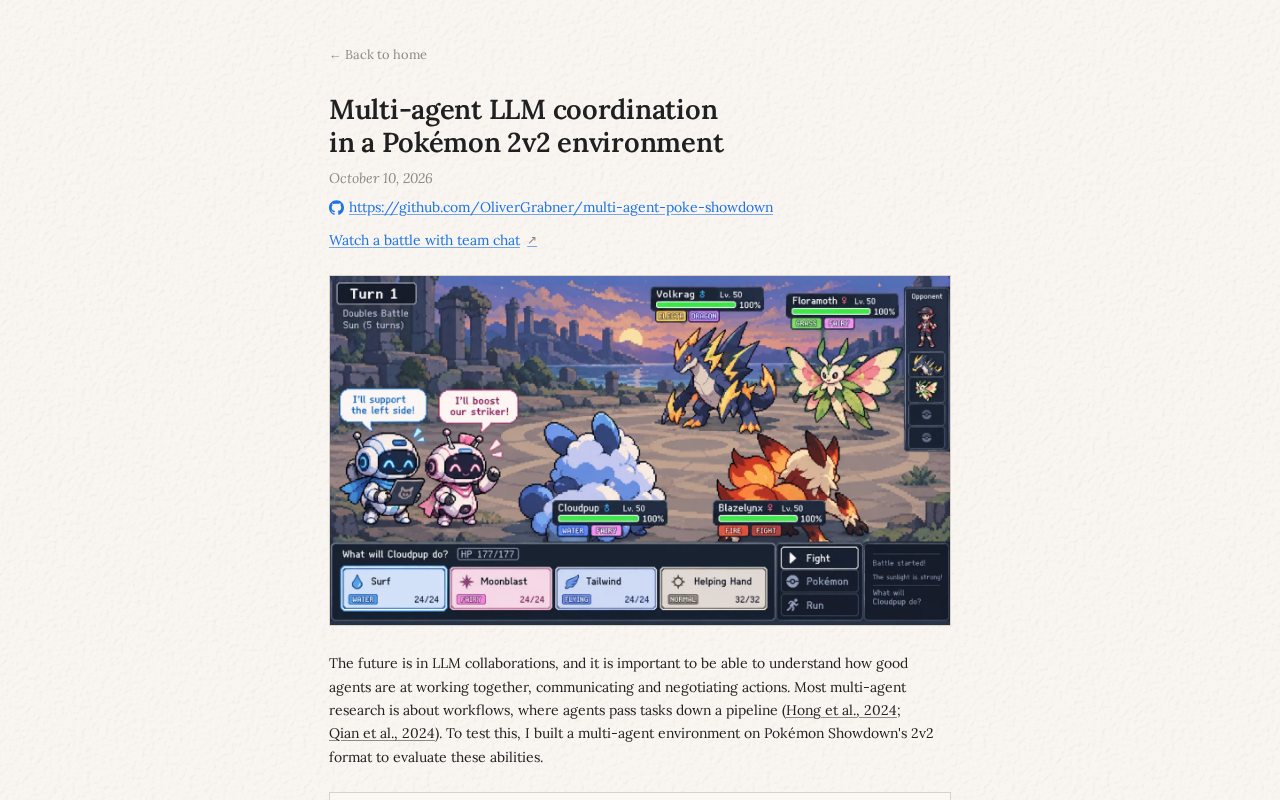
Why Pokémon battles are a great testbed for AI agents
Pokémon battles may look child-friendly, but they are in fact a strategy environment with incomplete information and extremely deep layers of gameplay. Every turn, players must weigh type matchups, speed tiers, HP management, and switching timing, while also guessing the opponent's team composition and intentions. This composite decision-making—part "mind reading," part risk assessment—is a natural exam room for LLM Agents.
Unlike chess, Pokémon battles involve hidden information and probabilistic elements. A model cannot win by brute-force search; it must rely on abstractions drawn from battle experience and commonsense reasoning. This makes it an ideal proving ground for evaluating an agent's planning ability and strategic depth.
In Pokémon battles, "incomplete information" means both sides can only see the revealed moves and items of Pokémon that have already appeared; the unrevealed team composition, EV spreads, and held items remain invisible. "Probabilistic elements" show up in random events such as move accuracy, critical hits, and status condition triggers. This differs fundamentally from fully observable, deterministic games like chess or Go: board games can use Monte Carlo tree search combined with precise game-tree expansion, whereas Pokémon battles cannot enumerate the hidden state space. The model must perform Bayesian-style intent inference based on uncertain information and optimize for expected value rather than deterministic outcomes. This also explains why the scenario is closer to real-world decision problems such as business negotiation and security adversarial settings.
How an agent "plays" a Pokémon battle
The core idea behind such projects is to convert the battle interface into a text state that an LLM can understand: the current Pokémon on both sides of the field, HP, known moves, historical turn records, and so on. After reading the state, the agent outputs action commands (which move to use, whether to switch), and a script relays those commands back to the battle platform for execution.
The level of discussion on Hacker News (12 points, 4 comments) indicates that this direction is still in an early exploratory stage. Community attention centers on whether agents can handle long-horizon strategy, avoid repeating mistakes, and maintain stable performance in the face of randomness. Some commenters point out that the real difficulty lies not in single-step decisions but in tactical coherence across turns.
Pokémon Showdown is an open-source Pokémon battle simulation platform that supports programmatic battles via a WebSocket interface and provides an official pokemon-showdown npm package as well as client libraries for Python and other languages. Because its protocol is public and scriptable, it has become a common foundation for AI researchers testing battle agents: developers do not need a graphical interface—they only need to send and receive JSON-formatted battle messages (such as |request| and |turn|) according to the protocol, and the agent can compete against humans or other bots. This design of "text-based protocol + renderless battles" aligns perfectly with the strengths of LLMs in processing structured text.
Gauging the limits of LLM Agents through game battles
Having models play games is nothing new, but Pokémon battles offer a structured environment that is closer to real-world decision-making. They require the model to simultaneously possess three capabilities: rules understanding, opponent modeling, and risk trade-offs—precisely the weakest links in current agent systems.
The value of such experiments goes beyond entertainment. The pipeline of state parsing, action planning, and feedback correction in battles is highly isomorphic to practical scenarios such as automated operations and customer-service decision-making. Using games as a low-cost strategy training ground is a pragmatic path for evaluating and improving an agent's reasoning chain.
"Opponent modeling" is a core concept in game theory and multi-agent systems. It refers to an agent inferring an opponent's strategy type, preferences, and likely next actions from the opponent's historical behavior, and adjusting its own strategy accordingly. In Pokémon battles, opponent modeling manifests concretely as: inferring the opponent's team composition from their switching habits, assessing their remaining threats based on revealed moves, and then deciding whether to attack aggressively, wear them down, or bait a switch. The current shortcoming of LLM Agents is that they typically rely on implicit inference from the battle record within the context window and lack an explicit belief-state maintenance mechanism. In long games, they easily "forget" early clues or overfit to recent turns—this is the technical root of why the community emphasizes "tactical coherence across turns."
Community perspectives and what to watch next
Publicly available information is currently limited, and project details remain to be disclosed further. But one thing is certain: attempts to bring LLM Agents into adversarial game environments will only increase. For developers interested in AI applications and agent research, open-source battle platforms like Pokémon Showdown provide a low-barrier, fast-feedback experimental foundation.
Directions worth watching include: the strategic stability of agents in long games, the efficiency of their use of hidden information, and whether multi-agent battles against each other can catalyze emergent tactical evolution.
One-line Summary
LLM Agents plug into Pokémon Showdown battles to test their strategic ability in games of incomplete information.
Paragraph Summary
The article introduces a project discussed on Hacker News that has large language model agents play turn-based Pokémon battles directly on the Pokémon Showdown platform. It notes that Pokémon battles involve hidden information and probabilistic elements and cannot be won by brute-force search, making them an ideal environment for testing an agent's planning and strategic depth. The core architecture feeds the battle state as text into the model and relays action commands back to the platform for execution. The project is still in its early stages, with community attention focused on tactical coherence across turns, avoiding repeated mistakes, and stability under randomness. The author argues that such experiments are highly isomorphic to practical scenarios like automated operations and customer-service decision-making, offering a pragmatic, low-cost path for evaluating and improving an agent's reasoning chain.
Related articles

iPhone Duo Hands-On: Is the $2,000 Small-Screen Foldable Worth It?
YouTube's Allison shares her iPhone Duo hands-on: dual-screen multitasking doubles efficiency, great video viewing, nice matte finish—but thick body, small outer screen, and a $2,000 luxury price.

Sentry's Ad Cracks Up Developers: Can On-call Actually Be Fun?
Sentry's ad short film taps into developers' on-call anxiety, using humorous dialogue to showcase its observability platform—errors, logs, traces, metrics, replays, and releases in one place.

LLM App Getting Worse With Every Change? Build an Effective Evaluation System in Three Steps
How do you know if your LLM app is getting better or worse? A Reddit-based guide to test sets, automated regression evaluation, LLM-as-judge scoring, and structured agent tracing.