LLM Application Development Interview Crash Course: High-Frequency Topics on LLMs, RAG, and Agents

LLM application development interviews now focus on principles and engineering execution, requiring systematic preparation along a knowledge tree.
The article outlines the assessment system for LLM application development interviews: the focus has shifted from "can call an API" to understanding principles and engineering execution. It covers LLM fundamentals (Transformer, tokenizer, inference parameters, KV Cache), Prompt and context engineering, the full RAG pipeline (chunking, embedding, hybrid retrieval, reranking, evaluation), Agents and tool calling (loop prevention, invalid call control, memory design), and AI coding workflows and architecture design. It emphasizes solid backend engineering skills and recommends building a knowledge tree in the order of LLM fundamentals → Prompt → RAG → Agents → engineering, preparing a presentable project case for each stage, and replacing concept recitation with trade-offs and lessons from pitfalls.
Why LLM Application Development Interviews Require Systematic Preparation
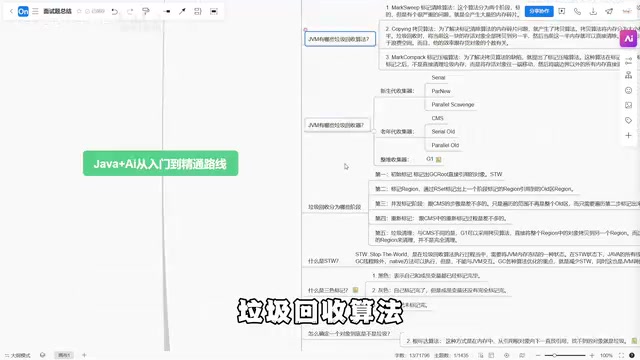
Interviews for LLM application development roles are shifting from "can call an API" to "understands the principles, can ship to production, and has engineering thinking." A technical interview crash-course resource circulating on Bilibili shows that the current scope covers LLM fundamentals, Prompt engineering, RAG, Agents, tool calling, and follow-up questions on engineering projects. The content also touches on high-frequency Java backend questions and AI coding practices, reflecting that companies value candidates' overall ability to embed LLM capabilities into existing systems.
LLM Fundamentals: The First Hurdle in the Interview
The fundamentals section typically tests the Transformer architecture, attention mechanisms, tokenizer principles, context window limits, and the impact of inference parameters (such as temperature and top_p). Interviewers want candidates to understand why the model outputs what it does, not just how to call an interface. A grasp of concepts like KV Cache, positional encoding, model fine-tuning, and distillation demonstrates awareness of inference costs and deployment constraints.
KV Cache is a key optimization mechanism in the Transformer inference phase. During autoregressive generation, each new token requires attention computation over all previous tokens; without caching, the computation grows quadratically with sequence length. KV Cache stores the computed Key and Value tensors for each layer and reuses them in subsequent steps, reducing complexity to linear. The cost is that memory usage grows linearly with context length and batch size, so in long-context and high-concurrency scenarios KV Cache is often the memory bottleneck, which has spurred compression and scheduling techniques such as PagedAttention and MQA/GQA. In interviews, being able to clearly explain the trade-off of "using memory to save computation" is usually more appreciated than reciting definitions.
Positional encoding addresses the fact that self-attention itself is insensitive to order. Early approaches used sinusoidal positional encoding and learnable absolute positional encoding; modern large models mostly adopt RoPE (Rotary Position Embedding), which injects relative position information by rotating vectors and supports a degree of length extrapolation. Positional encoding directly determines how well the model handles long texts, and it is also important background for understanding why context window limits exist.
Prompt Engineering: From Tricks to Methodology
The Prompt section is no longer just about "writing a good prompt." The Context Engineering mentioned in the resource shows that interviewers care about how to systematically design context, including instruction layering, few-shot example selection, output format constraints, and writing tool descriptions. ToolsRegParameter (tool registration and parameter design) is also a high-frequency follow-up topic: how to make the model reliably select the correct tool and pass valid parameters is directly tied to Agent reliability.
Context Engineering is a further abstraction of Prompt Engineering: instead of optimizing a single prompt, it systematically designs all the information that enters the model's context window, including system instructions, conversation history, retrieved documents, tool definitions, examples, and output constraints. The core problem is priority allocation and truncation strategy within a limited token budget, while ensuring that the information from different parts does not conflict. It is closely related to RAG and Agent memory management, because the context window is both a resource and a constraint. In interviews, being able to explain "which information must go into context, which should be externalized for retrieval, and how to make trade-offs when conflicts arise" demonstrates a more mature engineering perspective than prompt tweaking.
RAG: The Core Pipeline of Retrieval-Augmented Generation
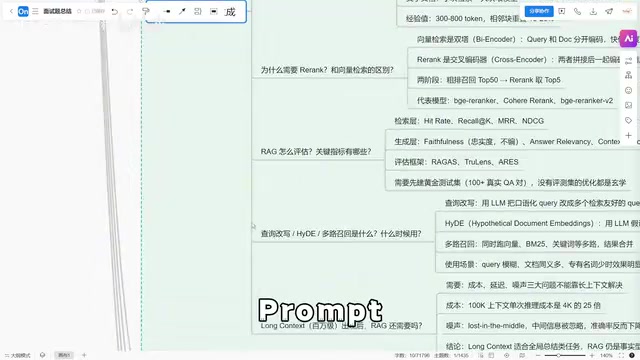
RAG is a major focus in application development interviews. Typical questions include document chunking strategies, embedding model selection, hybrid vector and keyword retrieval, the trade-off between recall and precision, the necessity of reranking, and how to evaluate RAG performance. Engineering follow-ups often involve knowledge base updates, permission filtering, and citation traceability. Candidates need to clearly explain the trade-offs at each stage rather than piling up component names.
Rerank sits after retrieval and before generation. Vector retrieval pursues high recall but has limited precision, often retrieving dozens of candidates at once; a reranking model (such as a Cross-Encoder architecture) performs finer relevance scoring on "query–document" pairs, then selects the Top-K to send to the LLM. It can significantly improve the quality of documents fed into context, at the cost of additional inference latency and expense. A practical pipeline is usually "vector recall + keyword recall → fusion → rerank → truncation"; whether to introduce reranking depends on the trade-off between accuracy and latency, which is also a trade-off point interviewers often probe.
Hybrid retrieval refers to using both dense vector retrieval and sparse keyword retrieval (such as BM25). The former excels at semantic similarity, while the latter is more sensitive to proper nouns, identifiers, and precise terminology; fusing the two can mitigate the blind spots of either approach. Common practices include weighted fusion after score normalization or using RRF (Reciprocal Rank Fusion).
Agents and Tool Calling: Avoiding Infinite Loops and Invalid Calls
The Agent section is the most differentiating part. The resource explicitly raises two practical problems: how to avoid Agent infinite loops and invalid calls, and how to design Agent memory. The former requires timeout control, maximum step limits, state detection, and failure retry strategies; the latter involves short-term conversation memory, long-term memory storage and retrieval, and memory compression. On tool calling, the clarity of function descriptions, parameter validation, and error feedback mechanisms are all entry points interviewers use to assess engineering experience.
An Agent's short-term and long-term memory need to be designed separately. Short-term memory consists of the conversation and intermediate steps within the current task, usually placed directly in the context window; limited by tokens, it requires rolling truncation or summarization compression. Long-term memory is persisted to external storage (vector databases, databases, knowledge graphs) and injected after retrieval by relevance. Common memory compression methods include summarizing history, extracting structured facts, and discarding low-value turns. Design must consider write timing, retrieval recall quality, and privacy boundaries; otherwise, memory can introduce noise and mislead subsequent decisions.
Engineering Project Follow-ups: AI Coding and Architecture Design
Interviewers will ask follow-up questions about the AI coding workflows and best practices used by the team, such as human review after code generation, test coverage, and security boundaries. The architecture design of AI applications involves model service orchestration, degradation and circuit breaking, cost control, and observability. The Java high-frequency questions listed alongside (JVM, concurrency, Spring, MySQL, Redis, distributed systems, and middleware) show that LLM application development does not exist independently of backend engineering; candidates still need solid system design skills.
Preparation Strategy: Understand First, Then Memorize
The resource's advice is to "explain it once, then record it once with a mind map," combined with resume optimization to form a closed loop. For candidates, a more effective path is to build a knowledge tree in the order of "LLM fundamentals → Prompt and context → RAG → Agents and tool calling → engineering," and prepare a presentable project case for each stage. In interviews, being able to clearly explain trade-offs and lessons learned from pitfalls is more persuasive than reciting concepts.
Common Follow-up Questions and Answer Approaches
- How do you prevent Agent infinite loops? Answer on three levels: step limits, loop detection, and human fallback.
- What if RAG recall is inaccurate? First identify whether the problem is chunking, embedding, or query rewriting, then discuss hybrid retrieval and reranking.
- How do you ensure quality in AI coding? Emphasize the review process, tests first, and human confirmation for sensitive code.
- How do you handle overly long context? Discuss compression, summarization, segmented retrieval, and priority retention.
One-line Summary
LLM application development interviews have shifted toward understanding principles and engineering execution, requiring systematic preparation along a knowledge tree.
Paragraph Summary
The article outlines the assessment system for LLM application development interviews: the focus has shifted from "can call an API" to understanding principles and engineering execution. The scope covers LLM fundamentals (Transformer, tokenizer, inference parameters, KV Cache), Prompt and context engineering, the full RAG pipeline (chunking, embedding, hybrid retrieval, reranking, evaluation), Agents and tool calling (infinite loop prevention, invalid call control, memory design), and AI coding workflows and architecture design. The article emphasizes that candidates need solid backend engineering skills and recommends building a knowledge tree in the order of "LLM fundamentals → Prompt → RAG → Agents → engineering," preparing a presentable project case for each stage, and replacing concept recitation with trade-offs and lessons from pitfalls.
Related articles

Animal Conservationist Maya Higa's Advice to Her 9-Year-Old Self
Animal conservationist Maya Higa shares advice to her 9-year-old self, core values, and a philosophy of observing nature in a National Geographic interview, discussing Jane Goodall and Bill Nye's influence—offering transferable inspiration for tech content creators.

EACL 2027 Decisions Imminent: The Wait and Anxiety Trending on Reddit
EACL 2027 decisions are imminent, and a Reddit decision thread has drawn collective attention from authors. This article analyzes the waiting anxiety during conference decision periods, the review decision mechanism, and how authors should plan resubmission and revision after decisions are released.

Meta Expands Instagram AI Age Detection Globally: Using Algorithms to Catch "Fake Adult" Teens
Meta expands Instagram's AI age detection globally—even teens who enter adult birthdates can be flagged via behavioral cues. We analyze how it works, the regulatory context, and controversies.