LLM Moral and Emotional Tone Auditing: Seeking Expert Feedback

An LLM moral and emotional tone audit publicly seeks expert feedback, exploring evaluation frameworks and challenges for tone orientation.
The article introduces an LLM audit study publicly seeking expert feedback in a Reddit community, notable for treating model moral stance and emotional tone as independent evaluation dimensions rather than byproducts of output style. It notes that such audits are harder than conventional capability evaluation because model outputs vary with wording, context, and prompting, and because auditors' own value judgments seep into the process. By openly soliciting input, the researchers aim to strengthen methodological credibility through peer review and expose disagreements early in indicator definition, sample selection, and interpretation. Since the original material does not disclose specific methods or conclusions, the article discusses only the framework and significance, noting that whether tone can be measured stably, whether results can guide development, and who will accept the conclusions remain unanswered.
LLM Moral and Emotional Tone Auditing: Seeking Expert Feedback
Recently, a Reddit community saw the release of an audit study on the moral and emotional tone orientation of large language models (LLMs), with the researchers publicly seeking expert feedback. This development is worth noting: it pushes the question of "what the model says" to the level of "from what moral stance and emotional disposition it says it."
Audit Subject: The Overlooked Dimension of Tone
Evaluation of LLMs has long focused on factual accuracy, safety compliance, and reasoning ability, while moral stance and emotional tone are often treated as byproducts of output style. This audit singles out these dimensions, meaning the researchers treat the value orientations and emotional coloring in model outputs as independent variables to examine, rather than incidental observations.
It should be noted that the original material only disclosed the audit's topic and the intent to seek feedback; it did not reveal the specific audit methodology, sample size, or conclusion data. Therefore, this article does not address specific evaluation results and only discusses the framework and significance of this research direction.
Emotional Tone and Moral Foundations Theory
Emotional tone typically refers to the tendency of model outputs along emotional valence (positive–negative) and arousal (calm–intense), which can be characterized through sentiment analysis tools or human ratings. Moral stance is more complex, often operationalized through Moral Foundations Theory, which divides moral judgment into dimensions such as care/harm, fairness/cheating, loyalty/betrayal, authority/subversion, and sanctity/degradation, and has led to measurement tools such as the Moral Foundations Dictionary.
Applying these two frameworks to LLM auditing means mapping model outputs into a comparable dimensional space, thereby observing whether the same question shows systematic tone shifts under different prompts. This differs from simply checking whether outputs contain harmful content; it focuses on the more subtle layer of "in what tone it is expressed." It should be noted that these frameworks originate from research on human moral psychology, and their applicability when transferred to model outputs still requires testing.
Why "Tone Orientation" Is Hard to Audit
Auditing moral and emotional tone is trickier than conventional capability evaluation. On one hand, a model's answer to the same question may present different moral stances depending on wording, context, or prompting method, making stability difficult to guarantee; on the other hand, evaluators' own value judgments seep into the audit process, making "neutrality" itself a stance that needs to be scrutinized.
This also explains why the researchers are publicly seeking expert feedback. In the absence of a unified benchmark, peer review of methodology is more urgent than the release of results: how audit standards are defined, by whom, and how auditor bias is avoided all require external input.
Value Alignment and Auditor Bias
One root cause of the difficulty in moral tone auditing is that LLM "value alignment" is not a single objective. Alignment typically includes multiple dimensions such as helpfulness, harmlessness, and honesty, and these dimensions are in tension: overemphasizing harmlessness may make models tend toward evasion or moralizing, while overemphasizing helpfulness may weaken moral constraints. If auditors set standards from only one dimension, they will unconsciously amplify that dimension's weight.
A deeper issue lies in "auditor bias." Auditors' own cultural backgrounds, political positions, and moral intuitions seep into indicator design and sample annotation, making so-called "neutrality" a stance that needs to be reflected upon. A common practice in the social sciences is to introduce multiple independent annotators and report inter-annotator agreement (such as Cohen's kappa) to quantify the degree of disagreement in subjective judgments. For moral tone auditing, similar mechanisms can to some extent expose rather than eliminate bias, which is precisely the methodological significance of publicly seeking expert feedback.
The Value of Expert Feedback
The practice of publicly seeking feedback is itself a reinforcement of audit credibility. For research involving values, a methodology designed behind closed doors by a single team easily leaves blind spots. Bringing in domain experts can expose disagreements early in areas such as indicator definition, sample selection, and interpretation of conclusions.
Judging from the format of the community discussion, this is more of an open methodological consultation than a release of results. For researchers concerned with LLM alignment, this kind of process material provides an observation window: how the industry is building a discussable framework for model attributes that are difficult to quantify.
Open Questions
This type of audit ultimately needs to answer questions at several levels: whether tone orientation can be measured stably, whether measurement results can guide model development, and who will accept the audit conclusions. The original material has not yet provided answers to these questions, but the researchers' posture of proactively opening their methodology to scrutiny provides a starting point for further discussion. More details await disclosure by the research team.
Related articles
 Tech Frontiers
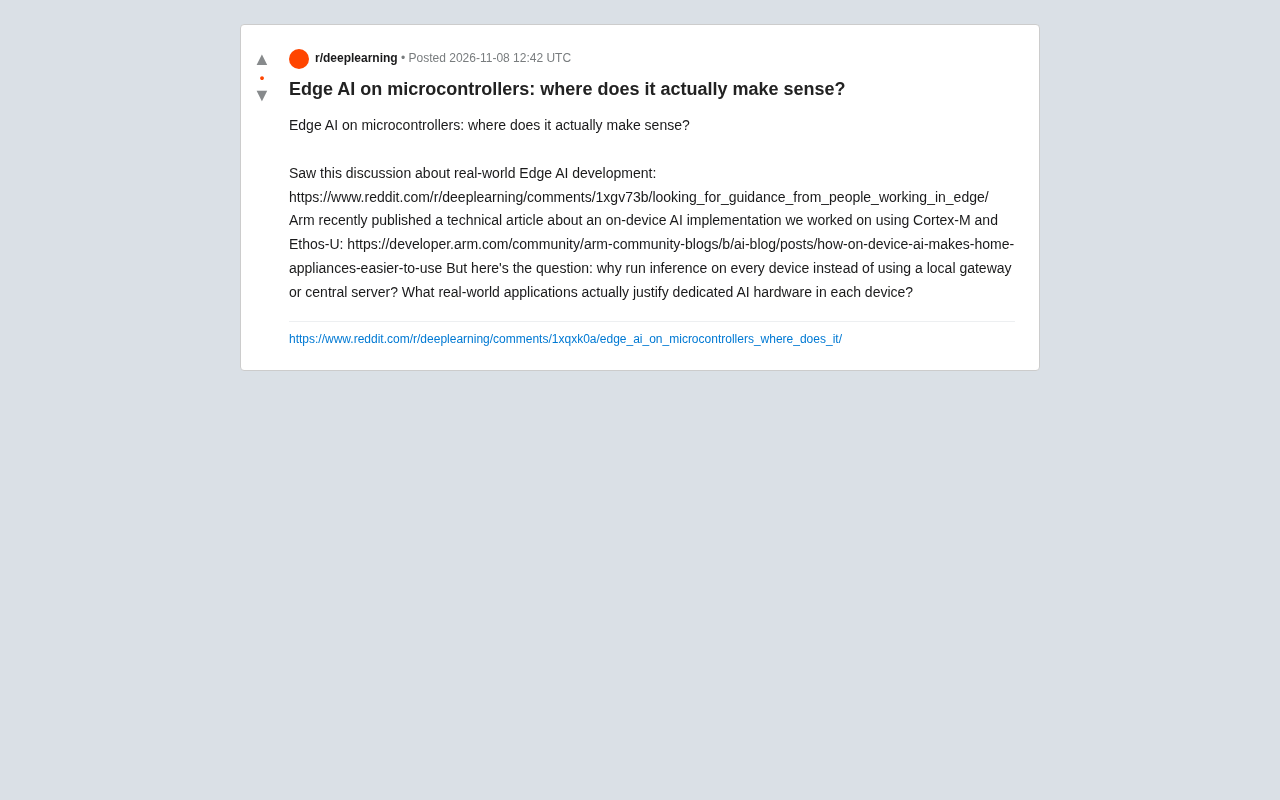
Edge AI on Microcontrollers: When Is It Actually Worth Deploying?
Drawing on Reddit discussions and Arm case studies, this article analyzes the real-world use cases for edge AI on microcontrollers: when each device needs independent inference, when a gateway or cloud is more reasonable, and the costs and boundaries of specialized hardware.
 Tech Frontiers
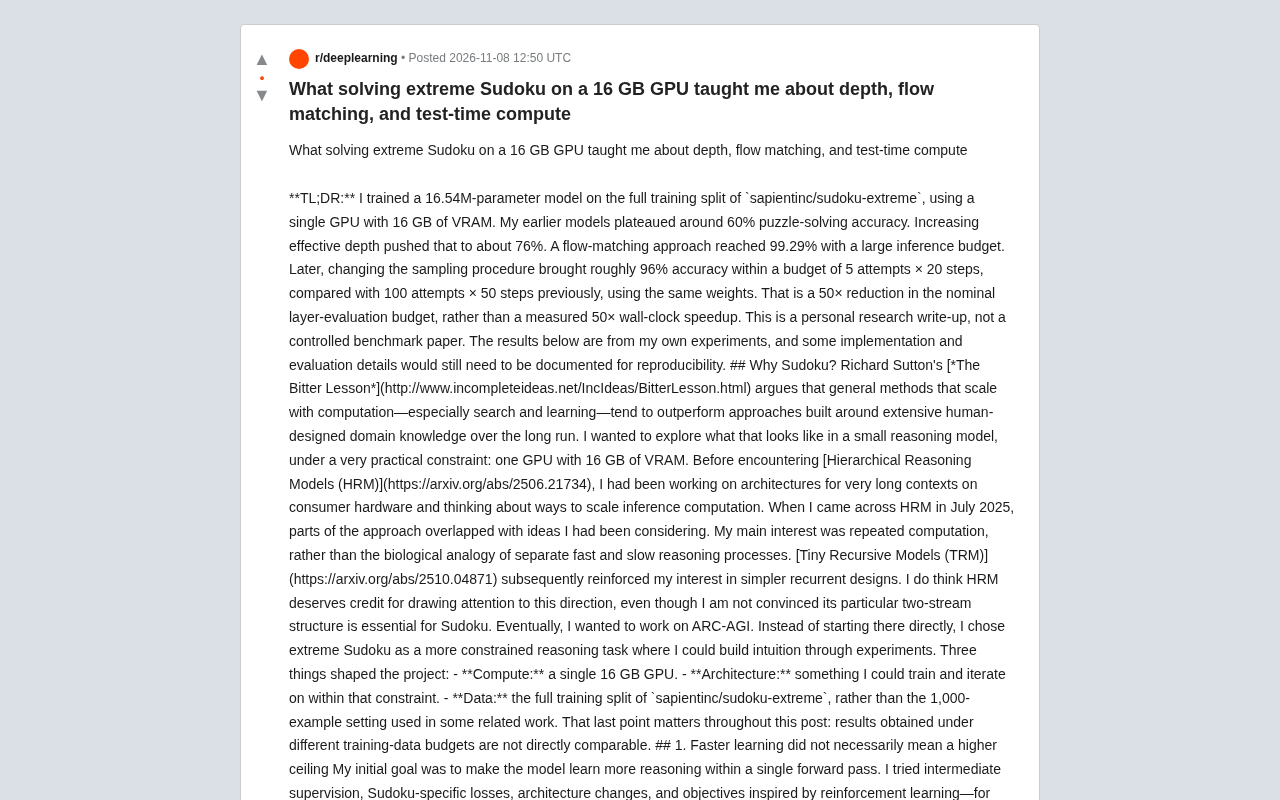
Pushing the Limits of Extreme Sudoku on a 16GB GPU: Insights from Depth and Flow Matching
A researcher trained a 16.54M-parameter model on a 16GB GPU to solve extreme Sudoku, finding effective depth breaks the 60% plateau and flow matching with improved sampling pushes accuracy past 99% with ~50× lower layer-evaluation budget.
 Tech Frontiers
AI Agent Approval Workflows: Why Human Confirmations Always Get Mindlessly Clicked
Why do AI agent approval workflows always get mindlessly clicked? A Reddit discussion shows that separating rules from keys, low-frequency high-risk approvals, and GitHub Environments-style gates are the keys to effective approvals.