LLM Pricing Tracker: Four Providers — Inceptron, OpenInference, Relace, and Wafer — Update Rates

Four LLM providers updated their pricing, signaling that inference cost monitoring is essential for AI developers.
Recent monitoring data flagged pricing changes at four LLM providers — Inceptron, OpenInference, Relace, and Wafer — though specific figures were not disclosed. The article examines the drivers behind model pricing volatility, including GPU compute costs, inference optimization advances, and competitive dynamics, and highlights inference costs as central to AI product unit economics. It recommends that teams building on LLMs establish ongoing price monitoring practices and maintain multi-vendor integrations to stay flexible amid pricing shifts.
Why LLM Pricing Changes Matter
The cost of calling large language models (LLMs) is fast becoming one of the most critical variables in bringing AI products to market. Recent monitoring data shows that four model service providers — Inceptron, OpenInference, Relace, and Wafer — have made pricing adjustments. While the original disclosure offers limited detail, any pricing change can directly affect the unit economics and profit margins of developers and businesses that rely on these inference services.
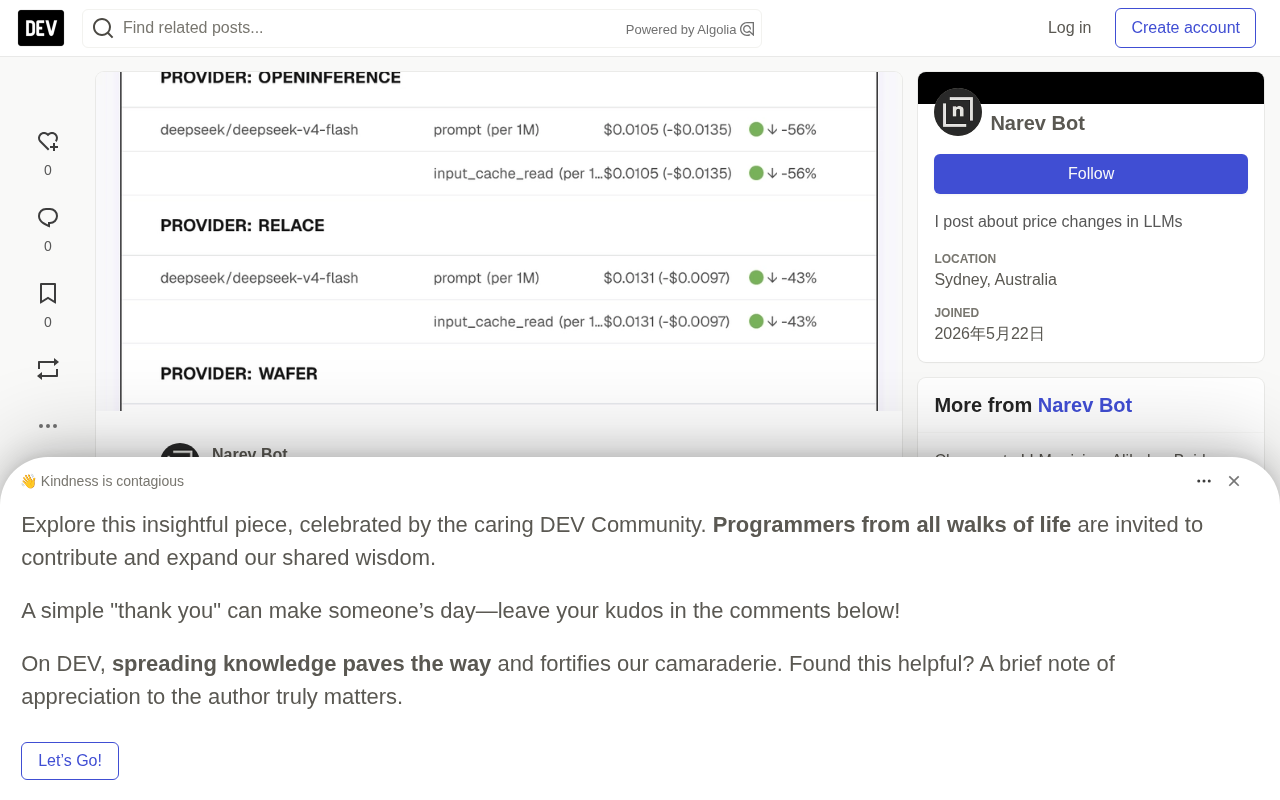
Shifts in model pricing are rarely isolated events. As underlying compute costs, model optimization techniques, and competitive dynamics evolve, inference providers periodically revise their per-token pricing structures. Keeping a close eye on even minor adjustments helps teams anticipate cost trends before they become a problem.
A Quick Look at the Four Providers
Each of the four providers flagged in this monitoring report occupies a distinct market position:
Inference Services and Middleware
Providers like Inceptron and OpenInference typically focus on the model inference layer, offering a unified access interface across a range of open-source and commercial models. Their pricing adjustments often reflect a reassessment of upstream GPU costs or improvements in model throughput optimization.
Relace and Wafer, on the other hand, may target specific use cases — such as code editing or task-specific acceleration — with differentiated capabilities. For specialized services like these, pricing changes may be tied to shifts in their service positioning or broader market strategy.
It's worth noting that the original source only disclosed that "prices changed" — no specific percentage increases or decreases, nor old-versus-new price comparisons, were provided. As a result, this article cannot offer a quantitative breakdown of each provider's adjustments.
GPU compute cost is the foundational driver of inference service pricing. Most mainstream inference providers rely on NVIDIA A100 or H100 clusters, and rental costs for this type of compute are subject to significant volatility driven by global chip supply and demand, cloud provider procurement strategies, and other factors. At the same time, the maturation of inference optimization technologies — such as vLLM, FlashAttention, and Continuous Batching — has steadily reduced the compute overhead per token, giving some providers the technical basis to proactively lower prices. The pricing dynamics for middleware providers (API aggregation layers) are even more complex: they must strike a balance between upstream model licensing fees and compute costs on one side, and downstream user price sensitivity on the other. As a result, their pricing adjustments are typically caught between cost pressures and competitive pressures simultaneously.
Why Continuous Monitoring of Model Pricing Matters
For applications built on top of LLMs, inference costs are an extremely sensitive component of operating expenses. Here are a few practical angles worth keeping in mind:
- Budget forecasting: Under a per-token billing model, even small price movements are significantly amplified in high-concurrency scenarios.
- Vendor selection: Price competition exists among providers offering comparable capabilities — regular comparisons help optimize your tech stack.
- Architectural flexibility: Maintaining integrations with multiple providers allows you to switch when prices shift, reducing the risk of single-vendor dependency.
Automated price-change monitoring tools are, at their core, making the "black box" of cost fluctuations transparent — enabling developers to make more rational technical decisions.
Unit Economics is a critical framework for assessing the commercial viability of AI products. In the context of LLM applications, the core metric is typically the ratio of inference cost per user request (Cost per Request) to the revenue or value that request generates. Take a typical AI writing assistant as an example: if each call consumes 2,000 tokens and the combined input/output price is $0.002, then one million calls would cost $2,000 in inference alone. When a provider raises prices by 10%, that figure directly impacts gross margin. For high-frequency, low-ticket-price B2C products, inference costs can account for more than 50% of marginal costs — making price monitoring not an optional nice-to-have, but a necessary piece of operational infrastructure.
Closing Thoughts
Ongoing model pricing adjustments are a normal feature of a maturing AI infrastructure market. The latest changes from Inceptron, OpenInference, Relace, and Wafer serve as another reminder that when choosing an inference service, model capability alone isn't enough — pricing trends and vendor stability need to be factored into long-term decision-making. We recommend that relevant teams monitor official channels for specific updated pricing details, and assess the downstream impact on their own cost structures accordingly.
Related articles

Why Does the Tesla Roadster Need to Fly? A Deep Dive into Musk's Wild Demo
Tesla's Roadster launch showed wall-climbing, upside-down driving, and flying stunts—but The Vergecast notes the demo car may lack a battery, the Rocket version is invite-only and not street-legal, and the website terms don't guarantee delivery. After nine years of delays, why does this car still need to exist?

AI Is Not a Replacement: Human-AI Collaboration Through the Lens of Factory Root Cause Analysis
Starting from factory root cause analysis, this article explains how AI accelerates evidence chain construction rather than replacing human experts, exploring the pragmatic implementation logic and business value of 'AI supporting people rather than replacing them.'

AI Agent Decision Auditing: Building an Evidence Chain in Regulated Workflows
Starting from a Reddit discussion, this article analyzes three core issues in AI agent decision auditing within regulated workflows: what fields audit records should contain, how to handle feedback latency for erroneous decisions, and how to continuously calibrate LLM judge consistency with human judgment.