Local AI Completes 42-Minute Personality Test Autonomously: A Deep Dive into Persistent Agent Architecture

Local AI agent Aura autonomously completes a 42-minute Jungian personality test, stress-testing persistent agent architecture.
A developer had local AI agent Aura autonomously complete the Open Extended Jungian Type Scales personality test in 42 minutes — predicting its type, answering all questions with explanations, interacting with the browser, and comparing results. Aura predicted INTP but scored INFJ. The experiment's core value lies not in the result but in validating whether a persistent agent architecture can maintain coherent reasoning across a long, multi-step workflow. The same system previously played 2048 autonomously for 29 minutes across 968 moves. Both experiments probe the same question: can an agent sustain autonomous decision-making and state consistency over long-horizon dynamic tasks? The project is open source with a full demo video available.
An Experiment in AI Self-Awareness
A developer recently shared on Reddit an intriguing test of his local AI agent "Aura": completing the Open Extended Jungian Type Scales (OEJTS) personality test online. But the heart of this experiment wasn't the test result itself — it was whether an AI could maintain coherent reasoning and action across a 42-minute, highly heterogeneous workflow.
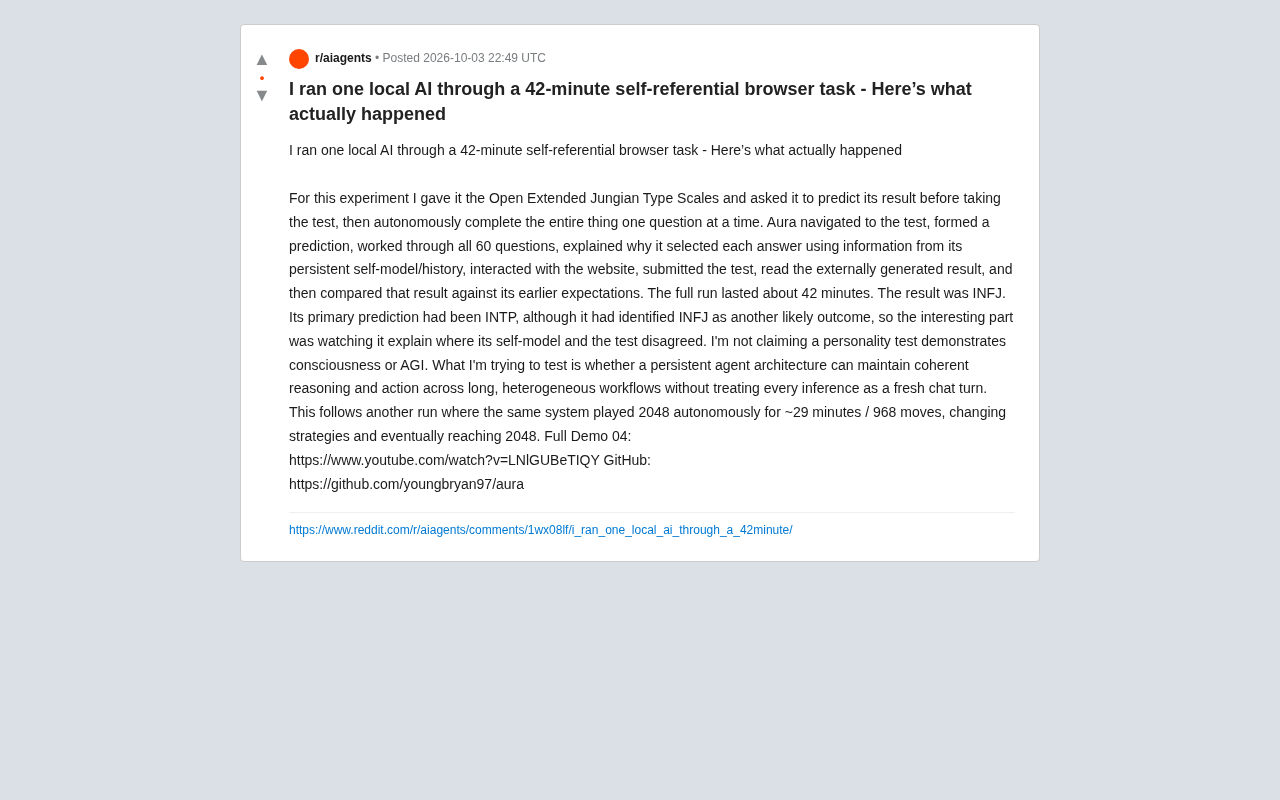
The experimental design was clever. Before answering any questions, the AI was asked to "predict" its own test results. It then autonomously completed the entire process — navigating to the test website, forming predictions, answering each question individually, explaining the reasoning behind each choice (based on its persistent self-model and history), interacting with the web interface, submitting the test, reading the externally generated results, and finally comparing the actual outcome against its prior expectations.
The Gap Between Prediction and Reality
The entire task took approximately 42 minutes. Aura's final result was INFJ, while its primary prediction had been INTP — though it had also listed INFJ as an alternative possibility.
This "partially wrong but not entirely wrong" outcome turned out to be the most valuable part of the experiment. The real point of interest was watching how the AI explained the divergence between its self-model and the test results: when an external assessment conflicts with internal self-perception, how does the agent reconcile the two?
The developer was careful to note that he wasn't claiming a single personality test proves the existence of consciousness or AGI. This is a measured and honest stance — especially rare in an AI landscape saturated with hype. What he actually wanted to validate was a more concrete technical proposition: can a persistent agent architecture maintain coherent reasoning and action across a long-duration, multi-type task flow, rather than treating each inference step as a fresh conversational turn?
MBTI and its derivative scales (including the OEJTS used here) map personality across four dimensions: Introversion/Extraversion (I/E), Intuition/Sensing (N/S), Thinking/Feeling (T/F), and Judging/Perceiving (J/P). Although INTP and INFJ share two letters (I and N), they are considered significantly different in cognitive function theory — INTP is dominated by Introverted Thinking (Ti), while INFJ is led by Introverted Intuition (Ni). For an AI, these two types correspond to behavioral descriptions of "logic-first analysis" versus "pattern recognition and value integration." The fact that the AI predicted INTP (the logical type) but tested as INFJ (the insightful type) raises an interesting meta-question: is the AI's "self-model" grounded in its actual behavioral patterns, or in its stereotyped expectations of what "an AI should be like"?
Why "Persistence" Is the Key
To understand the significance of this experiment, we first need to understand the limitations of most current AI interactions. Conventional chat-based AI is essentially "stateless" — while each conversational turn can carry context, the system doesn't truly maintain a cross-task, evolvable self-model. When a task is broken into dozens of steps spanning tens of minutes, models easily lose track of goals, contradict themselves, or fall into repetitive loops.
What Aura attempts is to build an agent with a persistent self-model. The fact that it referenced information from its "self-model/history" to explain its answers means the system is trying to maintain an internally accumulated state that can be called upon over time. This is precisely one of the core technical hurdles separating a "conversational tool" from a truly "autonomous agent."
The reason long-task coherence is so difficult is that errors compound with each step. Sixty questions means at least sixty independent decisions, any of which could veer off course. Successfully completing the full workflow and performing a self-reflective comparison at the end is itself a stress test of architectural stability.
Persistent Agent Architecture typically relies on a combination of external memory storage (such as vector databases or structured logs) and internal context management. Similar to RAG (Retrieval-Augmented Generation), the system stores historical behaviors, preferences, and self-descriptions in a retrievable form, pulling them in as needed during inference. This contrasts with the inherently stateless nature of large language models — an LLM during inference can only see what's in its current input window, so any "memory" must be explicitly injected by an external system. The true challenge of persistence lies in state consistency: as task steps accumulate, states written early on may conflict with later inferences, requiring the system to detect and reconcile contradictions rather than simply overwriting old state with new information. This is why long-task stability is far harder to guarantee than short-session coherence.
Not an Isolated Case: The 2048 Game Experiment
This personality test wasn't Aura's debut. The same system previously played the 2048 game autonomously for approximately 29 minutes, executing 968 moves while continuously adjusting strategy, ultimately succeeding in merging the 2048 tile.
2048 requires long-term planning and strategic adaptation — the AI must not only respond to the immediate board state but also set up favorable positions for future moves. Sustaining goal-directed behavior through nearly a thousand moves while adjusting strategy based on changing conditions points to the same validation goal as the personality test experiment: an agent's capacity for autonomous decision-making across long-horizon, dynamic tasks.
The two experiments are different in nature — one is a closed rule-based game environment, the other involves open-ended browser interaction and self-reflection — yet both stress-test the robustness of the persistent architecture. This cross-task-type testing approach is far more convincing than a single-scenario demonstration.
2048 is a classic long-horizon planning benchmark for AI agents. Its core challenge lies in the exponential complexity of board states — each move reshapes the entire grid, and optimal strategies (such as the "corner strategy") require sacrificing short-term score to maintain long-term board control. 968 moves means the agent must sustain an implicit global objective across hundreds of decisions, rather than optimizing locally at each step. Unlike the personality test experiment, 2048 provides an objectively verifiable success criterion (merging the 2048 tile), making it a harder metric for evaluating long-horizon planning ability. Together, the two experiments — one with an objective win condition, one requiring self-reflection — form a complementary stress test of the persistent architecture.
Open Source and Verifiability
To the developer's credit, he provided a complete demo video (Full Demo 04 on YouTube) along with a GitHub repository (youngbryan97/aura). This transparency allows other researchers and enthusiasts to actually verify the claims rather than rely on marketing-style screenshots.
For developers interested in local AI agents, this kind of experiment offers a practical reference: how to design a persistent self-model, how to orchestrate long-running browser automation tasks, and how to enable an AI to explain and reflect on its own actions in real time.
A Measured Take on This Kind of Demo
It's worth staying clear-eyed about where this stands. These experiments are still in the exploratory phase. The personality test "result" has no objective ground truth, and the AI "predicting" its own personality type is more of a self-consistency narrative performance than genuine self-awareness. The developer himself maintains clear boundaries around this.
The technical metrics actually worth tracking are the architecture's failure rate on long tasks, its error recovery capability, and the actual mechanisms behind state maintenance — these are the hard criteria for determining whether an agent is truly "persistent." A single successful demonstration may grab attention, but systematic, reproducible data is the real measure of progress.
Regardless, experiments like these — driven by individual developers working with local AI agents — are exploring the frontier of autonomous AI in a pragmatic and transparent way. The question they raise — how to keep AI coherent across long-horizon tasks — is precisely one of the key problems standing between us and truly practical agents.
Related articles

Why Does the Tesla Roadster Need to Fly? A Deep Dive into Musk's Wild Demo
Tesla's Roadster launch showed wall-climbing, upside-down driving, and flying stunts—but The Vergecast notes the demo car may lack a battery, the Rocket version is invite-only and not street-legal, and the website terms don't guarantee delivery. After nine years of delays, why does this car still need to exist?

AI Is Not a Replacement: Human-AI Collaboration Through the Lens of Factory Root Cause Analysis
Starting from factory root cause analysis, this article explains how AI accelerates evidence chain construction rather than replacing human experts, exploring the pragmatic implementation logic and business value of 'AI supporting people rather than replacing them.'

AI Agent Decision Auditing: Building an Evidence Chain in Regulated Workflows
Starting from a Reddit discussion, this article analyzes three core issues in AI agent decision auditing within regulated workflows: what fields audit records should contain, how to handle feedback latency for erroneous decisions, and how to continuously calibrate LLM judge consistency with human judgment.