Local AI Photo Search on macOS: Semantic Retrieval Across Photos and Every Video Frame

A macOS local AI tool for semantic search across photos and every video frame, with a privacy-first, on-device approach.
This macOS AI visual search tool uses CLIP-style image-text alignment models to map images and natural language into a shared vector space, letting users find specific photos or video moments using plain descriptions — no filenames or manual tags needed. Its standout feature is frame-by-frame video retrieval, likely accelerated by Apple Silicon's Neural Engine. All processing stays on-device for strong privacy guarantees. The project currently has minimal Hacker News traction and lacks public data on model choice, accuracy, or performance, so real-world validation is still needed.
A Local AI Visual Search Tool for macOS
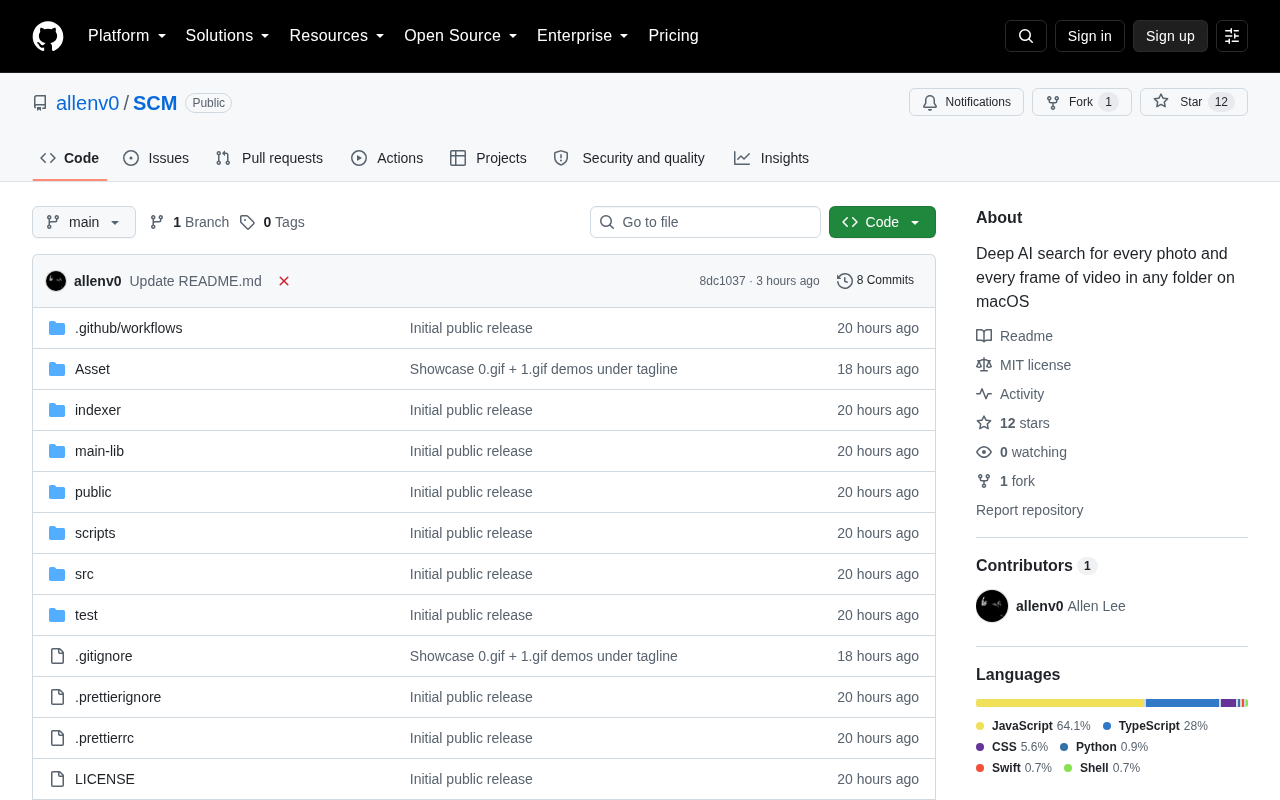
In the Show HN section of Hacker News, a developer showcased an AI search tool for macOS with a standout feature: semantic search across every local photo and every individual frame of a video. This means users no longer need to rely on filenames, capture dates, or manual tags — instead, they can describe a scene in natural language and let AI match results at the image content level.
For creators, designers, or everyday users who have accumulated massive libraries of photos and video footage, this kind of tool addresses a long-standing pain point: the more data you have, the harder it becomes to find a specific image or moment. Traditional photo apps have introduced face recognition and scene classification, but they still fall significantly short when it comes to fine-grained, custom content retrieval.
The Technical Significance of Frame-by-Frame Retrieval
The most noteworthy aspect of this tool is its frame-by-frame video search capability. Semantic search for photos has become increasingly common in recent years, typically relying on image-text alignment models (like CLIP-style multimodal embeddings) that map images and text into a shared vector space — enabling "find images with words."
From Static Images to Dynamic Video
Extending this capability to video raises the technical difficulty considerably. Video must first be decoded into frames, then each frame requires an embedding vector and an index entry. This introduces two key challenges:
- Compute load: A few minutes of video can contain thousands of frames. Processing all of them is a serious test of local computing power and storage.
- Index efficiency: A large volume of frame vectors requires an efficient vector search solution to keep query response times acceptable.
The developer's choice to run this entire pipeline locally on macOS likely leverages Apple Silicon's Neural Engine and unified memory architecture to accelerate inference — a key foundation behind the recent rise of local AI applications on the Mac platform.
The flagship example of image-text alignment models is CLIP (Contrastive Language–Image Pretraining), released by OpenAI in 2021. Its core idea is contrastive learning on massive image-text pair data: an image encoder and a text encoder each map their respective inputs into a shared high-dimensional vector space, so that semantically related image-text pairs end up closer together. At query time, a user's natural language input is encoded as a text vector, and the system uses cosine similarity or approximate nearest neighbor (ANN) search to quickly retrieve the best-matching results from the pre-built image vector index. Following CLIP, improved variants such as SigLIP and OpenCLIP have advanced accuracy and multilingual support, and these have become the most commonly adopted foundational components in local visual search tools.
The efficiency challenge of vector indexing is typically addressed by ANN algorithm libraries, with common solutions including FAISS (open-sourced by Facebook AI Research), Annoy, and the graph-based HNSW algorithm. The core idea behind these approaches is trading a small amount of accuracy for orders-of-magnitude gains in retrieval speed — enabling millisecond-level responses even at scales of millions to billions of vectors. For frame-by-frame video scenarios, developers also typically introduce keyframe extraction strategies (such as scene-change detection or fixed-rate sampling) to drastically reduce the number of frames that need to be indexed while preserving semantic coverage — striking a balance between compute cost and retrieval completeness.
The Privacy Advantage of Local Processing
Emphasizing "local" processing is a major differentiator for products in this category. Compared to uploading photos and videos to the cloud for analysis, running everything on-device means users' private media never leaves their machine, offering much stronger privacy and data security guarantees.
For users whose libraries contain large amounts of personal or professional material, the "data stays on device" design is often more compelling than the features themselves. As the inference capabilities of on-device models continue to improve, more and more AI functionality that once depended on cloud services is migrating to local execution. This tool can be seen as a concrete example of that trend in the visual search space.
The Product Is Still in Early Stages
It's worth noting objectively that the project has very limited traction on Hacker News so far (4 upvotes, no comments), indicating it's still at a very early stage of exposure, with little community discussion or real-world feedback. The original materials also don't disclose key details such as model selection, retrieval accuracy, processing speed, or resource usage.
As a result, it's too early to draw conclusions about the actual user experience or whether it remains usable at scale with large media libraries. Interested Mac users might treat it as an exploratory example of local AI visual retrieval, and keep an eye on future iterations and community feedback.
Summary
This macOS tool represents a clear direction for on-device AI applications: bringing multimodal semantic search capabilities to local hardware, covering both photos and per-frame video retrieval, with privacy protection as the core value proposition. While information is limited and community reception is still quiet, the problem it tackles — how to efficiently search through massive visual libraries — is a real and widespread need. As local computing power and multimodal models continue to advance, this space is well worth watching over the long term.
Related articles

NVIDIA's 30,000 Developers Use Cursor, Code Commit Volume Triples
Cursor engineer Chris Diaz breaks down five organizational gaps blocking enterprise AI coding scale—strategy, risk tiering, governance, metrics, and operating model. NVIDIA's 30,000 developers use Cursor daily, tripling code commits while defect rates stay flat. The key: rewrite the SDLC, not add tools.

Ponytail: Giving AI Coding Agents a Senior Engineer's Mindset
Ponytail is a free GitHub tool that injects a senior engineer's mindset into AI coding agents, making them ask whether code is even necessary first. According to TamilDeck, it can compress 200 lines of AI-generated code to 30, cutting token costs, with support for Cursor rules and Claude Code skill integration—though security review still requires human oversight.

Complete Guide to Connecting Cursor AI to the GitHub MCP Server
A step-by-step guide to connecting Cursor AI to the GitHub MCP server: create a personal access token, configure mcp.json, store the token in the ENV block, and verify with a PR query.