Local Deployment of Qwen3 Next MoE: Real-World Experience with 128GB VRAM

Qwen3 MoE runs locally at 241–274 tokens/sec on 128GB VRAM — impressive but with some marketing caveats.
A Bilibili creator tests Qwen3 Next's MoE architecture locally on a 128GB VRAM RTX 5000-class machine, achieving 241–274 tokens/sec with a smooth experience. The article explains MoE's efficiency advantages, the value of local deployment for privacy and cost, and an agent demo completing 3D modeling tasks. It also flags credibility concerns: misspoken model names, missing benchmark parameters, and overblown "AGI" claims driven by product promotion intent.
An Underrated Open-Source MoE Model
The open-source LLM race has entered a new phase — parameter count alone is no longer the only benchmark. Architectural efficiency and local deployability are gaining more attention. The subject of this hands-on experience is the Next variant of the Qwen3 series (verbally referred to in the original video as "Qwen3.8 Flash Next," likely a misspoken model name), which uses a MoE (Mixture of Experts) architecture.
The core advantage of MoE architecture is that while the total parameter count is substantial (weights around 130GB), only a subset of "expert" networks are activated during inference. This means that under the same compute conditions, MoE models can significantly outperform dense models of comparable size. The creator emphasizes in the video that this model's capabilities are "severely underestimated" — a large weight file doesn't automatically mean high resource consumption. What matters is the number of activated parameters and the architectural design.

The fundamental principle of MoE architecture is to divide a model's internals into multiple "expert" sub-networks. During each inference pass, a lightweight "Router" dynamically selects a small number of experts to participate in computation based on the input, while the remaining experts stay silent. This contrasts sharply with traditional dense models, which activate all parameters on every inference pass. Take the Qwen3 MoE series as an example: total parameters may reach tens or even hundreds of billions, but the number of parameters actually activated per inference might be only about one-tenth of the total. This brings inference compute closer to that of a much smaller dense model, while theoretically retaining the expressive capacity of a large-scale model. The main challenges of MoE architecture are: the full set of weights still needs to be loaded into VRAM or RAM, placing high demands on memory bandwidth; and the load-balancing design across multiple experts is complex, making training harder than with dense models. Representative recent open-source models such as Mixtral, DeepSeekAd, and Qwen3 all adopt this architecture — a collective bet by the industry on trading architectural efficiency for reduced compute costs.
Hardware Platform and Performance
The test platform is a local compute device equipped with 128GB VRAM and an NVIDIA RTX 5000-class GPU (referred to in the video as a "Lazy Cat Compute Pod"). Running a 130GB MoE model on such a machine, the creator describes the experience as "performance that literally doubles" and "extremely smooth with zero stuttering."
The hard metric worth paying attention to is decoding speed:
- Steady-state speed: approximately 241 tokens/second
- Peak speed: approximately 274 tokens/second
It's worth noting that the video verbally says "TB per second," which from context clearly refers to tokens per second (TPS) — the standard unit for measuring LLM inference throughput. These decoding speeds are quite impressive for a local single-machine deployment, meaning interactive use feels nearly instantaneous.
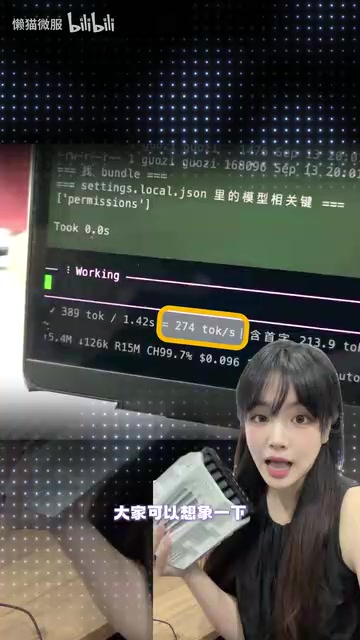
Tokens per second (TPS) is the core metric for measuring LLM inference speed — the number of tokens the model can generate per second. A human reads at roughly 200–400 English words per minute, which translates to about 5–10 tokens per second. At 241 tokens/second, generation far outpaces human reading speed, meaning model output appears virtually instantaneous with no perceptible wait. It's important to note that TPS is influenced by multiple factors: lower quantization precision (FP16, INT8, INT4, etc.) increases speed at the cost of some accuracy; longer context lengths increase KV cache usage and typically reduce speed; and larger batch sizes (concurrent requests) lower per-request throughput. Without knowing these parameters, the 241/274 tokens/second figures should be treated as reference points under specific conditions and should not be directly compared to other benchmarks.
The Real Value of Local AI Deployment
The creator raises a thought-provoking point: once local model inference can consistently reach hundreds of tokens per second, nearly all AI-related tasks at work can be migrated to local hardware. The logic is:
Once local inference performance crosses a certain threshold, the costs of calling cloud APIs, data privacy risks, and network latency can all be avoided. For individuals or teams who use AI heavily, a one-time hardware investment can "pay for itself" through long-term use.
This is the core value proposition of local deployment — trading upfront hardware costs for long-term usage freedom and data sovereignty. Whether it's truly cost-effective still depends on individual usage frequency, task complexity, and privacy requirements.
Agent-Based Modeling Task Demo
The most compelling part of the video is when the creator uses an AI Agent powered by this model to autonomously control a computer and complete a 3D modeling task. This test scenario mirrors OpenAI's approach of using 3D modeling demos when releasing open-source models.

The creator's assessment is quite enthusiastic, claiming that open-source LLMs "can now approach AGI-level agent capabilities." This claim deserves a critical look — AGI (Artificial General Intelligence) is a widely discussed but loosely defined concept, and using it to describe performance on a single task involves obvious hyperbole. A more objective framing would be: open-source model-driven agents have demonstrated solid usability for specific structured tasks involving computer operation and tool use.

An AI Agent is a system that uses a large language model as its "brain" and can autonomously plan steps and call external tools (such as code executors, file systems, browsers, GUI interaction interfaces, etc.) to complete complex tasks. Unlike simple Q&A, agents require the model to have task decomposition, context tracking, error correction, and multi-step reasoning capabilities. Tasks like autonomously controlling a computer to complete 3D modeling typically rely on a computer vision module to interpret screen state, combined with model-generated action commands (mouse clicks, keyboard input, etc.) to form a closed loop. These "GUI Agents" have become a hot research and industry topic over the past two years, with representative work including OpenAI's Operator, Anthropic's Computer Use, and multiple open-source frameworks. Evaluating agent capabilities is difficult because task success rates are heavily influenced by software versions, OS environments, and task boundary definitions — a single successful demo does not equate to stable, reliable generalization.
A Note on Content Credibility
This content comes from a single source (a Bilibili creator) and has an obvious product promotion angle — the video ends by directing viewers to "comment '1'" to receive compute pod benchmark data, with clear intent to sell local compute hardware. Keep this in mind when referencing it:
- Frequent misnaming and unit errors: Terms like "Qwen3.8 Flash Next" and "TB per second" don't align with standard industry terminology — refer to official naming conventions instead.
- Performance data lacks reproducibility conditions: The 241/274 tokens/second figures don't specify quantization method, context length, batch settings, or other key parameters.
- "AGI" framing is marketing overreach: Success on a single modeling task is insufficient to support a conclusion of "approaching AGI."
Overall, this type of content provides some useful reference for understanding the general experience of locally deploying MoE models, but specific performance claims and "return on investment" conclusions should be cross-referenced with independent third-party evaluations before drawing conclusions.
Related articles

iPhone Duo Hands-On: Is the $2,000 Small-Screen Foldable Worth It?
YouTube's Allison shares her iPhone Duo hands-on: dual-screen multitasking doubles efficiency, great video viewing, nice matte finish—but thick body, small outer screen, and a $2,000 luxury price.

Sentry's Ad Cracks Up Developers: Can On-call Actually Be Fun?
Sentry's ad short film taps into developers' on-call anxiety, using humorous dialogue to showcase its observability platform—errors, logs, traces, metrics, replays, and releases in one place.

LLM App Getting Worse With Every Change? Build an Effective Evaluation System in Three Steps
How do you know if your LLM app is getting better or worse? A Reddit-based guide to test sets, automated regression evaluation, LLM-as-judge scoring, and structured agent tracing.