Locally Deploying LLMs for Trading Bots: Hardware Selection & Model Recommendations

Guide to locally deploying 7B-14B LLMs on AMD GPUs to build AI-assisted quantitative trading systems.
This article explores how to leverage an AMD RX 7800 XT with 16GB VRAM for locally deploying LLMs to power trading bots. It covers ROCm ecosystem maturity, VRAM-to-model-size calculations with quantization, recommended models (Qwen2.5, Llama 3.1, DeepSeek, Mistral), deployment tools like Ollama and LM Studio, and a microservice architecture that positions LLMs as analytical assistants rather than direct decision-makers.
Background: Powering Trading Bots with Local LLMs
In a Reddit discussion about AI hardware, a user posed a highly representative question: they own a well-configured mini PC and want to run a large language model (LLM) locally to power their quantitative trading bot. This type of demand is growing rapidly—more and more developers are moving beyond cloud API calls, seeking to maintain data control locally, reduce latency, and avoid subscription costs.
The user's hardware configuration:
- GPU: Sapphire Radeon RX 7800 XT (16GB VRAM)
- RAM: Corsair Vengeance DDR5 32GB (2×16GB), up to 6000MHz
- Motherboard: GIGABYTE B650I AORUS Ultra (AM5 ITX)
- CPU: AMD Ryzen 7 7800X3D (8 cores, 16 threads)
- Storage: Samsung 2TB SSD
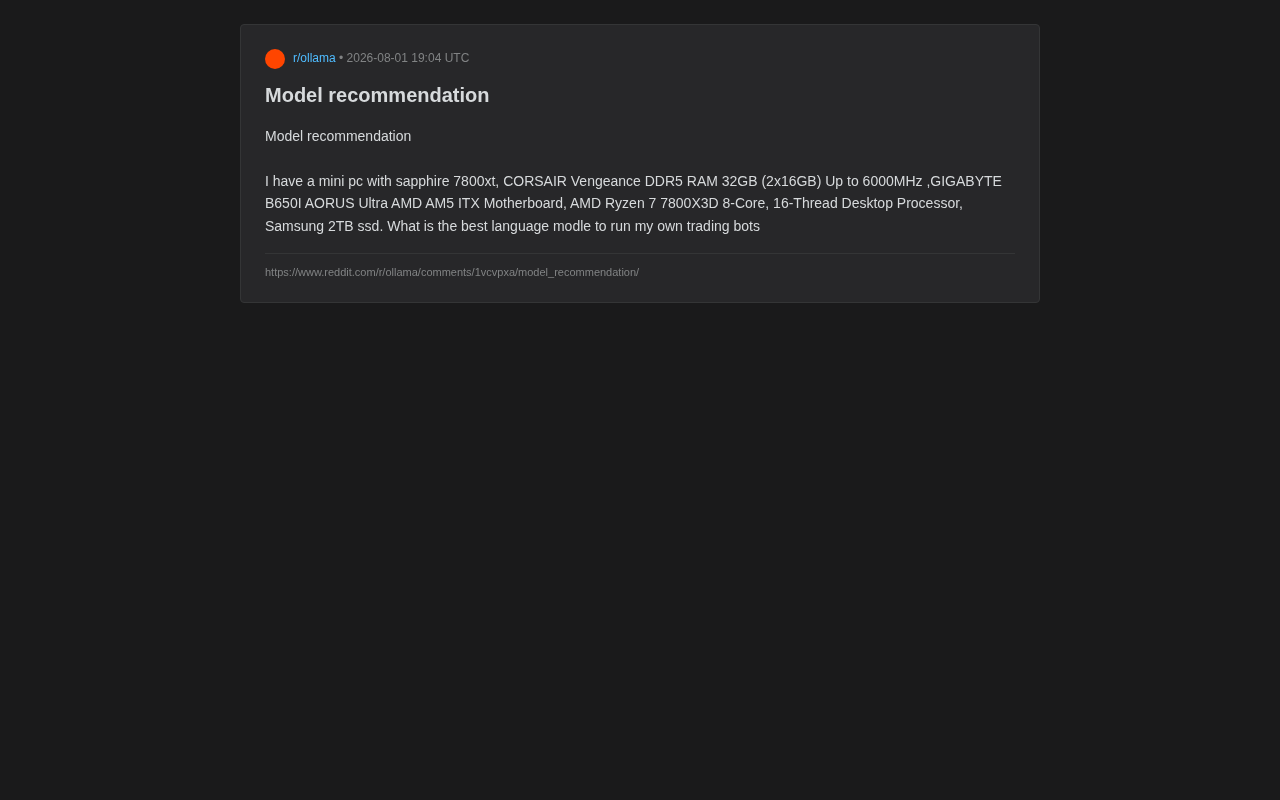
The core highlights of this setup are the 7800 XT's 16GB VRAM and the 7800X3D's powerful cache performance. For local LLM inference, VRAM capacity is often the key bottleneck determining whether a specific model size can run smoothly. It's worth noting that the 7800X3D processor features a massive 96MB 3D V-Cache, which can significantly reduce memory access latency when the CPU participates in inference computation—a hidden advantage for hybrid inference scenarios.
Practical Considerations for Running LLMs on AMD GPUs
ROCm Ecosystem Maturity
One issue that must be addressed head-on: this setup uses an AMD GPU rather than NVIDIA. In the local LLM space, the CUDA ecosystem has long been dominant, with the vast majority of inference frameworks and optimization tools supporting NVIDIA first. CUDA's deep moat stems from NVIDIA's continuous investment since its 2007 release—from low-level libraries like cuBLAS for linear algebra and cuDNN for deep learning primitives, to higher-level tools like TensorRT inference optimization engine, forming a complete software stack. Nearly all mainstream AI frameworks (PyTorch, TensorFlow, JAX) treat CUDA as the primary GPU backend.
However, in the past two years, AMD's ROCm (Radeon Open Compute) ecosystem has improved significantly, especially under Linux. ROCm was first released in 2016, and its long-standing pain points included unstable driver compatibility, limited GPU model support, and sparse documentation and community resources. But between 2023-2024, with the launch of AMD's MI300X data center GPU and improvements in PyTorch 2.0's native ROCm support, overall usability has made a qualitative leap.
For RDNA3 architecture GPUs like the RX 7800 XT, inference tools with ROCm or Vulkan backend support are recommended. The Vulkan backend is a particularly noteworthy alternative—it bypasses ROCm's complex HIP compilation environment setup, using a universal graphics API for GPU-accelerated inference with better compatibility for consumer AMD cards. Ollama and LM Studio both provide solid AMD GPU support, with LM Studio's built-in Vulkan backend enabling relatively painless utilization of the 7800 XT for acceleration without complex ROCm environment configuration.
What Model Size Can 16GB VRAM Handle?
Using 16GB VRAM as the baseline, combined with quantization techniques (such as Q4_K_M), here are the reasonably expected model sizes:
- 7B-8B parameter models: Fit entirely in VRAM with smooth performance (e.g., Llama 3.1 8B, Qwen2.5 7B)
- 13B-14B parameter models: Can run with quantization at acceptable speeds
- 32B parameter models: Require more aggressive quantization, some layers may need to be offloaded to RAM, with noticeably reduced speed
It's worth explaining the principles behind quantization. Original LLM parameters are typically stored in FP16 (16-bit floating point) or FP32 (32-bit floating point)—a 7B parameter model requires approximately 14GB of VRAM in FP16. The core idea of quantization is representing weights with fewer bits: Q4 means 4-bit quantization, K indicates using a k-quant grouping strategy (applying different precision levels to different model layers based on their sensitivity), and M represents the medium quality tier (between S/small and L/large). 4-bit quantization can compress model size to roughly one-quarter of the original FP16, allowing a 7B model to load with just 4-5GB. The tradeoff is some precision loss, but in practice, Q4_K_M output quality differs very little from FP16, typically showing only 1-3% degradation in perplexity tests.
Given that the user also has 32GB of high-speed DDR5 RAM, they can employ GPU+CPU hybrid inference to run larger models, though with some speed compromises. Hybrid inference (also known as layer offloading) works as follows: Transformer models consist of multiple identically-structured stacked layers, and the system places some layers' computation on the GPU while processing the remaining layers using CPU and system memory. For example, a 32B model might have 64 Transformer blocks—if VRAM can only accommodate 40 of them, the remaining 24 layers get offloaded to CPU. DDR5-6000MHz's high bandwidth (theoretical peak of approximately 96GB/s dual-channel) is particularly important here—LLM inference is a memory bandwidth-intensive task, and CPU inference speed is primarily bottlenecked by memory bandwidth rather than compute power. The 7800X3D's 96MB L3 cache can also provide additional acceleration during CPU inference, as some weight data can reside in the high-speed cache, reducing access to main memory.
Model Recommendations for Trading Bot Scenarios
Identify Task Types Before Choosing Models
It's worth emphasizing that a "trading bot" doesn't directly rely on LLMs for decision-making—actual trading signals typically come from quantitative strategies, technical indicators, and risk management logic. LLMs are better suited for the following auxiliary roles in trading systems:
- News and earnings sentiment analysis: Parsing real-time information to gauge market sentiment
- Strategy code generation: Assisting in writing and debugging trading scripts
- Natural language queries: Retrieving historical data and position status through conversation
- Structured information extraction: Extracting key trading signals from unstructured text
Attempting to have an LLM directly make buy/sell decisions is a high-risk and unreliable approach in practice, prone to erroneous judgments caused by "hallucinations." LLM hallucination refers to models generating information that appears plausible but is actually incorrect—in financial trading scenarios, this risk is particularly lethal: the model might fabricate non-existent earnings data, misinterpret policy implications, or provide unfounded judgments about market trends. Academic research shows that even GPT-4 level models have non-negligible hallucination rates when dealing with specific numbers and time series predictions. Therefore, the industry consensus is to position LLMs as information processing and analytical assistance tools, not direct trading signal sources. All LLM outputs should pass through a rule validation layer before entering the trading decision chain.
Specific Model Recommendations
For the auxiliary scenarios and hardware conditions described above, the following models are recommended:
Qwen2.5 Series (7B/14B): Alibaba's Tongyi Qianwen open-source models excel in mathematics, code, and structured reasoning, making them highly suitable for processing financial data and generating trading logic code. Qwen2.5 is an open-source model series released by Alibaba Cloud in September 2024, covering multiple sizes from 0.5B to 72B. Its outstanding performance in financial scenarios stems from training data containing extensive Chinese and English financial corpus, as well as specialized optimization for mathematical reasoning capabilities. In multiple benchmarks, Qwen2.5-14B's math and coding abilities approach or even surpass larger models like Llama 3.1 70B. For trading assistance scenarios, its structured output capability (such as stably generating JSON-formatted sentiment scores) and deep understanding of Chinese financial news are clear differentiating advantages. The series uses the Apache 2.0 license, allowing commercial use. The 14B version runs smoothly on 16GB VRAM with Q4_K_M quantization.
Llama 3.1 8B Instruct: Meta's general capability benchmark model, with strong instruction-following ability and stable performance on sentiment analysis and text comprehension tasks, backed by a mature community ecosystem. The Llama 3.1 series employs Grouped Query Attention (GQA) and larger-scale training data (over 15 trillion tokens), achieving industry-leading levels at equivalent parameter scales. Its open licensing terms and massive community support mean you can find numerous finance-domain fine-tuned versions and use cases.
DeepSeek Series: Has unique advantages in code generation and mathematical reasoning, valuable for scenarios requiring writing and optimizing quantitative strategies. DeepSeek uses a Mixture of Experts (MoE) architecture, maintaining lower active parameter counts while having larger total parameter counts, enabling the model to outperform similarly-sized dense models on specialized tasks.
Mistral / Mixtral: If you prefer a European team's open-source solution, Mistral 7B strikes a good balance between efficiency and quality. Mistral AI is a French company whose 7B model achieves unique inference efficiency advantages through innovative architectural designs like Sliding Window Attention, particularly suitable for scenarios requiring longer context processing (such as complete earnings report texts).
Practical Deployment and Integration Recommendations
Recommended Toolchain
For this user's AMD platform, the recommended deployment path is:
- Inference Engine: Try LM Studio first (GUI-based, Vulkan support) or Ollama (CLI-based, easy API integration)
- API Integration: Ollama provides an OpenAI-compatible local API endpoint that can be directly called by Python trading scripts, with minimal integration overhead
- Quantization Format: Choose GGUF format quantized models for the best compatibility
GGUF (GPT-Generated Unified Format) is a model file format designed by Georgi Gerganov, founder of the llama.cpp project, which replaced the earlier GGML format in August 2023. GGUF's core advantages include: self-contained metadata (tokenizer configuration, model architecture parameters, etc.), enabling inference without additional files; support for mixed-precision quantization storage; and excellent cross-platform compatibility, running on CPU, CUDA, Metal, Vulkan, and other backends. Many models on HuggingFace provide GGUF-format quantized versions, allowing users to select different precision tiers (from Q2_K to Q8_0) based on their VRAM capacity. This format has become the de facto standard for local LLM deployment.
System Architecture Approach
The sensible approach is to run the LLM as an independent "analysis service," decoupled from the main trading program through a local API. The trading bot's core decision logic should still be based on deterministic quantitative rules, with the LLM called only when text understanding and information processing are needed. This leverages LLM language capabilities while ensuring trading system stability and auditability.
Specifically, the advantages of this microservice architecture include: LLM service crashes won't affect the main trading program's operation; models can be independently upgraded and swapped without modifying trading logic; it's easy to log and trace every LLM output, meeting compliance audit requirements for financial systems; and request queues can control LLM invocation frequency, preventing inference service overload from excessive concurrent requests during volatile market conditions.
Conclusion
This Reddit user's hardware configuration is more than capable of running local 7B-14B class LLMs—the 7800 XT's 16GB VRAM and high-speed DDR5 RAM provide a solid foundation. The key mindset adjustment is: LLMs are the intelligent auxiliary layer of a trading system, not the decision-making core. By choosing mainstream open-source models like Qwen2.5 or Llama 3.1 and deploying on the AMD platform with Ollama or LM Studio, you can build a practical local AI trading assistance system. For AMD users, while the ecosystem still slightly lags behind NVIDIA's, the existing toolchain is mature enough—there's no need to purchase an NVIDIA GPU specifically for this purpose.
Key Takeaways
Related articles

Palantir Pays Just £2 Million in UK Tax: Analyzing the Tax Avoidance Controversy of Multinational Tech Giants
Palantir paid just £2M in UK corporate tax, sparking controversy. This analysis explores how multinationals use transfer pricing and IP arrangements to minimize tax, plus global reform responses.

Introduction to Mathematical Foundations of Machine Learning: Definitions, Probabilistic Perspective & Core Framework Explained
Starting from Tom Mitchell's T-P-E framework, this guide explores ML's probabilistic perspective, random variables, and decision-making under uncertainty to build solid math foundations for ML.

Debunking 8 Myths About GenAI in Software Engineering: The Truth Behind AI-Powered Programming
An in-depth analysis of 8 common myths about GenAI in software engineering, covering AI replacing programmers, code quality, productivity, security, and compliance.