Logitech G Pro Superstrike: A New Approach to Haptic Feedback in Gaming Mice

Logitech's G Pro Superstrike swaps mechanical switches for haptic actuators, enabling customizable click feel at a $20 premium.
The Logitech G Pro Superstrike is a gaming mouse that replaces traditional mechanical micro-switches with haptic actuators, decoupling signal registration from tactile feedback to reduce latency while letting users tune click feel via software — or disable it entirely. It's an iterative upgrade on existing Logitech haptic tech, priced $20 higher than its predecessor. Competitive players who value precision may find the upgrade worthwhile; casual users will likely find better value in conventional mice. The product's broader significance lies in pointing toward an industry-wide shift to "software-defined feel" — as mechanical optimization hits its ceiling, haptic systems offer a new path to experience differentiation, though long-term durability still needs market validation.
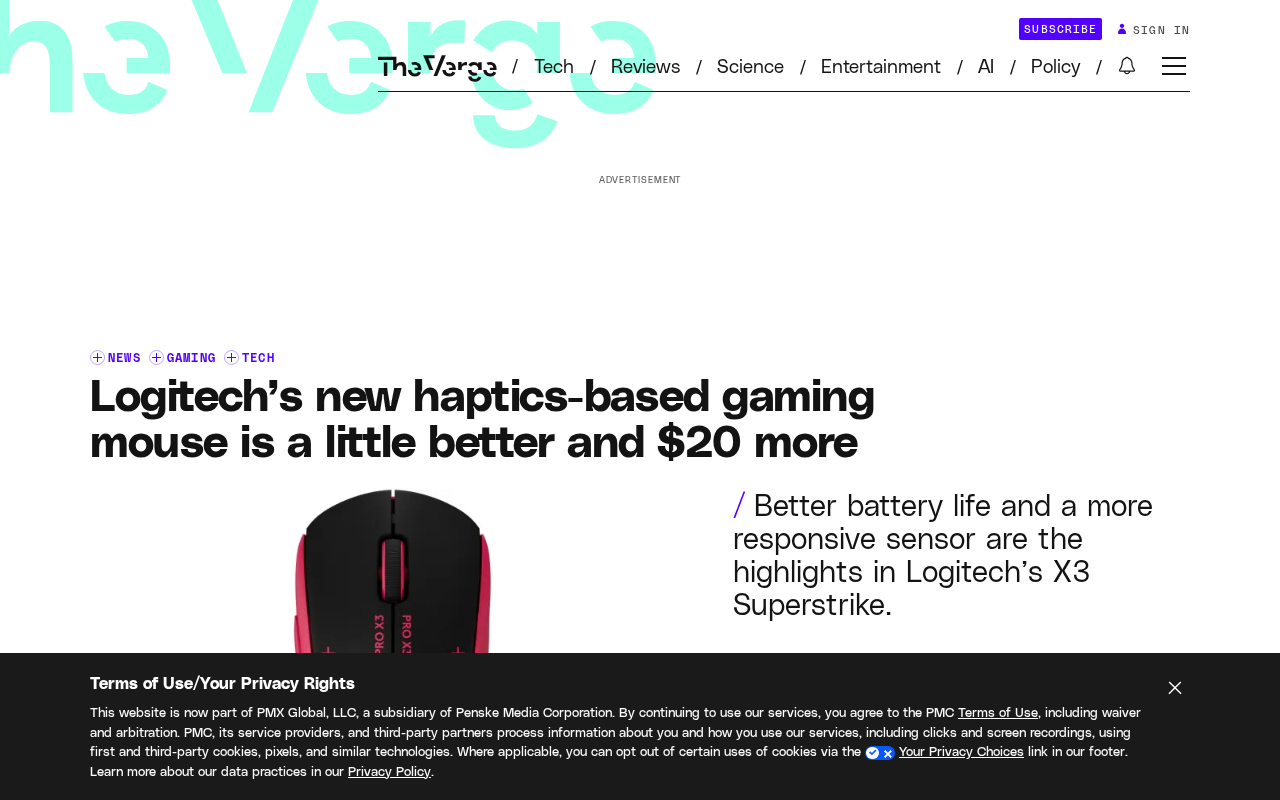
The Logitech G Pro Superstrike is one of the most noteworthy peripherals to emerge recently. It abandons traditional mechanical micro-switches entirely, instead placing haptic actuators beneath both primary buttons — a bold attempt to redefine the feel and responsiveness of a mouse click.
How Haptic Actuators Change the Click Experience
The vast majority of gaming mice rely on mechanical micro-switches to register clicks. This approach carries inherent physical latency, and the click feel is locked in by the hardware itself — users have no way to adjust it. The G Pro Superstrike takes a fundamentally different approach: by replacing mechanical switches with haptic actuators, it changes how clicks are implemented at the most basic level.
This delivers two immediate benefits. First, reduced latency: since the system no longer depends on the physical closing of a contact, click signals register faster — and for competitive players, millisecond-level differences in response time can affect outcomes. Second, click feel becomes customizable in a way that mechanical switches simply cannot offer.
Adjustable Click Feel
The most compelling aspect of the haptic approach is that click feedback can be fully customized through a combination of software and hardware. According to Logitech, users can tune clicks to feel extremely light and subtle, dial them up to a more pronounced and tactile response, or disable haptic feedback altogether.
This means a single mouse can accommodate different player preferences — some prefer a crisp, distinct actuation point, others want the lightest possible trigger. The haptic system delivers both from one device. This flexibility is something traditional mechanical switches simply cannot match, and it's the core selling point of this technology.
The fundamental principle behind a haptic actuator is that an electrical signal drives a miniature vibration or force-feedback element — typically a linear resonant actuator (LRA) or piezoelectric ceramic component — to produce a simulated "click" sensation the instant a button is pressed, rather than relying on a real mechanical contact opening and closing. Traditional mechanical micro-switches require a series of physical steps to complete a circuit: the spring blade deforms, the contacts physically meet, and so on. This typically introduces at least 1 millisecond of mechanical latency, with trigger force and feel determined by physical parameters like spring stiffness — all fixed at the factory and impossible to change. The haptic approach decouples "signal registration" from "tactile feedback": the former can be triggered by a sensor the moment the key moves even slightly, while the latter is entirely determined by the actuator's vibration parameters (frequency, amplitude, duration), all adjustable in real time via software. This software-hardware co-design architecture is the fundamental technical advantage of haptic systems over mechanical ones.
Iterative Improvements and a Price Increase
In terms of product positioning, haptic technology itself isn't new — it has appeared in Logitech's lineup before. The G Pro Superstrike is an iterative update built on existing technology: a modest step forward rather than a revolutionary leap.
The pricing strategy is worth noting. The new model costs $20 more than its predecessor. For consumers, this premium requires a genuine trade-off: whether the lower latency and customizable feel of haptic feedback justifies the extra spending ultimately depends on how much a player values precision and control.
Who Is This Mouse For?
For professional or semi-professional esports players, reduced latency and precise control over click feel have real, practical value — the extra $20 may well be worth it. For everyday gamers, traditional mechanical switch mice still hold a strong advantage in value for money, and the haptic option is more of a premium upgrade.
What This Means for the Gaming Peripheral Industry
The existence of the G Pro Superstrike reflects the gaming peripheral industry's ongoing exploration of interaction technology. As the performance ceiling for mechanical micro-switch optimization approaches its limits, manufacturers are looking for alternative approaches at the hardware level — and haptic feedback is one of the more promising paths.
If this technology matures and becomes widespread, it could gradually shift the design paradigm for high-end gaming mice. The concept of software-defined hardware feel moves peripherals from fixed configurations toward personalized setups — a direction consistent with the broader industry trend toward customization in recent years.
That said, as a relatively novel technology, the durability, long-term reliability, and cost control of haptic systems still need to be validated by the market over time. Whether a $20 premium can win over the mainstream market will be an important indicator of this technology's commercial viability.
The performance race among gaming mouse switches has reached a fever pitch over the past decade — from Omron's D2FC series to Japanese Cherry switches, and on to optical micro-switches developed in-house by various manufacturers (such as Razer's optical switches, which use a light beam interruption instead of physical contacts to bring theoretical latency below 0.2ms). The room for further latency optimization along the mechanical path is shrinking fast. Haptic systems and optical switches represent two different "de-mechanization" approaches: the former preserves the physical sense of displacement, using actuators to simulate and enhance feel; the latter eliminates physical contacts entirely, chasing ultimate low latency at the cost of a more uniform feel. Both paths point in the same direction: freeing the click experience from the constraints of purely mechanical structures and moving toward software-controllable design. By choosing the haptic route, Logitech is seeking a balance between latency and customizable feel — a choice that reflects how competition in the high-end peripheral market is shifting from "spec stacking" to "experience differentiation."
Related articles

OpenAI Partners with Shield: How the Astra Agent Revolutionizes IT Troubleshooting
OpenAI and Shield launch the Astra agent, which autonomously logs into computers and legacy systems to fix IT issues in real time, 35-40% faster than traditional models, with humans involved only when judgment is needed.

iPhone Duo Battery Life Tested: One Charge a Day Is Unavoidable, and the Large Screen Is the Culprit
iPhone Duo battery test: heavy use needs at least one charge a day, and about 30% remains after 6.5 hours of screen-on time. How often the large screen is unfolded is key; a MagSafe battery pack helps, and long-term degradation is also worth watching.

Kimi K3.1 Pro Open-Sourced: 2.8 Trillion Parameters Close In on Opus
Moonshot releases the open-source MoE model Kimi K3.1 Pro, with 2.8T total parameters and 104B activated, trailing Opus 5.5 by under 1 point on Terminal Bench 4.0.