LogT: No RL Complexity Needed — High-Quality SFT Data Teaches VLMs to Think with Images

LogT uses a fully automated data engine to generate logic-chain-guided SFT data, surpassing SFT+RL methods with less data and compute.
The LogT paper argues that the bottleneck for VLMs 'thinking with images' is not RL complexity but SFT data quality. It proposes a fully automated SFT data engine that explicitly generates logic-chain-guided reasoning trajectories, ensuring questions rely on visual details and tool-use trajectories approach human logic. Fine-tuned on Qwen2.5-VL-7B and InternVL3.5-8B, LogT-SFT surpasses state-of-the-art SFT+RL methods on seven benchmarks with 3.1× less data and over 120× fewer GPU hours; a simple RL recipe adds another 9.59 points. This suggests high-quality demonstration data can replace some RL engineering, though the method is currently limited to Zoom-in visual search.
When Visual Search Meets "Thinking with Images"
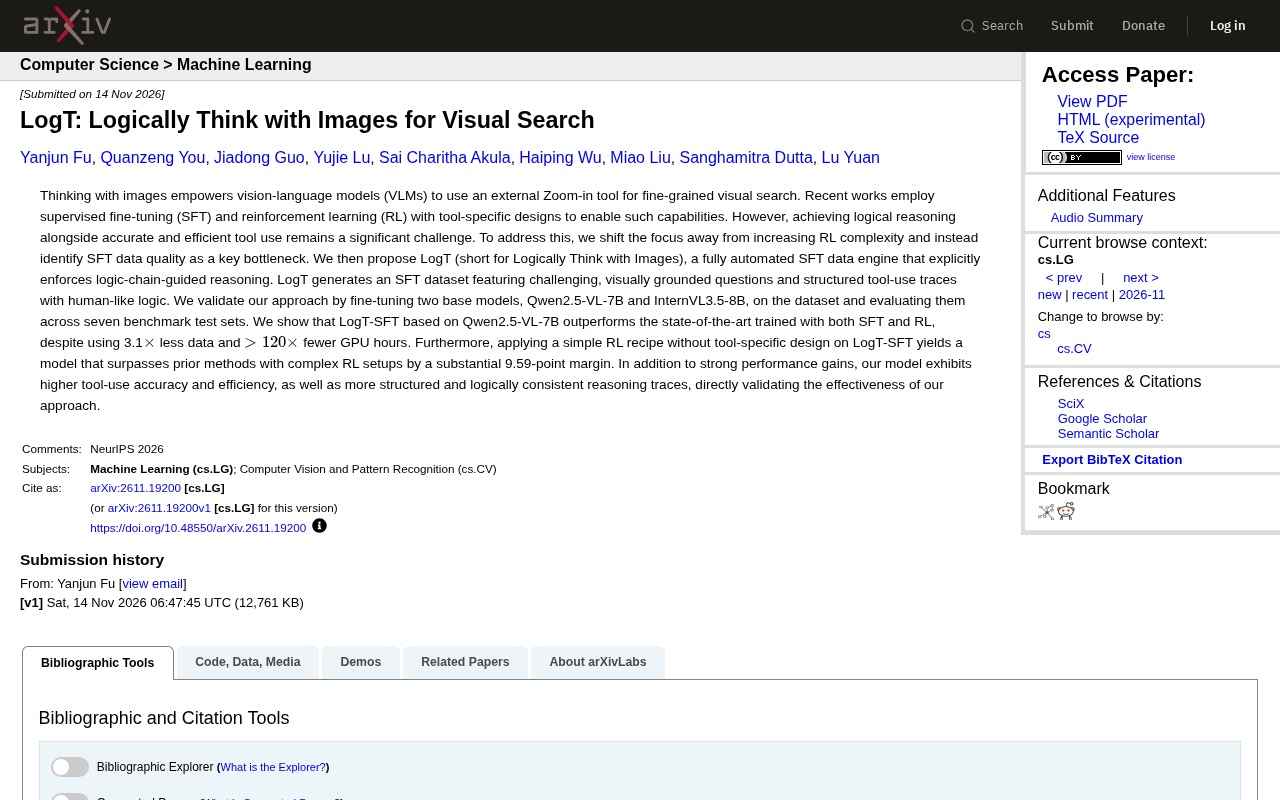
Getting vision-language models (VLMs) to "think with images" has been an important branch of multimodal reasoning over the past two years: instead of looking at an image once and answering immediately, the model calls external Zoom-in tools like a human would, zooming into regions of interest to observe them more closely and progressively completing fine-grained visual search. This sounds like a classic reinforcement learning (RL) problem — let the model learn through trial and error when to zoom in and where. But a paper titled LogT: Logically Think with Images for Visual Search offers a different judgment: what's really blocking this path may not be that RL algorithms aren't clever enough, but that SFT data quality falls short.
The Problem Isn't RL — It's the Data
Existing "thinking with images" work generally combines supervised fine-tuning (SFT) with reinforcement learning, and designs specialized rewards or action spaces for tool calls. Such approaches bring performance gains, but the authors point out that simultaneously achieving "logical reasoning" and "accurate, efficient tool use" remains a significant challenge.
The research team made a key shift in perspective: rather than continuing to increase RL complexity, it's better to revisit the quality of SFT data — because the model must first learn from demonstration data "what a reasonable reasoning chain looks like" before RL has room to optimize in the right direction. If the demonstration data itself lacks logical structure, no matter how sophisticated the RL design, it can only search through noise.
Division of labor between SFT and RL: Supervised fine-tuning (SFT) uses expert demonstration data to directly teach the model an "input→output" mapping — essentially behavior cloning; reinforcement learning (RL) lets the model try and fail in an environment, optimizing its policy based on reward signals. In multi-step tool-calling tasks, SFT provides the initial policy and reasoning format, while RL fine-tunes decision boundaries under reward guidance. If the SFT demonstrations themselves are logically messy, RL's exploration space gets drowned in noise — this is exactly the basis for LogT's emphasis on data quality over algorithmic complexity.
LogT: An Automated Data Engine That Emphasizes Logic Chains
Based on this judgment, the authors propose LogT (Logically Think with Images), a fully automated SFT data engine. Its core design explicitly enforces "logic-chain-guided reasoning," producing two things:
- Challenging, visually grounded questions: questions must truly depend on image details to be answered, rather than being guessed from language priors;
- Structured tool-use trajectories: trajectories should have near-human logic — what to look at first, why zoom in here, and how to revise judgments after zooming in.
The significance of a fully automated data engine lies in scalability. Manually annotating multi-step reasoning trajectories with tool calls is extremely costly, while LogT embeds "logical structure" as a generation constraint into the pipeline, making data both cheap and quality-preserving for reasoning.
Visually grounded: means that the answer to a question must rely on specific visual evidence in the image to be derived, rather than being guessed from language priors or common sense alone. For example, "What color is the second car on the left in the image" requires the model to actually zoom in and look, whereas "Is there a car in the image" might be answerable from scene priors. LogT explicitly requires a visual evidence chain when generating questions, ensuring that every zoom step in the tool-use trajectory has a clear visual basis, thereby preventing the model from learning "fake reasoning" — appearing to reason while actually relying on language shortcuts.
Experiments: Less Data, Less Compute, Better Performance
The authors fine-tune two base models, Qwen2.5-VL-7B and InternVL3.5-8B, on the LogT dataset and evaluate on seven benchmarks. The most noteworthy result is the efficiency comparison:
- The LogT-SFT model based on Qwen2.5-VL-7B outperforms existing state-of-the-art methods trained with combined SFT and RL, while using 3.1× less data and over 120× fewer GPU hours;
- Running a simple RL recipe without any tool-specific design on top of LogT-SFT yields performance 9.59 percentage points higher than prior methods using complex RL setups.
The latter result is especially convincing: it shows that once the SFT stage has solidified the logic chain, RL no longer needs extensive custom engineering for tool use — a general recipe can continue pushing the performance ceiling. In other words, complexity has been moved upstream to the data side rather than the algorithm side.
Beyond benchmark scores, the authors report that the model also achieves higher tool-use accuracy and efficiency, and its reasoning trajectories are more structured and logically consistent — directly corresponding to LogT's original design intent and showing that the performance gains are not accidental overfitting.
GPU hours: a common metric for total training compute consumption, equal to the number of GPUs used multiplied by training duration. LogT reports using over 120× fewer GPU hours than existing state-of-the-art methods, meaning training time can be shortened by two orders of magnitude on the same hardware, or reproduction can be done with very little compute. This comparison highlights the compute savings brought by improved data efficiency and has direct reference value for compute-constrained research teams.
Implications for Multimodal Reasoning Research
LogT's value goes beyond a stronger visual search model — it offers a methodological reminder: at a time when multimodal agents and tool calling are hot topics, the community tends to focus on RL reward design and action-space engineering while underestimating the weight of "reasoning structure" in demonstration data.
This line of thinking also has its boundaries. LogT currently validates the visual search scenario with a Zoom-in tool; whether logic chains can be automatically generated and generalized to more open tool sets (such as code execution or multi-tool collaboration) remains to be tested. Meanwhile, the automatic generation quality of the data engine depends on the underlying model and filtering mechanisms, and its upper bound requires more analysis. But at least on this task, a small step on the data side has bought a big step on the compute side — a quite practical signal for compute-constrained researchers.
One-line Summary
LogT uses a fully automated data engine to generate logic-chain-guided SFT data, surpassing SFT+RL methods with less data and compute.
Paragraph Summary
The LogT paper argues that the bottleneck for VLMs "thinking with images" is not RL algorithmic complexity but supervised fine-tuning data quality. The authors propose LogT, a fully automated SFT data engine that explicitly generates logic-chain-guided reasoning trajectories, ensuring questions depend on visual details and tool-use trajectories approach human logic. After fine-tuning on Qwen2.5-VL-7B and InternVL3.5-8B, LogT-SFT surpasses state-of-the-art SFT+RL methods on seven benchmarks with 3.1× less data and over 120× fewer GPU hours; adding a simple RL recipe further improves performance by 9.59 percentage points. This shows that high-quality demonstration data can replace some RL engineering, though the method is currently limited to Zoom-in visual search scenarios.
Related articles

Gemini 4 Neon Leak: A Potential Strong Contender Against Opus 5.5
A Hacker News thread suggests Gemini 4 Neon looks like an Opus 5.5 competitor. This article unpacks the product positioning behind this community signal, shifts in the top-model competitive landscape, and what it means for developers' model selection strategy.

Claude Fable 5.2's Self-Authored Short Film 'Fable' Sparks Discussion
A short film 'Fable,' credited to Claude Fable 5.2 for script, visuals, and directing, appears on Hacker News. This article analyzes the significance of full-pipeline AI creation, community reactions, and what it means for content creators.

Anthropic IPO Pricing: A Signal of AI Giants Going Public
Anthropic's IPO pricing draws attention. This article analyzes its potential impact on AI industry valuation, commercialization paths, and the competitive landscape, and highlights public-market expectations and challenges for AI companies.