Long Tasks Shouldn't Block the Chat: How Asynchronous Architecture Is Reshaping AI Interaction

Long tasks shouldn't block the chat—asynchronous decoupling and visible state are foundational design principles for conversational AI.
Starting from the brief observation "Long tasks shouldn't block the chat," this article analyzes the experience bottleneck of blocking the chat interface in AI products. The synchronous request-response model occupies the interface during long tasks, preventing users from asking follow-ups, modifying requirements, or initiating parallel requests, and it systematically suppresses product usage depth. The solution is to decouple task execution from the conversation flow using asynchronous execution, task queues, state persistence, and result callbacks—letting long tasks persist in the conversation as lightweight status indicators, achieving "visible but not waited on." The article further notes that Agent and multi-task scenarios are especially sensitive to this, and that interaction design matters as much as model capability for long-term usage intent.
An Overlooked Experience Bottleneck
In AI product design, there's a common but rarely discussed problem: when the system needs to execute a time-consuming task, the chat interface often gets "stuck." The user issues a command, waits, and the interface gives no feedback—and they can't continue the conversation. This experience recurs across developer tools, Agent platforms, and all kinds of AI applications.
A brief observation from social media—"Long tasks shouldn't block the chat"—precisely identifies this pain point, accompanied by two links. It doesn't elaborate, but the design philosophy behind it is worth exploring in depth: the core value of conversational AI lies in continuous, bidirectional interaction, not one-off waiting. Once a long task blocks this channel, the product degrades from "conversation" into "submit a form and wait."
Why Long Tasks Block the Conversation
The Default Trap of Synchronous Execution
Many AI applications adopt a synchronous request-response model in their initial versions: user input triggers backend processing, and the frontend suspends while waiting for the result to return. For simple tasks that complete in seconds, this is fine; but once a task involves multi-step reasoning, external tool calls, large-scale retrieval, or file processing, it may take anywhere from tens of seconds to several minutes. At this point the frontend can only display a loading animation, and the user can neither ask follow-up questions nor modify requirements—they can't even tell whether the task is alive or dead.
Synchronous vs. asynchronous execution models: In the synchronous request-response model, the client must wait for the server to return a result after sending a request, and the entire connection is occupied during this period; the asynchronous model allows the request to immediately return a task identifier, with the actual processing happening in the background, and the client learns of progress and final results through polling, WebSocket push, or Server-Sent Events. AI applications are naturally suited to asynchronous operation, because a single inference may chain multiple model calls, tool calls, and retrievals (the commonly called multi-step Agent flow), making latency unpredictable. Common industry implementations include task queues (such as Celery, BullMQ), persistent task state tables, and SSE-based streaming responses, enabling the frontend to remain interactive while a task is running.
The Cascading Losses Caused by Blocking
Blocking isn't just a matter of "waiting a long time." It deprives users of the opportunity to add context while a task is executing, and it also removes the possibility of initiating other requests simultaneously. More subtly, the uninterruptibility of long tasks makes users hesitant to try complex operations—because they know that once they press Enter, the interface is "occupied." This systematically suppresses how deeply the product is used.
Architectural Approaches That Don't Block the Conversation
Decoupling Tasks from Conversation
To solve this problem, the core is to decouple "task execution" from the "conversation flow." The conversation layer remains interactive at all times, tasks run asynchronously in the background, and progress and results are returned through messages, status cards, or notifications. This way users can continue chatting, initiate other tasks, and even interject at any time during a task's execution to adjust direction.
This model places higher demands on the system: it requires task queues, state persistence, result callback mechanisms, and frontend rendering logic that can distinguish between "conversation messages" and "task events." Engineering complexity goes up, but the interaction continuity it delivers is something the synchronous model cannot provide.
Task queues and state persistence are the two technical pillars of a decoupled architecture. The task queue handles receiving, queuing, and scheduling time-consuming jobs, preventing request threads from being occupied for long periods; state persistence writes each task's lifecycle (queued, running, awaiting input, completed, failed) into a database or key-value store, so that context can be restored after page refreshes or reconnections. At the frontend level, two types of event streams need to be distinguished: conversation messages follow a linear session order, while task events may arrive concurrently and out of order, typically rendered as a separate message type or embedded card. Without this distinction, asynchronous result callbacks easily disrupt conversation timing and instead create new confusion.
Making Long Tasks "Visible but Not Waited On"
After decoupling, there's another experience detail: long tasks can't be hidden too deeply, or users will forget they exist. A reasonable approach is to let tasks persist in the conversation as lightweight status indicators—like an expandable task entry that shows the current stage and updates the result in place upon completion. Users can check on it at any time without having to stare at it. This is precisely where the value of the original observation lies: it advocates an interaction principle of non-blocking but not disconnected, rather than simply throwing tasks into the background and washing your hands of them.
Implications for AI Products
Agent and Multi-Task Scenarios Are Especially Sensitive
As Agent-type products proliferate, running multiple subtasks in parallel within a single conversation is becoming the norm. If every long task monopolizes the conversation, multi-task capability becomes impossible. An asynchronous, non-blocking conversation architecture is in fact a prerequisite for Agent products to become practical.
An Agent's parallel subtasks refer to multiple independently executable jobs derived from the main flow within a single conversation, such as simultaneously performing information retrieval, code generation, and data validation. These scenarios place higher demands on non-blocking architecture than ordinary chat: not only must the UI stay responsive, but subtask dependency orchestration, result aggregation, and user intervention on individual subtasks (cancellation, parameter modification, adding constraints) must also be supported. If the architecture is still based on "one request corresponds to one response," multi-task capability can only remain single-threaded queuing, and the practical value of Agents will be significantly diminished.
Interaction Design Should Come Before Model Capability
This observation reminds us that the competitiveness of AI products depends not only on how powerful the model is, but also on whether the interaction is designed for "continuous conversation." A product that responds a bit more slowly but never interrupts you is often more appealing for long-term use than one that is capable but leaves you waiting. The issue of long tasks blocking the chat may look like an engineering detail, but it's essentially a choice of product philosophy.
Conclusion
"Long tasks shouldn't block the chat" is just one sentence, but it points to a foundational design principle of conversational AI: put the continuity of interaction first. Asynchronous execution, task decoupling, and visible state—these mechanisms together support an uninterrupted conversation experience. For teams building AI applications, this is a constraint worth incorporating early in the architecture.
Related articles
 Tech Frontiers
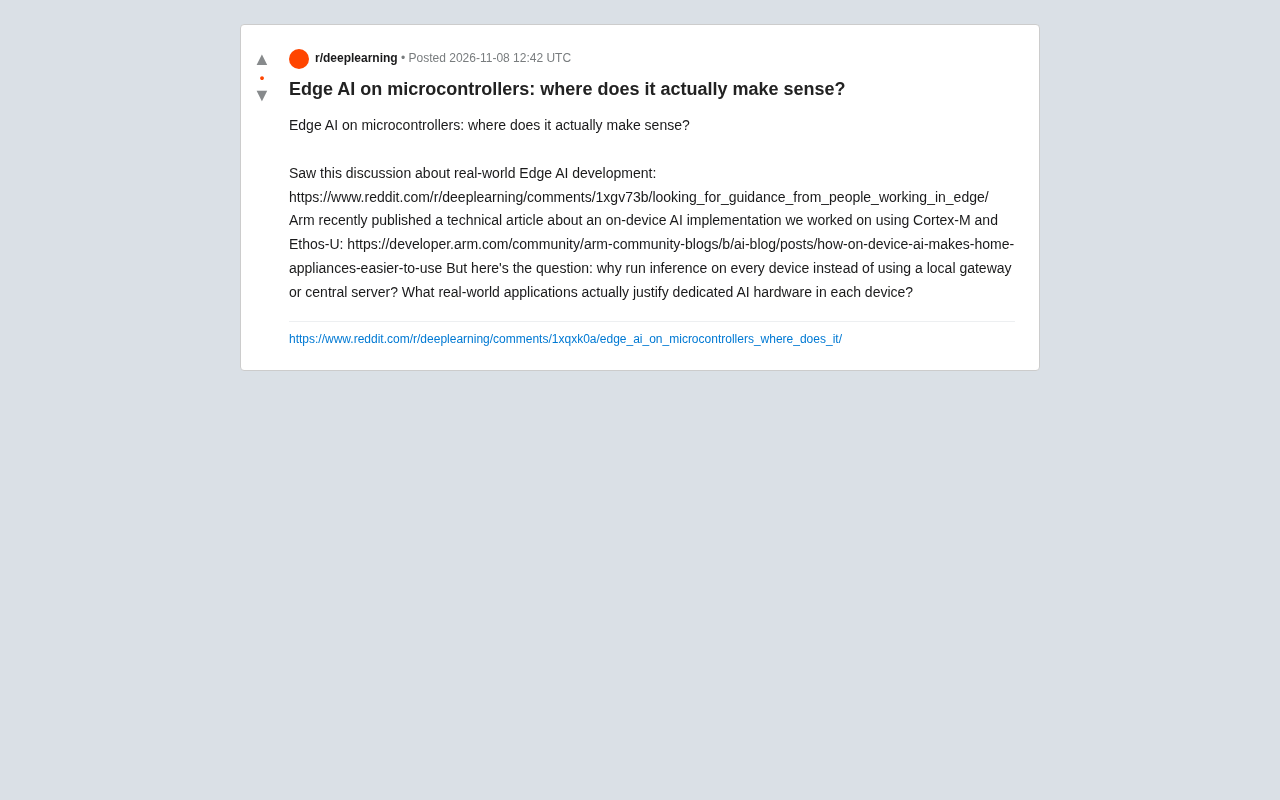
Edge AI on Microcontrollers: When Is It Actually Worth Deploying?
Drawing on Reddit discussions and Arm case studies, this article analyzes the real-world use cases for edge AI on microcontrollers: when each device needs independent inference, when a gateway or cloud is more reasonable, and the costs and boundaries of specialized hardware.
 Tech Frontiers
Pushing the Limits of Extreme Sudoku on a 16GB GPU: Insights from Depth and Flow Matching
A researcher trained a 16.54M-parameter model on a 16GB GPU to solve extreme Sudoku, finding effective depth breaks the 60% plateau and flow matching with improved sampling pushes accuracy past 99% with ~50× lower layer-evaluation budget.
 Tech Frontiers
AI Agent Approval Workflows: Why Human Confirmations Always Get Mindlessly Clicked
Why do AI agent approval workflows always get mindlessly clicked? A Reddit discussion shows that separating rules from keys, low-frequency high-risk approvals, and GitHub Environments-style gates are the keys to effective approvals.