Looking for Recommendations: A Casual Yet Technical AI Podcast?

A Reddit user seeks a casual, intermediate-to-advanced technical AI podcast with two fixed hosts, reflecting the scarcity of such programs.
Starting from a Reddit post looking for a "casual chat-style" technical podcast, the article analyzes why such podcasts are hard to find: technical podcasts are mostly divided into news-broadcast and guest-interview types, and talk-show-style discussion with fixed partners is demanding for hosts and hard to scale. Community recommendations focus on academic-leaning podcasts made part-time by researchers, industry-observation two-person chats, and open-source community spin-off programs. The article also provides selection criteria, such as complementary host backgrounds, willingness to make judgments, stable updates, and adjustable technical depth, and points out that this reflects a trend in AI content consumption toward "companion-style understanding".
A Thought Sparked by a Reddit Question
Recently I came across a post on Reddit with a very direct title: "any fun casual podcasts? [D]". The poster was looking for a specific style of podcast—light, casual, chatty, discussing the latest papers or industry trends, with intermediate-to-advanced technical depth, and ideally in the format of two regular co-hosts in conversation.
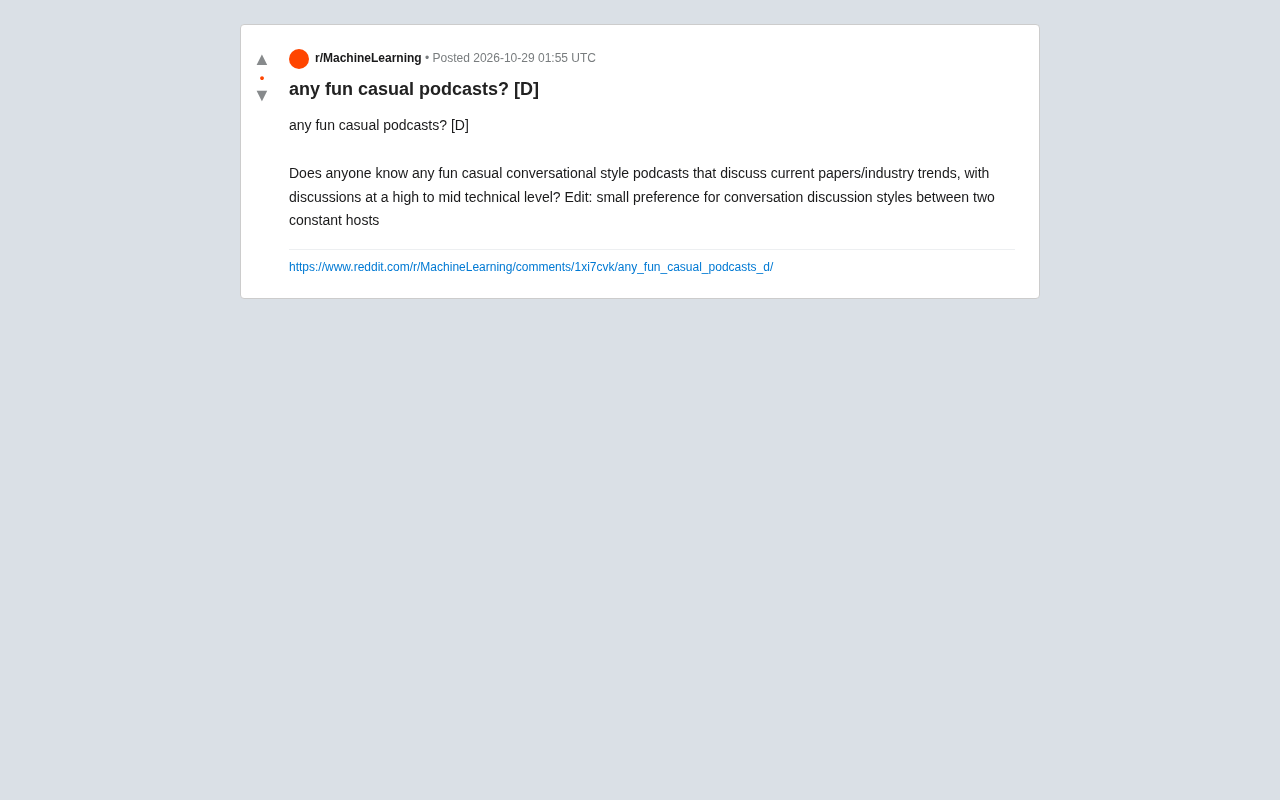
This need is actually quite typical. The AI field updates quickly, with papers and product releases coming thick and fast, but most podcasts are either too pop-science or too academic. Programs that truly manage to "discuss technology thoroughly like friends chatting" are not many. The poster specifically emphasized "two regular co-hosts", which shows he values the rapport that comes from long-term collaboration—that sense of conversation where they can catch each other's jokes without deliberate preparation and dive into technical details at any moment.
Why "Casual Technical Podcasts" Are So Hard to Find
Technical podcasts roughly fall into two categories: one is the news-broadcast type, where the host goes through the week's big events along a timeline—high information density but lacking clash of viewpoints; the other is the interview type, inviting guests each episode—deep enough but the style fluctuates with the guest, making it hard to form stable listening expectations.
What the poster actually wants is a third type: talk-show-style technical discussion with a fixed duo. This format places high demands on the hosts—they need to continuously track papers and industry developments, be able to break down complex concepts into colloquial expressions, and have the chemistry to keep the conversation from going cold. Many replies on Reddit also mentioned that such programs are often driven by personal charisma and are hard to produce at scale.
Common Recommendation Directions in the Community
Although the post itself didn't list specific programs, judging from the discussion directions, the community usually concentrates recommendations on a few types:
Academic-Leaning but Lighthearted Duo Combos
Some podcasts made part-time by researchers regularly pick popular papers on arXiv and go through the methods and experiments in a bantering way. The advantage of such programs is guaranteed technical accuracy; the disadvantage is unstable update frequency, since the hosts' main job is research.
arXiv is a preprint paper database operated by Cornell University, covering physics, mathematics, computer science, statistics, and many other disciplines. In the AI field, researchers typically upload papers to arXiv before formal peer review to quickly share the latest results. Therefore, papers on arXiv update extremely fast, with a large number of new submissions every day, but quality varies. For podcast hosts, selecting popular papers from arXiv for discussion ensures the topicality of the subject without waiting for the formal publication cycle. However, since preprints are not peer-reviewed, hosts often need to add caveats about the paper's credibility when interpreting, and listeners should also maintain critical thinking.
Industry-Observation Two-Person Chats
Another type is two practitioners discussing product launches, funding news, and technical roadmap debates. The technical depth may not match paper deep-dives, but it wins in diverse perspectives—one person leans engineering, the other research,刚好 covering the "intermediate-to-advanced" range the poster mentioned.
Technical roadmap debates refer to disagreements in the AI field between different technical schools or companies about development directions. For example, in model architecture, the debate between Transformer and hybrid architectures alternating convolution and attention; in training methods, the trade-off between self-supervised learning and supervised learning; in deployment strategies, the balance between cloud-based large models and on-device small models. These debates involve not only technical details but also commercial interests and ecosystem positioning. Two-person chat podcasts often revolve around these controversies, because clashing viewpoints naturally suit the conversational format and can help listeners understand the trade-offs behind technical choices.
Open-Source Community Spin-off Programs
Some podcasts grow out of open-source project communities, where the hosts are maintainers themselves and have first-hand experience when discussing technical decisions. Such programs tend to be more casual, even with inside jokes, making the barrier a bit higher for outsiders, but with strong immersion.
Open-source community spin-off programs are usually hosted by core maintainers or contributors of open-source projects. Since they directly participate in code development, issue discussions, and version releases, they have first-hand experience with the background and trade-offs of technical decisions. Such podcasts often circulate within the project community, and content may involve sensitive topics like unreleased roadmaps, internal debates, or technical debt. For outside listeners, some project background knowledge may be needed to fully understand, but once you get in, you gain a more vivid perspective than official documentation. Common examples include community podcasts around the Linux kernel, the Python ecosystem, or machine learning frameworks.
Several Practical Criteria for Choosing Such Podcasts
If you're also looking for similar programs, you can judge whether they suit your taste from these dimensions:
- Whether the hosts' backgrounds are complementary: Two people in the same direction easily lead to a single perspective; a combination of one engineering and one research, or one academic and one industry, usually sparks more.
- Whether they dare to make judgments: The value of casual podcasts lies in opinions, not restating abstracts. If the hosts only give neutral descriptions of papers without evaluations, the listening experience approaches an audio paper list.
- Whether the update rhythm is stable: The advantage of fixed hosts is stable style, but if updates are sporadic, the follow-along experience suffers.
- Whether the technical depth is adjustable: Good two-person conversations find a balance between "explaining clearly" and "not being verbose", pausing to expand on key details and quickly skimming the rest.
A Little Observation
This post itself didn't give an answer, but it reflects a real gap: AI content consumption is shifting from "acquiring information" to "companion-style understanding". People are no longer satisfied with knowing what happened; they want to hear two knowledgeable people chat and clarify the logic together. For content creators, this may be a direction more worth investing in than simply chasing hot topics.
If you have a podcast that fits "casual chat + intermediate-to-advanced technical depth + fixed two hosts", feel free to add it in the comments—such recommendations rely on word of mouth in the community, far more reliable than algorithmic rankings.
One-line Summary
A Reddit user seeks a casual, intermediate-to-advanced technical AI podcast with two fixed hosts, reflecting the scarcity of such programs.
Paragraph Summary
The article starts from a Reddit post looking for a "casual chat-style" technical podcast and analyzes why such podcasts are hard to find: technical podcasts are mostly divided into news-broadcast and guest-interview types, and talk-show-style discussion with fixed partners is demanding for hosts and hard to scale. Community recommendations focus on academic-leaning podcasts made part-time by researchers, industry-observation two-person chats, and open-source community spin-off programs. The article also provides selection criteria, such as complementary host backgrounds, willingness to make judgments, stable updates, and adjustable technical depth, and points out that this reflects a trend in AI content consumption toward "companion-style understanding".
Related articles
Ollama+RAG Local Knowledge Base Setup: A Step-by-Step AnythingLLM Tutorial
Based on a Bilibili tutorial, this guide details building a local RAG knowledge base with Ollama + AnythingLLM: from general LLM knowledge limits and RAG principles to document upload, vector storage, and verification.
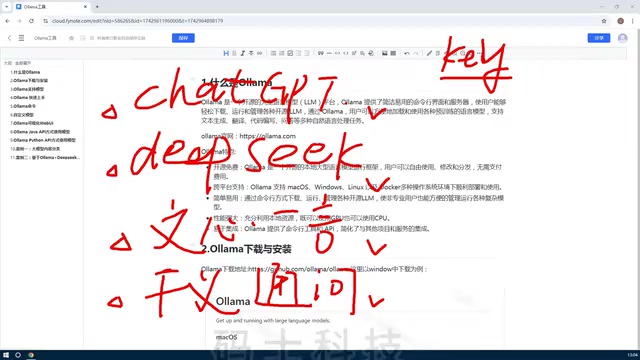
The Ultimate Ollama Tutorial: A Beginner's Guide to Running Large Models Locally for Free
Ollama is an open-source local large model management tool supporting free download and deployment of models like DeepSeek, with command-line and Web UI, cross-platform, automatic GPU/CPU scheduling — ideal for AI beginners and private deployment.
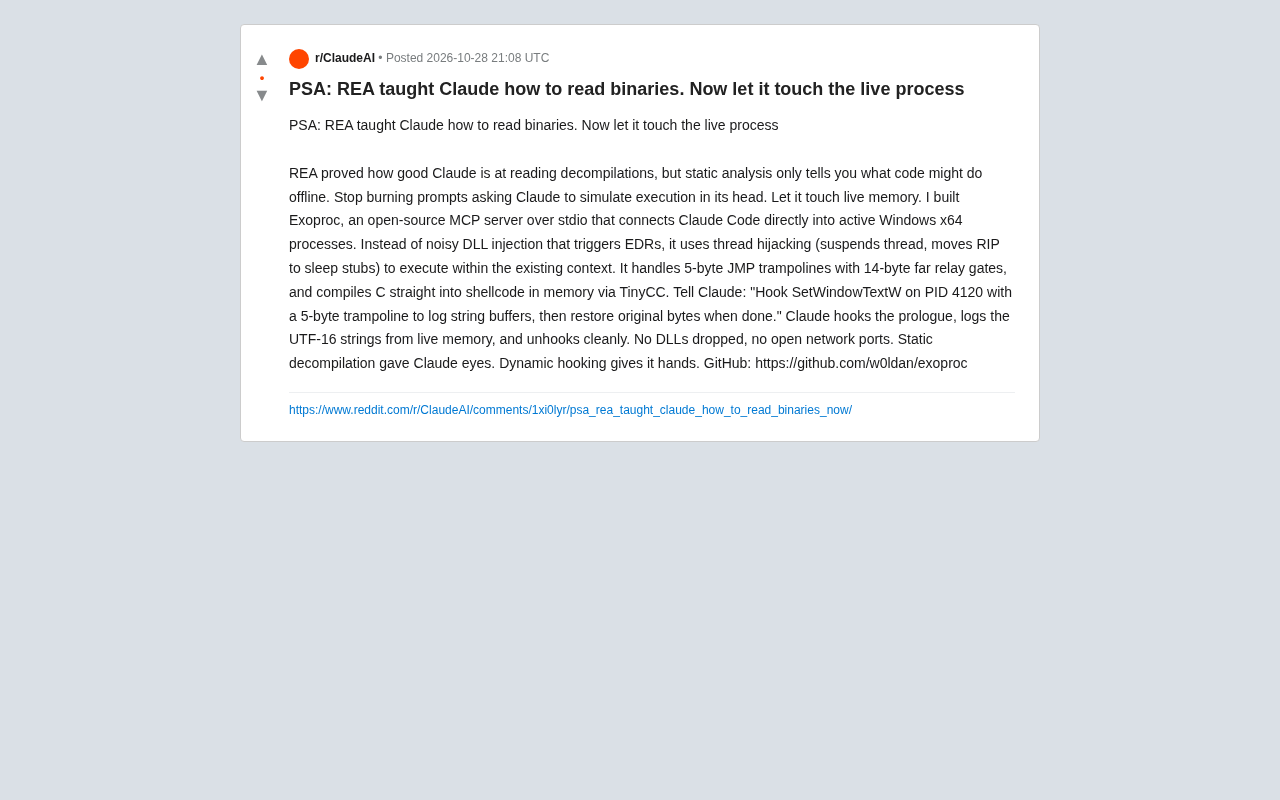
Giving Claude "Hands": Exoproc Open-Source MCP Server Enables Live Process Hooking
Exoproc is an open-source MCP server enabling Claude Code to hook live Windows x64 processes via thread hijacking, bypassing EDR for dynamic analysis. Static decompilation gave Claude eyes; dynamic hooking gives it hands.