Loop Engineering Builds an AI Development Pipeline: Keeping AI Code Generation Under Control

Loop Engineering uses an independent evaluator and circuit breaker to constrain large models, letting AI batch-produce code in a closed loop.
The article introduces an AI development pipeline called "Loop Engineering": the system automatically grabs error logs each day, dispatches a generator AI to draft fix code, then has an independent evaluator referee by running tests in a sandbox, with a maximum retry count as a circuit breaker to prevent death loops. Humans step outside the loop to design rules, boundaries, and termination conditions rather than interacting round by round. Only PRs that pass layer-by-layer filtering reach a human, enabling one team to auto-merge 1,300 PRs weekly. The article stresses that self-checking by large models leads to a "nodding loop," so deterministic processes must constrain their uncertain output; a programmer's core value shifts from typing code to system design and exception fallback.
When AI starts mass-producing code, a programmer's core job is no longer typing on a keyboard—it's designing a loop system that runs automatically while knowing when to hit the brakes.
According to a Bilibili creator, one team automatically merges 1,300 code PRs every week, with humans only taking a final glance. Behind that number is an AI development pipeline called "Loop Engineering"—it lets large models continuously produce fix code inside a closed loop without losing control due to blind overconfidence.
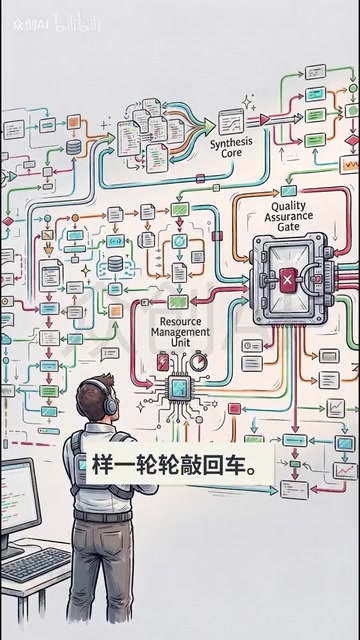
From "Operator" to "System Designer"
In the past, when using AI-assisted programming, programmers acted like operators—pressing Enter round after round, pasting error messages, waiting for replies, then manually verifying. The creator points out that this approach fragments a person's attention, and the efficiency bottleneck always remains with the human.
The core shift in Loop Engineering is this: you have to step behind the scenes and become a system designer outside the loop. The system automatically wakes up every morning, grabs the error logs from the previous night, and dispatches a generator AI dedicated to drafting fix code. Humans no longer participate in every round of interaction; instead, they design the loop's rules, boundaries, and termination conditions.
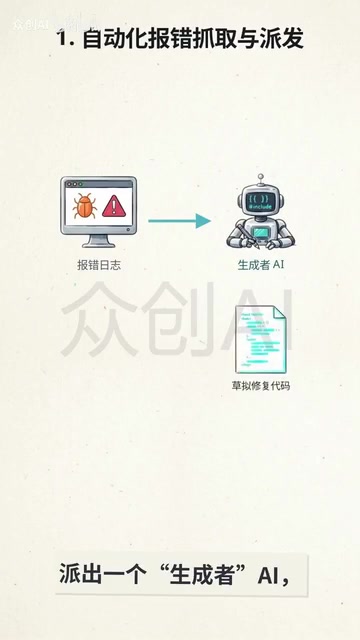
This role migration means a programmer's output shifts from "lines of code" to "the quality of system rules." If the rules are well designed, the machine can produce steadily unattended; if the rules have holes, the machine will spin at high speed or even churn out garbage code.
The Core Solution: An Independent Evaluator and a Circuit Breaker
Letting a large model check its own code is the most dangerous trap in Loop Engineering. The creator describes large models as inherently blindly overconfident—having them self-check only leads to a "nodding loop," where they keep confirming they're right and frantically pile up garbage code while drifting further from an actual fix.
The solution is to forcibly introduce an independent evaluator: a referee holding a red card, equipped with instructions different from the generator's, running tests in a sandbox. This evaluator has the power to say "no," and its judgment relies not on the generator's self-assessment but on executable test results.

A referee alone isn't enough. The system also pairs a maximum retry count as a circuit breaker: if it can't be fixed, archive it and call a human, preventing an idle death loop. The creator emphasizes that ultimately it's the machine's rules that govern probability—using a deterministic process to constrain the large model's uncertain output.

Sandbox in software engineering refers to an isolated test environment that is completely separated from side effects on the production environment or the main codebase. In Loop Engineering, the evaluator AI must run tests in a sandbox because the fix code generated by a large model may contain changes that are syntactically correct but behaviorally dangerous—for example, accidentally deleting data, introducing infinite loops, or breaking interface compatibility. A sandbox typically provides a restricted file system, network access, and compute resources, with observable and rollback-capable execution results. Only when tests pass in the sandbox is the code allowed into the merge queue—this is the precondition for "executable test results" to serve as the basis for a referee's judgment.
Circuit Breaker is a concept borrowed from the fault-tolerance pattern in distributed systems: when an operation fails consecutively up to a threshold, the system proactively cuts off the call and switches to a degraded path to avoid fault propagation or resource exhaustion. Loop Engineering borrows this mechanism, using a "maximum retry count" as the threshold. Once the generator AI fails to pass the evaluator's tests within a limited number of rounds, the system does not keep retrying; instead, it archives the current state and flags it for human intervention. This is fundamentally different from "retrying": retrying assumes the failure is temporary, whereas a circuit breaker acknowledges that the failure may be structural, and continuing the loop would only amplify waste.
The "Final Glance" After Layer-by-Layer Filtering
After layer-by-layer filtering through generation, independent evaluation, and circuit-breaker retries, only PRs that pass the tests reach a human. This is the premise for automatically merging 1,300 PRs per week: what a person sees is not the raw output but candidate results already filtered once by the rules.
When this closed loop runs fully across a codebase, a programmer's true value is no longer how many lines of code they type by hand, but whether the rules you set can stop a machine racing at high speed. The creator's conclusion is sharp: rule design has become the new core skill, while code itself has become a byproduct of the pipeline.
PR (Pull Request) is the merge-request mechanism in code collaboration platforms (such as GitHub and GitLab): a developer submits changes on a separate branch, initiates a review through a PR, and after discussion, testing, and approval, it is merged into the mainline. A PR is naturally suited to be the delivery unit of Loop Engineering because it separates the "change proposal" from the "merge action" and comes with a traceable diff record and status markers. The scale of 1,300 PRs per week means the system must automatically complete the entire process of creating PRs, triggering tests, collecting evaluation results, and approving merges, with humans only spot-checking at the final stage rather than manually operating each one.
Implications for Developers
Loop Engineering doesn't replace programmers with AI; it pushes programmers to a higher level of abstraction. You need to think about: how should the generator's and evaluator's instructions be isolated? Which critical paths should sandbox tests cover? Where should the circuit-breaker threshold be set so it neither cuts off too early nor lets things spin idly?
There are no standard answers to these questions, but the direction is clear—when AI can mass-produce code on a weekly basis, a person's competitiveness shifts to system design, rule-making, and exception fallback. Whoever can design more robust constraints outside the loop can make AI run faster without crashing.
Related articles

Resume Guide for Programmers Transitioning to AI: From an HR Perspective to Job Requirement Matching
How should programmers transitioning to AI write a resume? This Bilibili tutorial gives five key preparation actions: set aside two or three days to review skills and projects, choose a simple template, reverse-engineer the tech stack from job sites, emphasize LLM capabilities, and do a final check from an HR perspective.

Building a RAG Knowledge Base: A Complete Guide from Architecture to Retrieval Evaluation
A systematic overview of the full RAG knowledge base workflow: from overall architecture and mature retrieval solutions to key details of retrieval evaluation and who should learn it, helping developers build a path from beginner to hands-on practice.

Turn Screenshots into Web Code in Seconds: Anyone Can Write HTML with AI
A Bilibili creator demonstrates using AI to turn webpage screenshots directly into HTML and CSS code without manual coding. The article analyzes the tool's usage, new features like video-based app cloning, iterative refinement, and the real boundaries of AI giving zero-foundation users programming ability.