Loop Engineering: The New Paradigm for AI Self-Evolution

Loop Engineering turns AI interaction into a self-evolving system using genetic algorithm-inspired closed loops.
Loop Engineering, a concept advanced by Anthropic, upgrades AI interaction from one-off prompting to self-iterating systems. Built on four components—Mutator, Executor, Evaluator, and Selector—it mirrors genetic algorithms and reinforcement learning to let AI autonomously evolve solutions. The key requirement is a quantifiable, automatically scorable evaluation function, making it ideal for coding and benchmarking tasks while unsuitable for subjective or high-stakes domains.
From Prompt to Loop: A Paradigm Upgrade in AI Interaction
While most people are still figuring out how to write better prompts, a concept proposed by Anthropic is quietly changing the game — Loop Engineering. Its core idea is simple yet revolutionary: instead of treating AI interactions as one-off conversations, it transforms them into a system that iterates and improves itself.
Here's a concrete scenario: you set up a research loop in the evening, and the AI starts automatically modifying scripts, running tests, keeping what works and discarding what doesn't — while you go to sleep. The next morning, you wake up and check the optimal results the AI evolved overnight. This isn't a slide-deck concept — Anthropic has already put it to work in real workflows, including its Auto Research application and nano GPT training experiments.
About Anthropic: Anthropic is an AI safety company co-founded in 2021 by Dario Amodei (former VP of Research at OpenAI) and his sister Daniela Amodei. Its flagship product is the Claude family of large language models. Claude Code is Anthropic's developer-focused AI coding tool, deeply integrated into terminals and IDEs. It can read and write files directly, execute code, call external tools, and perform multi-step autonomous tasks. Unlike conventional chat-based AI assistants, Claude Code is architecturally designed for long-running, multi-step, autonomous use cases — making it a natural vehicle for Loop Engineering.
The concept itself isn't brand new, but it has resurfaced and gained wide traction recently as prompt engineering continues to evolve and the AI tooling ecosystem matures. At its core, it transforms "talking to AI" into an automated search process with an evaluation function.
The Core Architecture of Loop Engineering: A Genetic Algorithm-Based Closed Loop
The underlying logic of Loop Engineering is essentially a closed loop based on genetic algorithms. Genetic algorithms, first proposed by John Holland in 1975, mimic natural selection and genetic mechanisms: individuals better adapted to their environment are more likely to survive and reproduce, passing their superior traits to the next generation. The algorithm searches for optimal solutions across generations through the cycle of "population → fitness evaluation → selection → crossover → mutation → new population." Loop Engineering maps this idea directly onto AI workflows: each generation of prompts or code is the "population," the evaluation function is the "fitness function," the LLM's process of generating variants is "mutation," and keeping the Top-K results is "natural selection." The entire loop is built on four indispensable components:
The Four Core Components
1. Mutator: Based on the best results from the previous generation and evaluation feedback, it prompts the large language model to generate N variants — whether that means modifying prompts, code, or hyperparameters.
2. Executor: Actually runs the code, calls APIs, and executes evaluation sets to produce real runtime results.
3. Evaluator: Automatically scores outputs using scripts — metrics like test pass rate, loss, reward, accuracy, and so on.
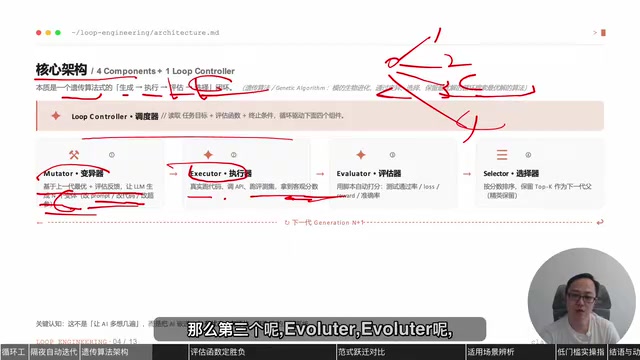
4. Selector: Ranks outputs by score and retains the Top-K as the "elites" for the next generation, implementing an elitist retention strategy.
At the end of each generation, the loop feeds back into the Mutator and repeats. All four components are tightly coupled — remove any one of them, and the loop simply won't run.
It's worth noting that Loop Engineering is structurally highly isomorphic with Reinforcement Learning (RL). In the RL framework, an agent interacts with an environment to receive reward signals and continuously adjusts its policy to maximize cumulative reward. OpenAI's RLHF (Reinforcement Learning from Human Feedback), used to train the GPT series, is itself a loop: model generates output → human or model scores it → policy updates → repeat. Loop Engineering can be seen as a democratization of RL thinking — moving it from the "model training layer" down to the "application usage layer." Ordinary developers don't need to train a model; they just need to design a good evaluation function, and an off-the-shelf LLM can complete a RL-like self-optimization process at the application level.
The System's Achilles' Heel: An Automatically Scorable Evaluation Function
All four components matter, but the automatically scorable evaluation function is the system's true linchpin. The qualifier "automatically scorable" is crucial, because it replaces the role of a human judge.
There's a clear dividing line here. Parts that can be automatically scored are quantifiable: unit tests, training loss reduction, benchmark scores, BLEU, business KPIs, and so on. Parts that are hard to automatically score typically involve subjective judgment: "Is this copy creative?" "Is this code elegant?" "Does this answer satisfy the user?"
Evaluation Metric Explainer: BLEU (Bilingual Evaluation Understudy) is a natural language generation evaluation metric proposed in the 1990s that measures quality by computing n-gram overlap between generated text and reference translations — still a standard benchmark in machine translation today. HumanEval is a code generation evaluation dataset released by OpenAI in 2021, containing 164 hand-crafted Python programming problems, each with test cases, measured by the "pass@k" metric for the probability that a model generates correct code. Both exemplify the core trait of "automatic scorability" — which is precisely why programming tasks are the easiest domain for Loop Engineering to take hold.

Forcing a large model to evaluate subjective questions often produces completely wrong results, causing the loop to evolve in the wrong direction. The conclusion is clear: hand quantifiable tasks to automated evaluation functions; keep humans in the loop as judges for anything that can't be quantified.
Common automatic scoring tools include unit tests, BLEU, HumanEval, business KPIs, and "LLM as Judge" approaches. LLM as Judge was systematically proposed by Lianmin Zheng et al. in the MT-Bench paper (2023). The core idea is to use an independent large language model to score the output of another model, replacing expensive human annotation. Its advantage is the ability to handle open-ended questions, bridging the gap that metrics like BLEU can't — evaluating semantic quality. But its limitations must be acknowledged: strong models carry biases (e.g., preferring longer answers), and judgments can be inconsistent. It's a compromise to bridge the "quantifiable" and "non-quantifiable" divide, not a silver bullet. Writing code lets you run tests — making code-related loops easy to run — while writing a marketing strategy is hard to auto-score, making a loop difficult to implement.
Loop Engineering vs. Prompt Engineering: A Seven-Dimension Comparison
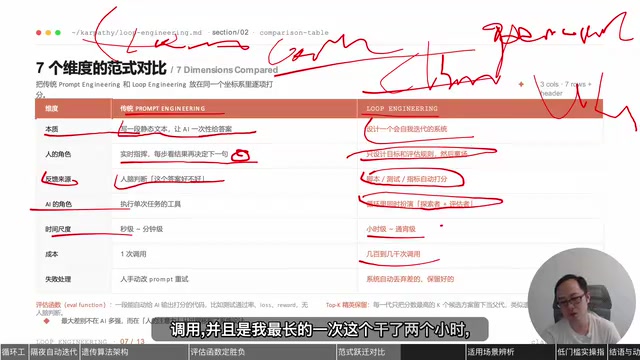
Is this a genuine paradigm shift, or just writing more complicated prompts? A seven-dimension comparison reveals the essential difference:
| Dimension | Prompt Engineering | Loop Engineering |
|---|---|---|
| Nature | Writing static text for a one-off answer | Designing a self-iterating system |
| Human role | Real-time direction, reviewing each step | Design the goal and evaluation rules, then step away |
| Feedback source | Human judgment of output quality | Automated script scoring |
| AI role | Execution tool for single tasks | Simultaneously explorer and evaluator |
| Time scale | Seconds to minutes | Hours to overnight |
| Failure handling | Manually discovered and corrected | System automatically discards bad, keeps good |
| Core shift | Direct use of AI capability | Human attention moves from process to system design |
In practice, tools like Claude Code, Codex, and OpenCode already have Loop Engineering capabilities built in — capable of hundreds to thousands of sustained calls. The longest single run lasted a full two hours, just to optimize one piece of code. This is the real picture of Claude Code continuously executing hundreds of tool calls unsupervised, automatically debugging code.
The most fundamental difference, in one sentence: It's not about how powerful the AI is — it's about shifting human attention from the "process" to the "system design."
A Memorable Analogy: SQL Query vs. Genetic Algorithm
Traditional Prompt Engineering is like writing an SQL query: you write a query, the database returns one result, done in one shot. If it's wrong, you revise the query and run it again — each output requires you to personally read and judge it.
Loop Engineering is more like running a genetic algorithm or reinforcement learning: you design a fitness function and let candidate solutions evolve over dozens or hundreds of generations. It keeps iterating while you sleep, and you wake up to see the Top-1 result directly. The human upgrades from "operator" to "rule designer." This philosophy aligns with the RL approach of "designing reward functions rather than manually specifying every step" — the difference being that Loop Engineering doesn't require you to train a new model; instead, it lets existing LLMs complete this evolutionary process at the application layer.
In other words, Prompt Engineering is you teaching AI how to take each step; Loop Engineering is you designing a system that lets AI run ten thousand steps on its own and filters out the optimal solution.
Practical Implementation: What Works, What Doesn't
The key to determining whether a problem suits Loop Engineering is whether it can be automatically scored.
Suitable Scenarios
- Programming tasks with clear test cases
- Model training with established benchmarks
- Tasks with validation sets that support automatic evaluation
- Data cleaning, hyperparameter tuning
Unsuitable Scenarios
- Subjective tasks (creative writing, aesthetic judgment)
- Single tasks with extremely high execution costs
- High-risk decisions requiring human alignment, such as medical diagnosis or legal judgment
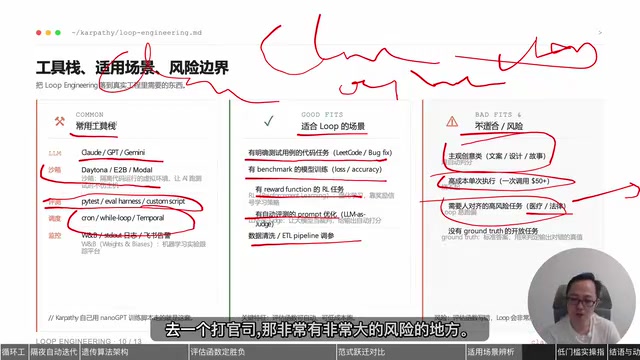
A wrong medical diagnosis could harm someone's health; a flawed legal judgment could determine the outcome of a case. These high-stakes domains absolutely cannot be left to autonomous AI loops. This also reflects the fundamental limitations of evaluation functions: when the "correct answer" involves complex ethical judgment, individual variation, or professional certification, no automatic scoring mechanism can truly replace human expert judgment. Forcing a loop in these contexts only amplifies errors at an exponential rate.
Try It Yourself: Build Your Minimal Loop
Reading ten articles is no substitute for running one loop yourself. Here's how to get started:
- Pick a function you write often: parsers, scraping scripts, data processing functions — any of these work;
- Write 5–10 test cases: this is your automatic evaluation function. Follow HumanEval's design philosophy — each test case covers one edge condition, ensuring comprehensive evaluation rather than just validating the "happy path";
- Build a minimal loop: use Claude/GPT + a Python loop + an Eval function, have the model generate three variants, run the tests, keep the Top-1 — you can even ask the model to write this code for you;
- Grab a coffee, get some sleep, and check the results in the morning.
Compare the best result against your hand-written version — in most cases, you'll be pleasantly surprised.
Closing Thoughts: A Fundamental Shift in How Humans and AI Collaborate
What Loop Engineering truly changes is the human's role in AI collaboration. Previously, the job was to write prompts, inspect outputs, judge quality, and revise — every iteration required human involvement. Now, humans only need to do one thing well: design the evaluation function, without even needing to sit at a computer supervising every run.
Even though tools like Claude Code, Codex, and OpenCode already have this looping mechanism built in, the best way to truly understand what Loop Engineering is — what it can and can't do — is to run through it yourself. Once you integrate this approach into your daily workflow, you'll find that the way you collaborate with AI has fundamentally changed.
Key Takeaways
Related articles

Alibaba Launches Happy Shrimp: AI-Powered One-Click Complete Song Generation
Alibaba launches Happy Shrimp, an AI music generation tool that creates complete songs with lyrics, melody, arrangement, and vocals from natural language descriptions. In-depth analysis of its core features, differentiation from competitors like Suno, and industry impact.
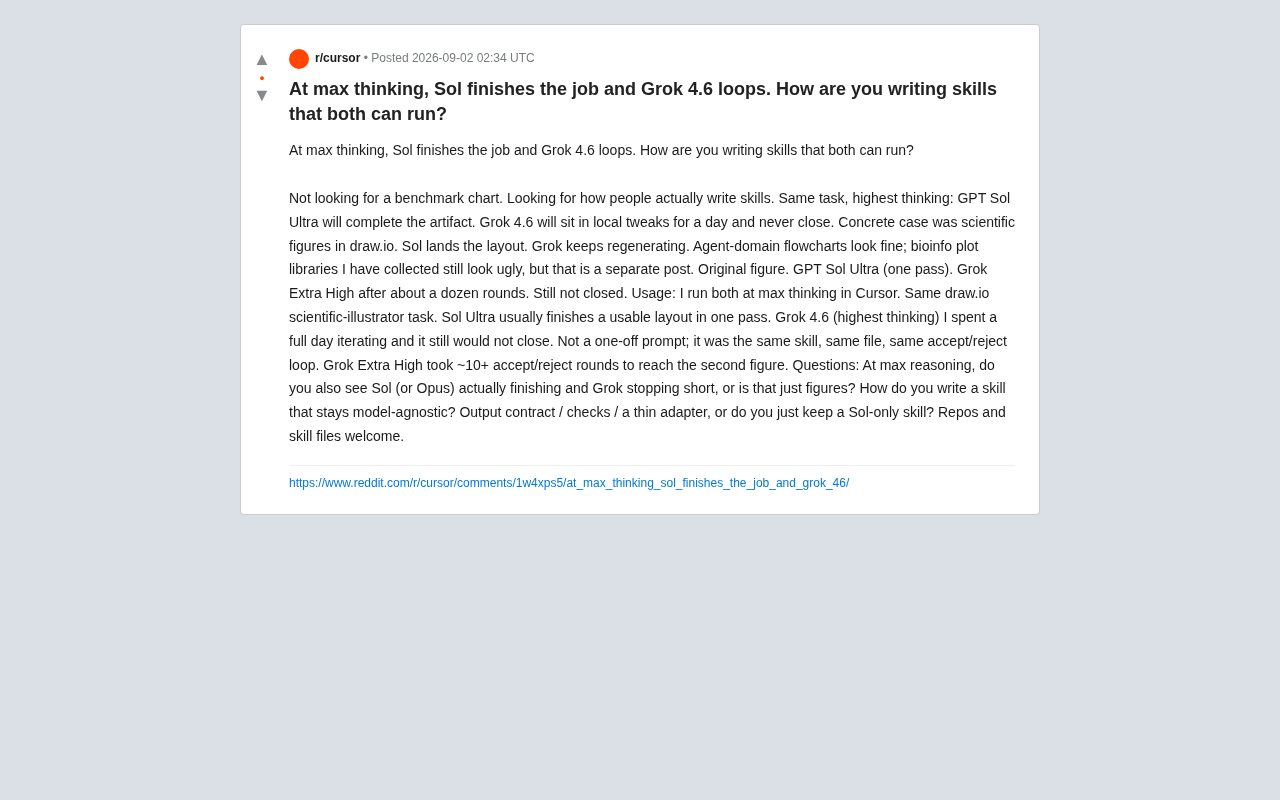
GPT Sol Ultra vs Grok 4.6: Real-World Task Completion Benchmark in Reasoning Mode
Developer benchmark reveals GPT Sol Ultra completes draw.io scientific diagrams in one iteration while Grok 4.6 fails to converge despite maximum reasoning mode, exposing that reasoning depth ≠ task delivery capability.
OpenAI Authorship Dispute: The Battle Over Academic Boundaries in the AI Era
OpenAI disputes authorship with mathematician Tristan Buckmaster over Navier-Stokes research, raising ethical questions about AI involvement in science.