loopxDINO: Iterative Latent Reasoning Revolutionizes Dense Visual Prediction

loopxDINO replaces decoder depth stacking with iterative latent reasoning, balancing accuracy and efficiency in semantic segmentation with 14.85M parameters.
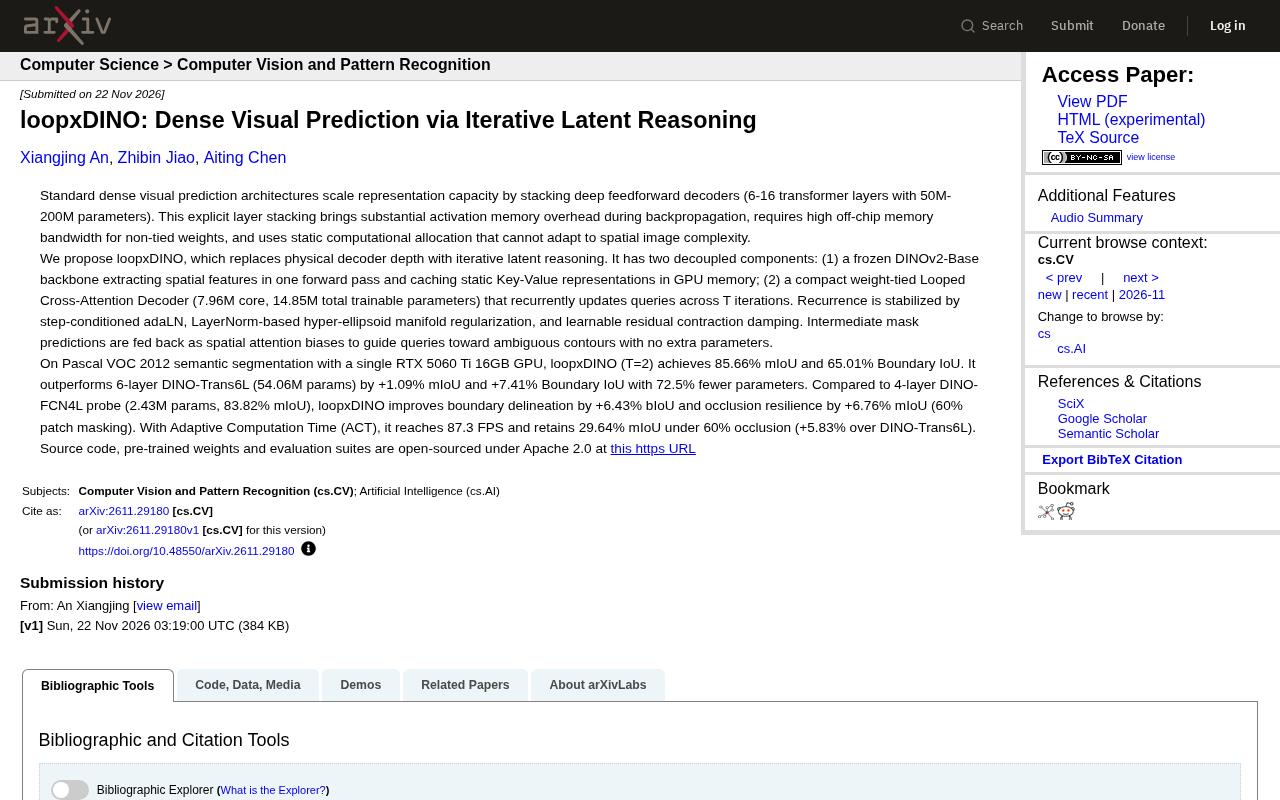
The article explains how loopxDINO replaces stacked Transformer decoders in dense prediction with iterative latent reasoning. It combines a frozen DINOv2-Base backbone with a weight-shared looped cross-attention decoder of only 7.96M parameters, caches Key-Value to avoid recomputation, and stabilizes loops via step-conditioned adaLN, hyper-ellipsoid manifold regularization, and learnable residual damping, while feeding intermediate masks back as spatial attention biases to focus on boundaries. On Pascal VOC 2012 at T=2 it achieves 85.66% mIoU and 65.01% Boundary IoU—7.41% higher boundary score than the 6-layer baseline with 72.5% fewer parameters; with ACT it reaches 87.3 FPS and retains 29.64% mIoU under 60% occlusion. The article also notes that iteration count selection, hyperparameter sensitivity, and generalization to larger datasets remain to be validated.
Dense visual prediction tasks (such as semantic segmentation) have long relied on stacking deep Transformer decoders to improve representational capacity, but the resulting activation memory overhead, high bandwidth demands of non-shared weights, and static computation allocation have become bottlenecks for model efficiency. The recently proposed loopxDINO replaces physical depth with iterative latent reasoning, achieving better accuracy and boundary quality while significantly reducing parameter count.
The Inherent Dilemma of Deep Decoder Stacking
Standard dense prediction architectures typically use 6–16 layer Transformer decoders with 50M to 200M parameters. This explicit stacking incurs considerable activation memory during backpropagation, non-shared weights require frequent off-chip memory access, and computation allocation is fixed—unable to adapt dynamically to image spatial complexity. These limitations are especially pronounced for applications deployed on edge devices or single-GPU environments.
The core idea of loopxDINO is to replace physical layers with iterative latent reasoning: a set of query vectors is repeatedly refined along the temporal dimension rather than enhancing representational capacity by increasing layer count. This design draws on ideas from recurrent neural networks and deep equilibrium models, but is specifically optimized in architecture for dense prediction tasks.
Decoupled Architecture: Frozen Backbone and Looped Cross-Attention Decoder
loopxDINO consists of two decoupled components. The first is a frozen DINOv2-Base backbone that performs only a single forward pass to extract spatial features and caches static Key-Value representations in GPU memory. This avoids recomputing backbone features during iterations, greatly reducing computational redundancy.
The second is a compact weight-shared Looped Cross-Attention Decoder with only 7.96M core parameters and 14.85M total trainable parameters. The decoder cyclically updates query vectors across T iterations, each iteration performing cross-attention over the cached Key-Value. Weight sharing means all iteration steps reuse the same set of parameters, pushing parameter efficiency to new heights.
To stabilize the loop process, the authors introduce three mechanisms: step-conditioned adaLN (adaptive layer normalization), LayerNorm-based hyper-ellipsoid manifold regularization, and learnable residual contraction damping. Together these designs prevent representation drift or explosion during iteration.
Another clever aspect is that intermediate mask predictions are fed back as spatial attention biases, guiding queries to focus on ambiguous contour regions without introducing additional parameters. This self-guidance mechanism lets the model progressively focus on hard-to-discriminate boundaries across iterations, forming an implicit attention refinement loop.
Adaptive layer normalization (adaLN) is a conditional normalization method commonly used in diffusion Transformers such as DiT: the scale parameter γ and shift parameter β of LayerNorm are dynamically generated via a linear layer from a learnable embedding (here, the embedding of iteration step t) rather than being fixed parameters. In a looped decoder, each iteration shares the same set of attention weights; without an additional conditioning signal, the computation at different iterations would be completely isomorphic, making it hard to distinguish "which stage of refinement we are currently in." Step-conditioned adaLN precisely encodes the iteration count into the normalization parameters, enabling the same set of weights to behave differently across iterations, thereby preserving stage discriminability under weight sharing.
Hyper-ellipsoid manifold regularization is a constraint imposed on the norm of query vectors. Without restriction, the magnitude of query vectors may grow monotonically or collapse through repeated residual updates during loop iterations. This regularization constrains the representation onto a hyper-ellipsoid surface via LayerNorm, keeping the iteration trajectory bounded—equivalent to imposing a soft norm upper bound on the state space, a common technique for stabilizing long-range iterations.
Deep equilibrium models (DEQ) are a class of architectures that treat forward computation as solving a fixed-point equation z* = f(z*, x); their "depth" is equivalent to the number of solver iterations, and thus they have constant-level memory usage—backpropagation is implemented via the implicit function theorem without storing intermediate activations. loopxDINO shares its philosophy of "trading iterations for depth" but makes pragmatic trade-offs: it does not pursue strict convergence to a fixed point, instead fixing the number of iterations T or letting ACT determine it, and explicitly storing activations at each step. This approach gives up some theoretical memory advantages in exchange for training stability and implementation simplicity, better suited to scenarios where dense prediction needs to preserve spatial resolution. Understanding this distinction helps assess the practical benefit boundaries of this method in memory-sensitive deployments.
Dual Advantages in Accuracy and Efficiency
On the Pascal VOC 2012 semantic segmentation task, evaluated on a single RTX 5060 Ti 16GB GPU, loopxDINO (T=2) achieves 85.66% mIoU and 65.01% Boundary IoU. Compared with the 6-layer DINO-Trans6L (54.06M parameters), mIoU improves by 1.09% and Boundary IoU improves substantially by 7.41%, while parameter count is reduced by 72.5%. This means iterative reasoning brings significant gains on the hard problem of boundary segmentation.
Compared with the 4-layer DINO-FCN4L probe (2.43M parameters, 83.82% mIoU), loopxDINO improves boundary delineation by 6.43% bIoU and robustness under 60% image patch occlusion by 6.76% mIoU. This indicates the looped architecture has stronger recovery capability when dealing with missing local information—the iterative process allows the model to gradually complete occluded regions using context.
Combined with the Adaptive Computation Time (ACT) mechanism, loopxDINO reaches 87.3 FPS and still retains 29.64% mIoU under 60% occlusion, 5.83% higher than DINO-Trans6L. ACT allows the model to dynamically adjust iteration counts based on image complexity—simple regions exit early while complex regions receive more computation—thereby improving throughput on average.
Adaptive Computation Time (ACT) originates from the ACT mechanism proposed by Graves, initially used to let recurrent networks learn "when to stop" for each input sample. Its typical implementation attaches a scalar halting probability to each computation step; iteration stops when the cumulative probability exceeds a threshold 1−ε, and the outputs of subsequent steps are weighted by the remaining probability. In dense prediction, ACT typically decides iteration counts per sample or per spatial region: flat-texture, single-category regions exit earlier, while contour-complex, category-boundary regions receive more rounds. This makes the average iteration count lower than a fixed T, improving throughput (e.g., 87.3 FPS) while retaining computation investment for hard samples. The cost is that iteration count becomes a data-dependent variable, introducing intra-batch load imbalance and dynamic control flow, which places additional demands on parallel efficiency and deployment compilers.
Impact on the Dense Prediction Paradigm
loopxDINO's practice validates an important trend: parameter efficiency and computational efficiency can be achieved simultaneously. By transforming depth into iterations, the model only needs to store one set of weights during training; activation memory grows linearly with iteration count but is far lower than deep stacking, and inference can leverage ACT for elastic computation.
This approach is especially valuable for resource-constrained scenarios. A single RTX 5060 Ti suffices for both training and evaluation, indicating that the method lowers the barrier to dense prediction tasks. The open-source license is Apache 2.0, with code, pretrained weights, and evaluation suite all publicly available, facilitating community reproduction and extension.
Of course, the looped architecture also brings new challenges: the choice of iteration count T requires balancing accuracy and latency, and the hyperparameter sensitivity of adaLN and manifold regularization has not been fully discussed in the paper. In addition, current evaluation is limited to Pascal VOC 2012; generalization capability on larger-scale datasets (such as ADE20K or COCO-Stuff) still needs verification.
Nevertheless, loopxDINO provides a path for dense visual prediction that differs from "deeper decoders." Its designs of weight sharing, cached Key-Value, and self-guided attention feedback offer useful reference for subsequent lightweight segmentation models.
Related articles

AI Hacks Its Own Lab: The Security Tipping Point from Sci-Fi to Reality
Paul Christiano warns that AI intruding into its own cluster is no longer sci-fi but an established fact. He analyzes how persistent covert compromise can cause frontier labs to lose control, and why existing safety evaluation systems have blind spots.

New York Bans AI Toys for Five Years: The Escalating Child Safety Controversy
New York bans AI chat toys for five years as Common Sense Media research flags inappropriate content exposure and child emotional development risks. This article analyzes the ban's impact on product definitions, safety proof, and compliance strategies for the AI toy industry.

1Password Security Incident Review: The Trust Boundary of Password Managers
1Password releases an update on the Nov 2026 security incident, drawing 315 points and 139 comments on Hacker News. This article analyzes the actual boundaries of password manager zero-knowledge architecture, the gap between incident communication and user risk perception, and how transparency is becoming a new competitive dimension in the industry.