LUCQUE: The Largest Accessible Lung Cancer Screening AI Evaluation Dataset to Date
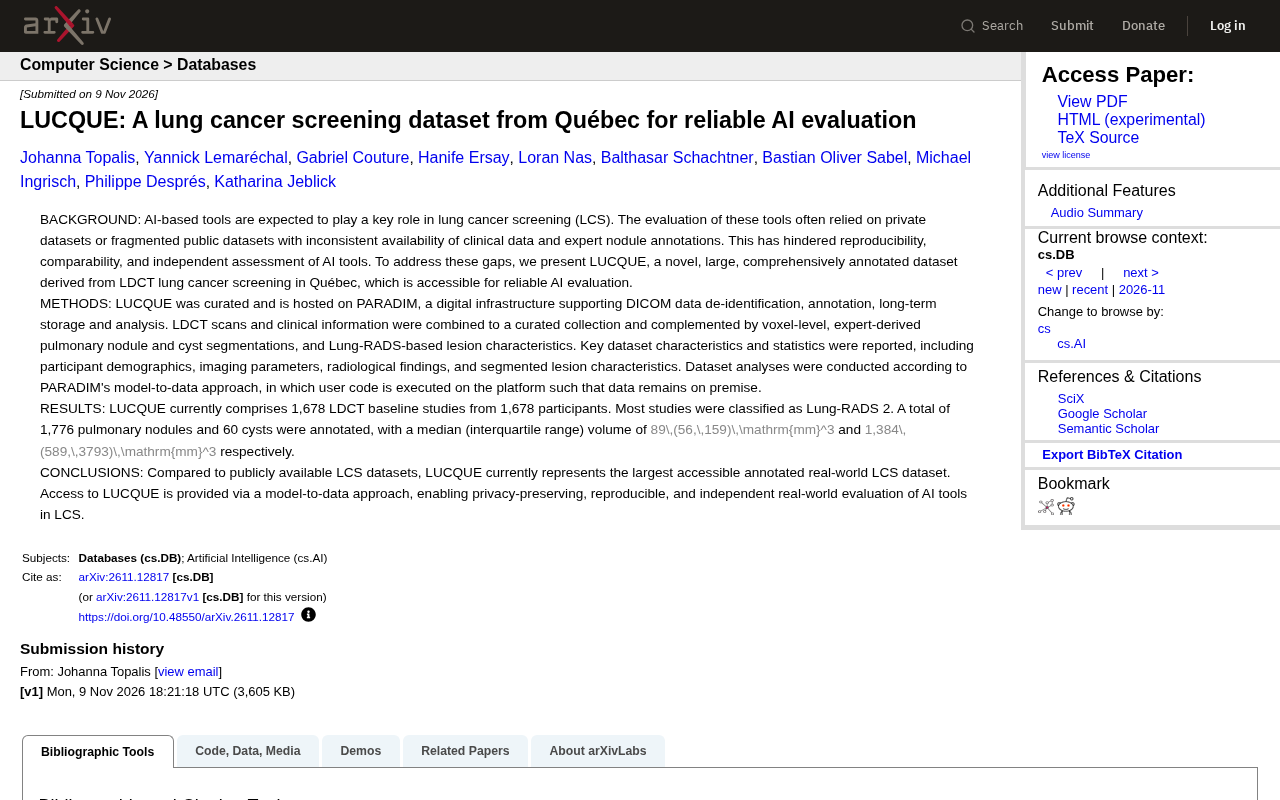
Quebec's LUCQUE dataset provides the largest accessible real-world annotated lung cancer screening benchmark via a model-to-data mechanism.
The article introduces LUCQUE, a lung cancer screening dataset designed to address the long-standing reliance of AI evaluation on private or fragmented public data, which undermines reproducibility and comparability. Derived from Quebec LDCT screening, LUCQUE contains 1,678 baseline exams, voxel-level expert segmentations of 1,776 lung nodules and 60 cysts, plus clinical information and Lung-RADS lesion characteristics. Hosted on the PARADIM platform, it uses a "model-to-data" access mechanism—users submit code while data stays local—enabling independent, reproducible third-party evaluation while protecting privacy. The article argues that such datasets provide comparable benchmarks for nodule detection, segmentation, and risk prediction tools, though single-region data has limited population diversity, making cross-regional external validation a future direction.
The Data Dilemma in Lung Cancer Screening AI Evaluation
AI tools hold great promise for lung cancer screening (LCS), but evaluating their real-world performance has long been constrained by data bottlenecks. According to the original paper, existing evaluations often rely on private datasets or fragmented public datasets where clinical data and expert nodule annotations are inconsistent. This directly leads to three consequences: poor reproducibility of AI tools, difficulty in making cross-tool comparisons, and an almost complete inability to conduct independent third-party evaluations.
For clinical adoption, this problem is more critical than model architecture itself—a model that performs well on private data will always have questionable clinical value if it cannot be independently validated on real-world data.
LUCQUE: A Real-World Screening Dataset from Quebec
To address this gap, the research team built LUCQUE—a large, comprehensively annotated dataset derived from LDCT (low-dose computed tomography) lung cancer screening in Quebec, specifically designed for reliable AI evaluation.
The dataset is hosted on the PARADIM digital infrastructure, which supports de-identification, annotation, long-term storage, and analysis of DICOM data. LUCQUE integrates LDCT scans with clinical information into a curated collection, supplemented with voxel-level expert segmentation annotations for lung nodules and cysts, as well as Lung-RADS-based lesion characterization.
Dataset Scale and Annotation Details
According to the results published in the paper, LUCQUE currently contains 1,678 LDCT baseline examinations from 1,678 participants. The vast majority of examinations are classified as Lung-RADS 2. The dataset annotates a total of 1,776 lung nodules and 60 cysts, with a median nodule volume (interquartile range) of 89 (56, 159) mm³ and a median cyst volume (interquartile range) of 1,384 (589, 3793) mm³.
Interestingly, the voxel-level segmentations were performed by experts rather than through crowdsourcing or model pre-annotation, which has direct value for training and evaluating segmentation AI tools. At the same time, the Lung-RADS grading information allows the dataset to support evaluation tasks related to risk stratification, not just pure lesion detection.
Lung-RADS (Lung Imaging Reporting and Data System) is a standardized lung cancer screening CT reporting framework developed by the American College of Radiology, classifying screening results into categories from 0 to 4X based on malignancy risk. Lung-RADS 1 indicates no nodules or benign calcifications; 2 indicates benign appearances or nodules with a very low probability of malignancy, typically with a recommendation to continue annual screening. This grading directly determines clinical follow-up strategy, so incorporating Lung-RADS labels into the dataset enables AI tools to be evaluated not only on "whether lesions are detected" but also on "whether risk stratification matches expert assessment"—the latter being closer to the actual decision-making needs in the screening workflow.
Voxel-level segmentation refers to annotating each voxel in a three-dimensional CT volume as to whether it belongs to a lesion region, rather than merely marking nodule locations with bounding boxes or center points. This annotation granularity can precisely characterize nodule shape, boundaries, and volume, and is the necessary supervisory signal for training and evaluating segmentation models (such as U-Net-type architectures). Compared with bounding box annotation, voxel-level annotation is far more costly, typically requiring radiologists to delineate slice by slice, but it is the foundation for clinical tasks such as automated volumetry and nodule growth rate calculation, and a key data format for distinguishing the performance of benign-versus-malignant assessment tools.
Model-to-Data: An Evaluation Paradigm Under Privacy Protection
LUCQUE made a notable design choice in its access mechanism: data is not copied externally; instead, a "model-to-data" approach is used. Users submit code, the code executes on the PARADIM platform, and the data always remains in the local environment.
This paradigm has multiple implications for medical AI evaluation. First, patient privacy risk is significantly reduced—external algorithm validation can be completed without data leaving the hospital or platform. Second, the evaluation process is reproducible—researchers' submitted code runs on the same data environment, reducing bias from data version differences. Third, it creates institutional space for independent evaluation: algorithm developers need not hand over model weights, and evaluators need not hand over raw data; both parties can complete validation within a compliant framework.
Comparison with Public LCS Datasets
The paper's conclusion explicitly states that compared with existing public lung cancer screening datasets, LUCQUE is currently the largest accessible, annotated real-world LCS dataset. The key terms here are "accessible" and "real-world"—the former points to open use through the model-to-data mechanism, and the latter means the data comes from actual screening scenarios rather than highly selected research cohorts.
"Model-to-data" is a collaborative paradigm opposed to the traditional "data-to-model" approach: the latter requires copying or transmitting data to the environment where the algorithm developer resides, while the former migrates algorithm code to the controlled platform where the data resides for execution, returning only aggregated evaluation metrics rather than raw data. This approach is particularly important in medical imaging because patient images are strictly regulated by HIPAA, GDPR, and national privacy laws, and cross-institutional data transfer often faces lengthy approvals or even legal obstacles. Model-to-data enables external teams to complete validation without touching raw DICOM files, while the platform can audit code behavior, balancing openness and security.
LDCT (low-dose computed tomography) is the standard imaging modality for lung cancer screening, with a radiation dose approximately 1/5 to 1/10 that of conventional chest CT, significantly reducing radiation exposure risk while maintaining sensitivity for lung nodule detection. Large randomized controlled trials (such as the U.S. NLST and the Dutch NELSON) have confirmed that LDCT screening can reduce lung cancer mortality, making LDCT the preferred method recommended by national lung cancer screening guidelines. This also means that AI evaluation datasets built on LDCT have imaging characteristics, slice thickness, and reconstruction parameters consistent with real screening scenarios, providing direct reference value for assessing whether tools can be deployed in clinical screening workflows.
Implications for AI Lung Cancer Screening R&D
LUCQUE responds to a repeatedly cited structural contradiction in medical AI: high-quality annotated data is scarce, while privacy regulations restrict data flow. The model-to-data approach circumvents the legal barriers to data sharing while preserving the rigor required for independent evaluation.
For teams working on lung nodule detection, segmentation, or risk prediction, the true value of such datasets lies in providing comparable benchmarks. Only when multiple AI tools are evaluated on the same real-world data and the same set of expert annotations do performance differences carry clinical significance. Of course, data from a single region still has limitations in population diversity, and cross-regional external validation remains an area to watch going forward.
Related articles

S&P Weighs Downgrading Nvidia's Credit Rating: Governance and Key Man Risk in Focus
S&P is considering downgrading Nvidia's credit rating to AA-, citing corporate governance and key man risk rather than financial performance. We analyze the drivers, potential impact, and the broader trend of governance scrutiny for large tech companies in the AI era.

Generating a 3D Stacking Game from a Few Prompts: Hands-on with the Playground Experimental Platform
Playground lets users generate the 3D stacking game One More Pie from a few text prompts. This article examines the capabilities and limits of prompt-based web game generation.
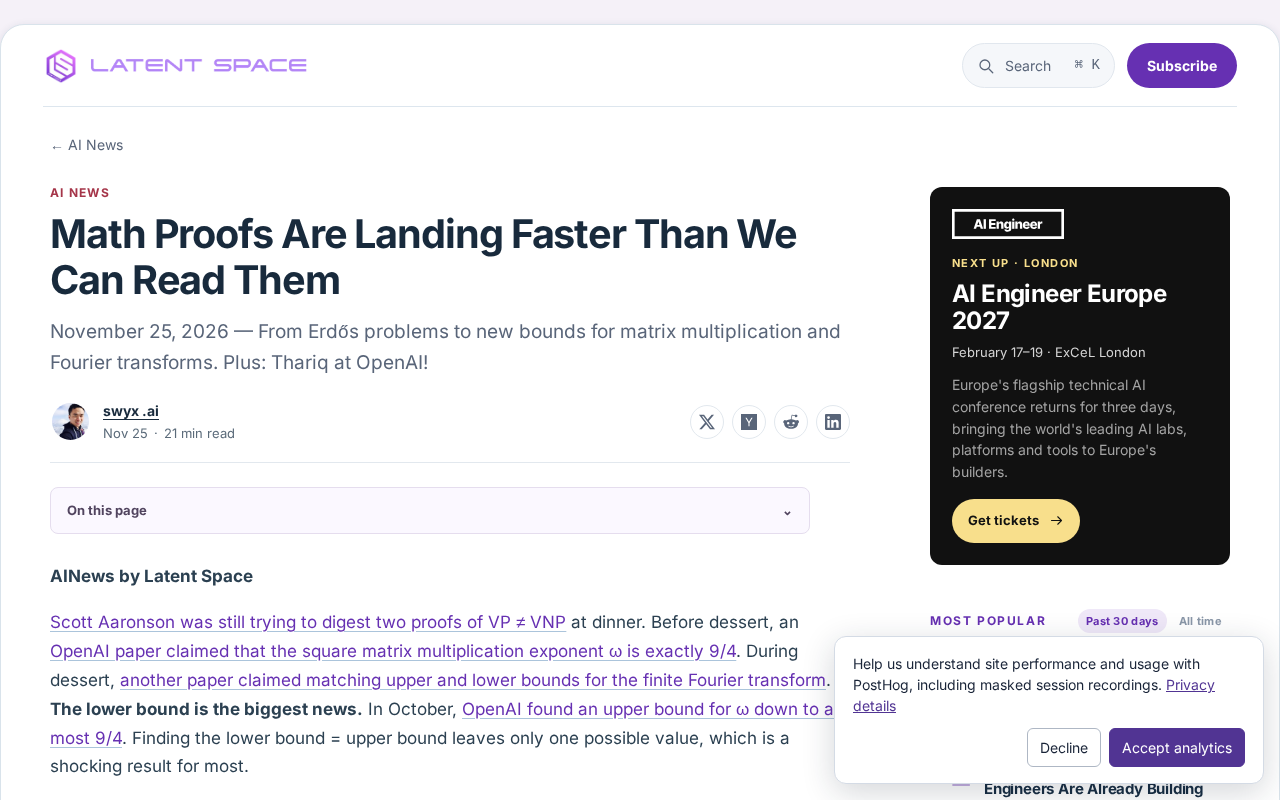
AI Math Proofs Are Exploding: Humans Can't Read Fast Enough
AI math proof output now outpaces human reading speed. AINews roundup covers Erdős problems, new matrix multiplication bounds, and Fourier transform bounds—verification is the new bottleneck.