LynnReal-Omni: 32B Unified Video Diffusion Model Goes Open Source with Multi-Task Coverage in Four Steps

LynnReal-Omni unifies text-to-video, restoration, and style transfer in a 32B model with 4-step generation and 377ms Flash output.
LynnReal-Omni is an open-source 32B video generation model based on the MiniMax H3 architecture that unifies text-to-video, image-to-video, pose guidance, style transfer, editing, and restoration into a single framework. It supports heterogeneous inputs — including 3D renders and game recordings — enabling agents to combine multiple visual conditions within one model. All tasks complete in four steps, dramatically cutting inference costs. The 27B Flash variant goes further with three-step generation, producing a 22-frame 540p video in just 377ms on a single H100. Weights and ComfyUI nodes are open-sourced, though the 32B/27B scale demands substantial VRAM, and per-task quality versus specialized models awaits community validation.
The open-source community has welcomed another heavyweight video generation model. LynnReal-Omni is built on the MiniMax H3 architecture, consolidating a wide range of tasks — text-to-video, image-to-video, pose-guided generation, structural control, style transfer, video editing, and video restoration — into a single unified framework. Model weights and ComfyUI nodes are now publicly available on GitHub and Hugging Face. This means developers no longer need to switch between multiple specialized models to cover most video generation needs.
One Model to Unify Multiple Video Tasks
The core selling point of LynnReal-Omni is unification. It employs a shared multimodal diffusion Transformer with 32B parameters (following the MiniMax H3 architecture) to integrate tasks that previously required multiple specialized models into a single framework.
According to the official description, its capabilities span a remarkably broad range:
- Text-to-video and image-to-video: The two most fundamental and widely used generation scenarios.
- Human body and hand pose-guided generation: Motion control via pose, suitable for character animation.
- Structural control and omni-reference generation: Constrain outputs using structural skeletons or multiple reference conditions.
- Style transfer and video editing: Apply stylization or local modifications to existing footage.
- Degraded video restoration: The team specifically highlights that it can not only restore videos with damaged visual quality, but also repair degradation caused by accumulated errors — a common pain point in long video generation.
- Streaming long video generation: Support for continuous, coherent long-clip generation.
Packing this many capabilities into a single model and completing all of them via four-step fast generation is the most noteworthy engineering achievement of this project. Traditional diffusion models typically require dozens of sampling steps; four-step generation dramatically reduces inference costs.
The MiniMax H3 architecture is a multimodal diffusion Transformer design introduced by MiniMax. Its core idea is to use a unified Transformer backbone to simultaneously process conditional inputs from different modalities — text, image, and video — rather than maintaining separate encoder-decoder pairs for each modality. The "H" in H3 typically refers to a Hybrid Attention mechanism that combines local window attention with global attention, balancing efficiency and receptive field on long sequences (such as video frame sequences). The key difference from earlier diffusion models (e.g., U-Net-based Stable Diffusion) is that the Transformer's tokenization approach naturally accommodates concatenating multiple visual conditions as a sequence, making "multi-condition combined input" an architectural capability rather than something bolted on via external adapters. This is the underlying reason why LynnReal-Omni can unify heterogeneous conditions like pose, style, and structure within a single model.
Four-step generation is typically enabled by accelerated sampling paradigms such as Consistency Models or Flow Matching. Traditional DDPM diffusion models require 50–1000 denoising iterations, but by introducing trajectory consistency constraints or linearized probability flows during training, models can achieve high-quality sampling in very few steps. Four-step or even three-step generation is not simply "skipping steps" — it involves specialized distillation training that teaches the model to accurately predict the denoising direction even at sparse timesteps.
Heterogeneous Inputs and Agent Composition
Beyond traditional text and image prompts, LynnReal-Omni can also accept a variety of heterogeneous inputs, including appearance references, editable 3D renders, and game recordings.
The significance of this design is that it enables an Agent to combine multiple visual conditions within a single model. In other words, an upper-level agent system can feed visual information from different sources and modalities as conditions into the same model, which then interprets and generates results in a unified manner — without requiring separate processing pipelines for each input type. For developers building automated video production workflows or multimodal creative tools, this unified conditional composition interface can significantly reduce system complexity.
Flash Version Targets Real-Time Rendering
To push latency even lower, the team also trained a LynnReal-Omni-Flash variant with 27B parameters using three-step generation. It reduces inference overhead through model acceleration, decoding acceleration, and a lightweight VAE decoder.
The team released specific performance benchmarks that are quite compelling:
| Model | Parameters | Generation Steps | Time for 22-frame 540p video on a single H100 |
|---|---|---|---|
| Standard | 32B | 4 steps | 843 ms |
| Flash | 27B | 3 steps | 377 ms |
In a warm state on a single H100, generating and decoding a 22-frame 540p video clip takes 843 ms for the standard version and just 377 ms for the Flash version. This level of speed lays the groundwork for real-time streaming video generation. While 540p at 22 frames is still a relatively short clip, sub-second end-to-end latency means that interactive, stream-while-generating applications are becoming genuinely feasible.
The latency figures in the table are measured in a warm state — meaning model weights are already loaded into GPU memory and CUDA kernels have been warmed up — and do not include cold-start overhead. In actual deployment, cold-start latency can be several times higher, which is an important engineering variable for on-demand online services.
The VAE decoder (Variational Autoencoder decoder) is responsible for reconstructing pixel-level video frames from the low-dimensional latent representations generated by the diffusion model in latent space. Because videos have many frames and high resolution, standard VAE decoding is often a non-trivial bottleneck in the inference pipeline — sometimes accounting for 30–50% of total latency. The Flash version's dedicated lightweight VAE decoder directly targets this bottleneck. The trade-off is that a lighter VAE may introduce slight fidelity losses in fine textures or high-frequency edges; the actual impact will need to be evaluated case by case.
What This Means for the Open-Source Video Ecosystem
LynnReal-Omni's release continues the trend of open-sourcing video generation models in recent years. Several of its characteristics are worth watching:
First, weights and ComfyUI nodes are released simultaneously. This lowers the barrier to entry, allowing creators already familiar with ComfyUI workflows to plug in and experiment without waiting for third-party wrappers.
Second, the practical value of the unified architecture remains to be validated. Multi-task unified models are theoretically elegant, but in real-world use, whether each sub-task can match the quality of dedicated specialized models still needs community verification on real-world content. In particular, claims like video restoration "incidentally" resolving accumulated errors require more independent testing to substantiate.
Third, being built on the MiniMax H3 architecture means it stands on a relatively novel multimodal diffusion Transformer design, making its scalability and fine-tuning potential worth keeping an eye on.
For developers eager to try it out, the project offers code, model weights, and ComfyUI integration on GitHub (LynnReal-AI/LynnReal-Omni) and Hugging Face. Given the 32B/27B model scale and H100-class testing environment, local deployment still demands significant VRAM and compute resources — but for teams with the necessary infrastructure, this is a new option worth adding to the evaluation list.
Note: This article is based on the project's release information. Please refer to actual testing for specific generation quality and per-task performance.
Related articles
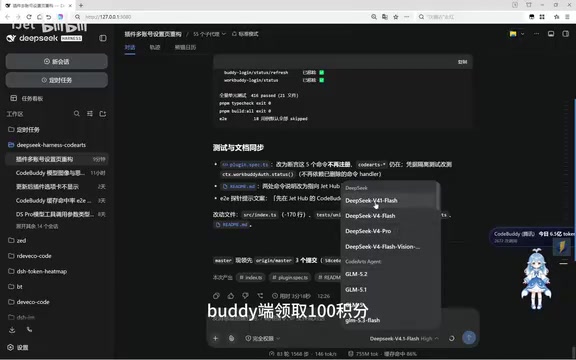
Free DeepSeek V4.1 Flash via DSH: Bulk Point Collection & International WorkBuddy Tested
DSH project update tested: WorkBuddy now offers 100 points per claim, rate limits raised beyond 80M tokens with faster resets, and international WorkBuddy supports free Hunyuan 4 and DeepSeek V4.1 Flash.

Capsule: Pack Web Apps and Data into a Single SQLite File
Capsule is a Rust/Tauri 2.0 tool that packs HTML web apps and data into a single SQLite file — privacy-first, local storage, portable sharing, with AI support.

DSH-SUBAGENT-UI Plugin: The Ultimate Sub-Agent Manager for DeepSeek Harness
DSH-SUBAGENT-UI is a DeepSeek Harness browser plugin offering sub-agent overview, search, local categorization, and completion snapshots — install with one command.