M5 MacBook Air Drops to Its Lowest Price Since July — Should You Buy?
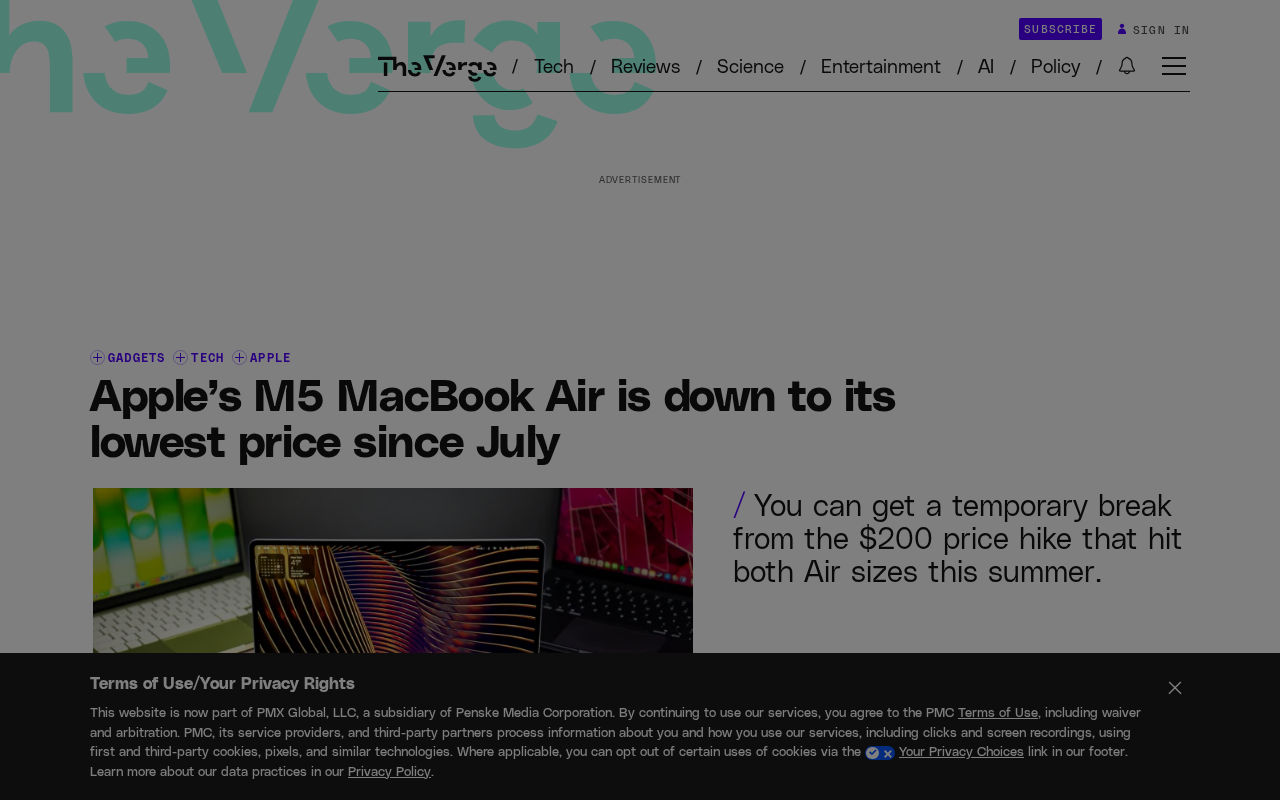
13-inch M5 MacBook Air falls to $1,099.99 — the lowest since July and the second $200 discount since the summer price hike.
The 13-inch M5 MacBook Air now sells for $1,099.99, its lowest price since July and the second $200 discount since Apple's summer price adjustment. The base config packs an M5 chip, 16GB unified memory, and 512GB storage, covering everyday productivity, light creative work, and local moderate-load AI applications. The article notes a brief $950–$1,000 range after the adjustment was short-term rather than normal, so it shouldn't set expectations. Buy now if you need a machine urgently; otherwise wait for bigger discounts around promotional periods. Those with recent M-series machines needn't upgrade.
Apple's M5 MacBook Air has hit its lowest price since July. According to an RSS source, the latest 13-inch MacBook Air is now priced at $1,099.99 — the second $200 discount since Apple's significant summer price hike.
The Context Behind the Price Drop
What makes this price cut noteworthy is that it comes after Apple's summer price adjustment. The base configuration (M5 chip, 16GB RAM, 512GB storage) briefly held in the $950–$1,000 range shortly after the adjustment, then prices climbed back up. Today's $1,099.99 mark is the lowest point since July. In other words, while this isn't an all-time low, it's a relatively friendly buying window compared to recent months.
For consumers who have been waiting on the sidelines, this discount sends a signal: M5 MacBook Air pricing is starting to soften, but the discount hasn't yet returned to summer sale levels.
Configuration and Positioning Analysis
The base M5 MacBook Air features Apple's in-house M5 chip, paired with 16GB of unified memory and 512GB of solid-state storage. This configuration covers everyday productivity, light creative work, and local execution for most AI application scenarios. Starting at 16GB of memory means multitasking and moderate-load AI tool usage won't hit a bottleneck right away, while 512GB of storage saves you the hassle of an external drive.
From a product-line perspective, the M5 MacBook Air continues the Air series' thin-and-light positioning, suited for users with moderate performance needs who prioritize battery life and portability. Compared to the Pro series, it falls short in sustained high-load scenarios, but for the vast majority of non-professional users, the performance is already more than enough.
M-series chips use Apple's in-house Arm architecture, integrating the CPU, GPU, Neural Engine, and unified memory into a single package. "Unified memory" means the CPU and GPU share the same high-bandwidth memory pool, eliminating the need to copy data between system memory and VRAM as traditional PCs do — a particular advantage for running AI models locally, since model weights only need to be loaded once and can be accessed by both CPU and GPU. The M5 is the fifth generation of Apple's M series, offering generational improvements in power efficiency and Neural Engine compute over earlier M1 chips — the technical basis for the article's emphasis on its ability to cover "moderate-load AI tool local execution."
The core difference between the MacBook Air and MacBook Pro isn't just raw performance — it's also thermal design. The Air uses fanless passive cooling, and during prolonged high-load operation it throttles due to heat accumulation, which is exactly why the article notes a "gap in sustained high-load scenarios." The Pro, meanwhile, has active fans that maintain more stable sustained performance output. Additionally, the Air emphasizes thinness and long battery life with relatively streamlined display and port configurations, while the Pro targets professional workflows like video editing and 3D rendering. Understanding this product tiering helps you judge the practical usage boundaries at the $1,099.99 price point.
Judging the Buying Timing
The current $1,099.99 price sits in a delicate position. If you urgently need a new machine, this price is friendlier than the regular post-hike price, and you can go ahead; if you're not in a hurry, given that this is the second discount of the same magnitude since July, there may be room for prices to drop further — especially around promotional periods.
It's worth noting that the $950–$1,000 range mentioned in the original article was a short-term market occurrence after the price adjustment, not a normal price. Using that range as a psychological expectation may lead to disappointment.
The "promotional periods" mentioned in the article typically refer to Black Friday, Cyber Monday, back-to-school season, and major e-commerce platform sales events. Third-party channel discounts on Apple products tend to cluster around these windows, and historical price fluctuations show clear cyclicality: older models drop in price around new product launches, and discounts are deepest during major sales. When judging whether to buy, consult historical curves from third-party price-tracking tools to distinguish "short-term anomalous lows" from "stable discount prices," and avoid treating sporadic low prices as your regular psychological benchmark.
Who Should Buy
- Users who need a thin-and-light laptop primarily for productivity and content consumption
- Developers or creators who want to run moderate-scale AI models locally
- Users upgrading from older Intel Macs or early M-series models
For users who already own a relatively recent M-series machine, this generation isn't essential to upgrade to — it's better to wait for a larger price concession or the next generation of products.
One-line Summary
13-inch M5 MacBook Air drops to $1,099.99, its lowest price since July and the second $200 discount since the summer price hike.
Paragraph Summary
The 13-inch M5 MacBook Air is now selling for $1,099.99, the lowest price since July and the second $200 discount since Apple's summer price adjustment. The base configuration features the M5 chip, 16GB unified memory, and 512GB storage, covering everyday productivity, light creative work, and local execution of moderate-load AI applications. The article notes that a $950–$1,000 range briefly appeared after the price adjustment but was a short-term market occurrence rather than a normal price, and shouldn't be used as a psychological expectation. For users who urgently need a new machine, the current price is friendlier than the regular post-hike price; those not in a hurry can wait for bigger discounts around promotional periods. For those holding relatively recent M-series machines, upgrading isn't essential.
Related articles

Hermes Agent Beginner's Guide: Hands-On with a Self-Evolving AI Agent
A beginner's guide to Hermes Agent, the open-source self-evolving AI agent that gained 41.7K GitHub stars in two months—covering Harness Engineering, the learning loop, three-layer memory, WSL installation, and hands-on configuration.

AI Agent in Action: Building a Smart Office Assistant with WorkBuddy
A practical case study shows how Tencent WorkBuddy batch-converts and archives files, compares chat LLMs with AI Agents, and analyzes WorkBuddy's credit system, use cases, and positioning for office automation selection.

From Single-GPU Bottlenecks to Hundreds of Billions of Parameters: 6 Key Questions in Large Model Distributed Parallelism
Based on a Bilibili tutorial, this article organizes core knowledge of large model distributed parallelism: starting from decoder-only architecture's token-by-token generation and the essence of X times W computation, it analyzes six key questions including data parallelism, tensor parallelism, and pipeline parallelism under single-GPU bottlenecks. Suitable for learners in private deployment and model training scenarios to build systematic understanding.