Machine Learning Self-Study Roadmap: A Complete Guide from Math Foundations to LLM Deployment
A structured ML self-study roadmap from math foundations through classic algorithms to LLM deployment.
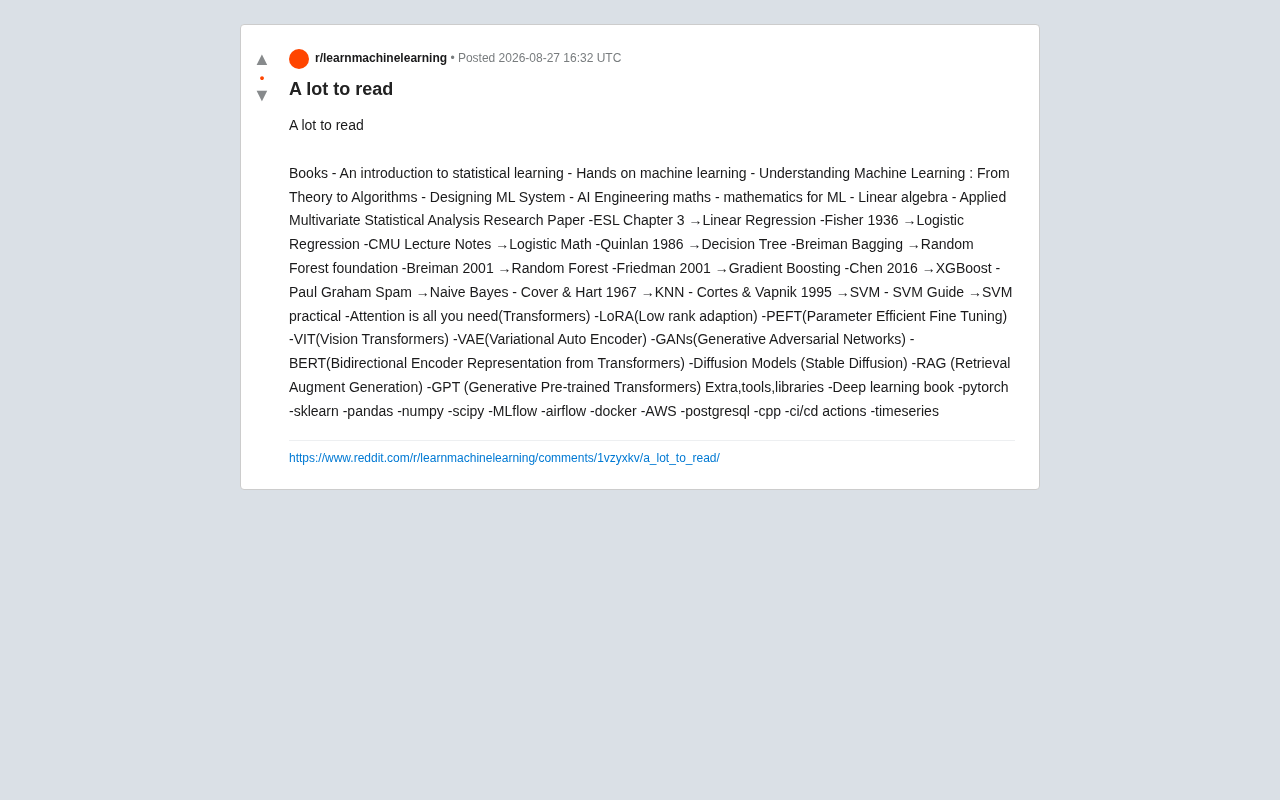
This article organizes a comprehensive machine learning study list shared on Reddit into a logical learning roadmap. It covers math foundations (linear algebra, probability, calculus), classic ML algorithms with their foundational papers, deep learning architectures centered on Transformers, practical LLM techniques like LoRA fine-tuning and RAG, and engineering deployment with MLOps tools — providing a clear path for self-learners.
An Intimidating Machine Learning Reading List
Recently, someone shared a truly "intimidating" learning checklist on Reddit's machine learning community. This list covers everything from classical statistical learning theory and foundational research papers to the hottest large language model architectures and full-stack engineering deployment toolchains. One comment — "A lot to read" — perfectly captured what countless learners were thinking.
But this seemingly chaotic list actually outlines a remarkably complete and logical growth path for machine learning. This article will organize and interpret it, helping you understand why these topics are grouped together and in what order you should tackle them.
Theoretical Foundation: Math Is the Bedrock of Machine Learning
Any serious machine learning journey starts with math. The list includes Linear Algebra, Mathematics for ML, and Applied Multivariate Statistical Analysis — together forming the foundation of the entire system.
Linear algebra is the most essential mathematical tool in machine learning. Matrix operations underpin the forward and backward propagation of neural networks, eigenvalue decomposition is used for PCA-based dimensionality reduction, and singular value decomposition (SVD) is a key technique in recommendation systems and natural language processing. For example, the computation in each layer of a neural network is essentially a matrix multiplication W·x + b, and the gradient descent optimization process involves Jacobian and Hessian matrices. On the probability and statistics side, Bayes' theorem forms the theoretical basis for many ML algorithms, while Maximum Likelihood Estimation (MLE) and Maximum A Posteriori estimation (MAP) are core methods for parameter learning. Partial derivatives and the chain rule from calculus directly support the backpropagation algorithm. Without these mathematical tools, ML models are impenetrable black boxes, and tuning and optimization become nothing more than blind guessing.
Without a solid foundation in linear algebra (matrix operations, eigenvalue decomposition, SVD), probability and statistics, and calculus, understanding model principles later on will devolve into rote memorization. The list's author was absolutely right to place math at the center.
Recommended Classic Textbooks for Beginners
The list recommends several industry-recognized classics:
- An Introduction to Statistical Learning (ISL): The best starting point, with a low math barrier — ideal for building intuition.
- The Elements of Statistical Learning (ESL): The advanced companion to ISL with deeper theory. The list specifically highlights Chapter 3 (Linear Regression).
- Hands-On Machine Learning: Practice-oriented, and extremely effective when paired with coding exercises.
- Understanding Machine Learning: From Theory to Algorithms: Approaches from a theoretical perspective (e.g., PAC learning), suitable for readers who value rigor.
ISL and ESL are companion volumes written by the same team of authors. ISL focuses on application and intuitive understanding, uses R code examples, and simplifies mathematical derivations — making it ideal for beginners to build a holistic view of statistical learning methods. ESL is a graduate-level textbook with rigorous mathematical proofs and theoretical analysis, diving deep into the statistical properties, convergence, and generalization bounds of algorithms. There's roughly 60% content overlap, but the depth is entirely different. For instance, regarding linear regression, ISL covers the geometric interpretation of least squares and explains R², while ESL dives into the Gauss-Markov theorem, the Bayesian interpretation of ridge regression, and the theoretical properties of regularization paths. The recommended learning strategy: read through ISL first to build a framework, then consult the corresponding ESL chapters when you encounter deeper questions in practice.
The logic behind this combination is clear: ISL builds intuition → Hands-On gets you coding → ESL and theory books fill in the depth.
Tracing the Origins: Classic ML Algorithms and Foundational Papers
The most valuable aspect of this list is that it maps every classic algorithm to its foundational paper. This "go to the source" approach yields far deeper understanding of an algorithm's design motivation than any second-hand tutorial.
Classic Machine Learning Algorithm Lineage
| Algorithm | Foundational Reference |
|---|---|
| Linear Regression | ESL Chapter 3 |
| Logistic Regression | Fisher 1936 + CMU Lecture Notes |
| Decision Trees | Quinlan 1986 |
| Random Forest | Breiman Bagging + Breiman 2001 |
| Gradient Boosting | Friedman 2001 |
| XGBoost | Chen 2016 |
| Naive Bayes | Paul Graham's spam filtering essay |
| KNN | Cover & Hart 1967 |
| SVM | Cortes & Vapnik 1995 |
This lineage is truly classic. From Fisher's 1936 discriminant analysis to Cortes & Vapnik's 1995 support vector machine, it traces nearly half the history of statistical learning. The evolution of ensemble learning is particularly noteworthy: Bagging → Random Forest → Gradient Boosting → XGBoost — a progression that remains the go-to arsenal for tabular data competitions to this day.
The core idea of ensemble learning is "the wisdom of crowds." Bagging (Bootstrap Aggregating) was the earliest ensemble method — it trains multiple independent models on bootstrap samples of the training set and averages their predictions, primarily reducing model variance. Random Forest builds on Bagging by adding random feature selection, further decorrelating the trees to make them more independent. Gradient Boosting takes a completely different approach: it trains weak learners sequentially, with each one fitting the residuals (negative gradient direction) of the previous round — essentially a forward stagewise optimization of an additive model. XGBoost optimizes traditional gradient boosting from an engineering standpoint: it introduces regularization terms to prevent overfitting, uses second-order Taylor expansion for improved accuracy, implements parallelized approximate split-point finding, and handles missing values automatically. This evolutionary path reflects a conceptual shift from variance reduction to bias reduction, from parallel to sequential, and from simple averaging to optimization-based solutions.
Paul Graham's famous essay A Plan for Spam is listed as the representative work for Naive Bayes — an interesting choice that demonstrates the enormous power of simple algorithms on real-world engineering problems.
Deep Learning and Large Models: The Transformer Architecture Decoded
Once the classic ML foundation is in place, the list shifts to modern deep learning architectures — the hottest area in the field right now.
Generative Models and Representation Learning
- VAE (Variational Autoencoder) and GANs (Generative Adversarial Networks): The two major schools of early generative models.
- Diffusion Models: The technology behind Stable Diffusion, which has comprehensively surpassed GANs as the mainstream approach for image generation.
Transformer and Its Family
The centerpiece of the list is undoubtedly the paper that changed everything — "Attention is All You Need" (Transformer). Its derivatives include:
- BERT: A bidirectional encoder and milestone for NLP understanding tasks.
- GPT: The generative pre-trained model that has become synonymous with large models today.
- ViT (Vision Transformer): Bringing the Transformer architecture into computer vision.
Google's 2017 paper "Attention is All You Need" fundamentally transformed the deep learning landscape. Before it, sequence modeling relied primarily on RNNs (Recurrent Neural Networks) and LSTMs (Long Short-Term Memory networks), which suffered from vanishing gradients, inability to parallelize, and difficulty capturing long-range dependencies. Transformer discarded recurrent structures entirely, relying solely on Self-Attention: through the interaction of Query, Key, and Value matrices, the model directly computes the relationship between any two positions in a sequence. Multi-Head Attention allows the model to learn information from different representation subspaces, while Positional Encoding compensates for the model's inherent position-agnostic nature. Transformer's parallelization capabilities enable efficient GPU utilization, which laid the groundwork for training large models like GPT and BERT. Today, Transformer dominates not only NLP but has also expanded through variants like ViT into computer vision, speech recognition, protein structure prediction, and virtually every AI subfield.
LoRA Fine-Tuning and RAG
For practical large model deployment, the list also includes three key technologies:
- LoRA (Low-Rank Adaptation) and PEFT (Parameter-Efficient Fine-Tuning): Enabling ordinary developers to fine-tune large models with limited compute.
- RAG (Retrieval-Augmented Generation): The mainstream solution for addressing outdated knowledge and hallucination problems in large models.
LoRA (Low-Rank Adaptation) is a parameter-efficient fine-tuning technique proposed by Microsoft Research in 2021. Traditional fine-tuning requires updating all parameters of a large model (e.g., GPT-3's 175B parameters), demanding enormous VRAM and compute. LoRA is based on a key insight: the weight update matrix ΔW during task adaptation tends to be low-rank (its intrinsic dimensionality is far smaller than its original dimensions). Therefore, LoRA decomposes ΔW into the product of two small matrices: ΔW = BA, where B is a d×r matrix, A is an r×k matrix, and r is a rank much smaller than d and k. During fine-tuning, only A and B are trained while the original pre-trained weights W remain frozen; at inference time, BA is simply added to W. For a layer with d=4096, traditional fine-tuning requires training 4096×4096 = 16M parameters, while LoRA (r=8) only needs 2×4096×8 = 65K parameters — a 250x reduction. LoRA not only saves resources but also avoids catastrophic forgetting and supports plug-and-play switching between multiple LoRA modules, making it ideal for multi-task scenarios.
RAG (Retrieval-Augmented Generation) is the mainstream approach for addressing the knowledge limitations of large language models. An LLM's knowledge comes from its training data and faces three critical issues: a knowledge cutoff date, inability to access private domain knowledge, and a tendency to hallucinate (fabricate nonexistent information). RAG operates in two stages: First, in the retrieval stage, the user query is converted to a vector representation (via embedding models like sentence-transformers) and the top-k most relevant document chunks are retrieved from a vector database (e.g., Pinecone, Milvus, Faiss). Then, in the generation stage, the retrieved documents are fed as context in the prompt along with the original query, allowing the model to generate answers grounded in external knowledge. RAG's advantages include: real-time knowledge updates (just update the vector store), source citations for improved trustworthiness, and reduced hallucination rates. Current improvements include hybrid retrieval (combining keyword and semantic search), reranking to improve retrieval precision, and advanced techniques like Hypothetical Document Embeddings. RAG has become the standard architecture for enterprise-grade AI applications.
These three are precisely the most practical skills for today's AI engineers, reflecting the list author's clear grasp of industry trends.
Engineering and Production Deployment: From Model to System
A point many learners overlook: knowing algorithms doesn't mean you can ship them. This list commendably includes engineering tools as well:
- Modeling libraries: PyTorch, scikit-learn, pandas, numpy, scipy
- MLOps & orchestration: MLflow (experiment tracking), Airflow (workflow scheduling)
- Deployment & infrastructure: Docker, AWS, PostgreSQL, CI/CD Actions
- Performance & specializations: C++, time series analysis
MLOps (Machine Learning Operations) applies DevOps principles to machine learning systems. Unlike traditional software, ML systems involve not just code but also data, models, and hyperparameters — multiple changing dimensions that create severe "technical debt." MLOps aims to solve several core challenges through engineering practices: 1) Experiment Tracking — using tools like MLflow and Weights & Biases to log parameters, metrics, and model versions for each training run, ensuring reproducibility; 2) Data Version Control — using tools like DVC and LakeFS to track dataset changes; 3) Model Deployment — enabling one-click deployment through containerization (Docker) and model serving frameworks (TorchServe, TensorFlow Serving); 4) Monitoring & Drift Detection — continuously monitoring production model performance and detecting data drift and concept drift; 5) CI/CD Pipelines — automating testing, training, and deployment workflows. Without MLOps, ML projects easily fall into "Jupyter Notebook hell" — experiments can't be reproduced, models can't be reliably deployed, and team collaboration efficiency plummets.
The list also recommends Designing Machine Learning Systems and AI Engineering — two books dedicated to system design and engineering practice. This signals that the author's goal isn't to become a "library caller," but an engineer capable of building end-to-end ML systems.
How to Systematically Digest This Machine Learning Checklist
Faced with such a massive body of content, reading straight through from beginning to end is practically impossible. A more sensible strategy:
- Start with math, then read ISL to build a big-picture intuition — don't jump straight into papers.
- Alternate between theory and practice: After learning each algorithm, immediately implement it using sklearn/PyTorch.
- Be selective with paper deep-dives: Prioritize "must-read" papers like Transformer, ResNet, and XGBoost; consult the rest as needed.
- Engineering skills can come later, but shouldn't be skipped: After completing your first end-to-end project, systematically learn Docker, MLOps, and other deployment tools.
Conclusion
This list — jokingly described as having "a lot to read" — is essentially a complete growth map from math foundations → classic algorithms → deep learning → large models → engineering deployment. Its value isn't in being consumed all at once, but in providing a clear coordinate system — so that throughout your long learning journey, you always know where you are and where to go next.
Real machine learning expertise is never built by powering through all the materials in one sitting. It's gradually forged through the cycle of "reading the original sources, building with your hands, and deploying to production."
Related articles

Micron's $10 Billion R&D Center in Boise: A Deep Dive into Its Strategic Significance
Micron announces a $10B R&D center in Boise focused on HBM and next-gen memory tech. We analyze the strategy, policy drivers, and impact on AI-era chip competition.

Chrome Updates Every Two Weeks: How AI is Reshaping Browser Security Strategy
Google Chrome shifts to biweekly updates to combat AI-accelerated cyberattacks. Deep dive into how AI is transforming security dynamics and the impact of faster release cycles.
reclip: Self-Hosted Video Downloader with Clean Web UI as Command-Line Alternative
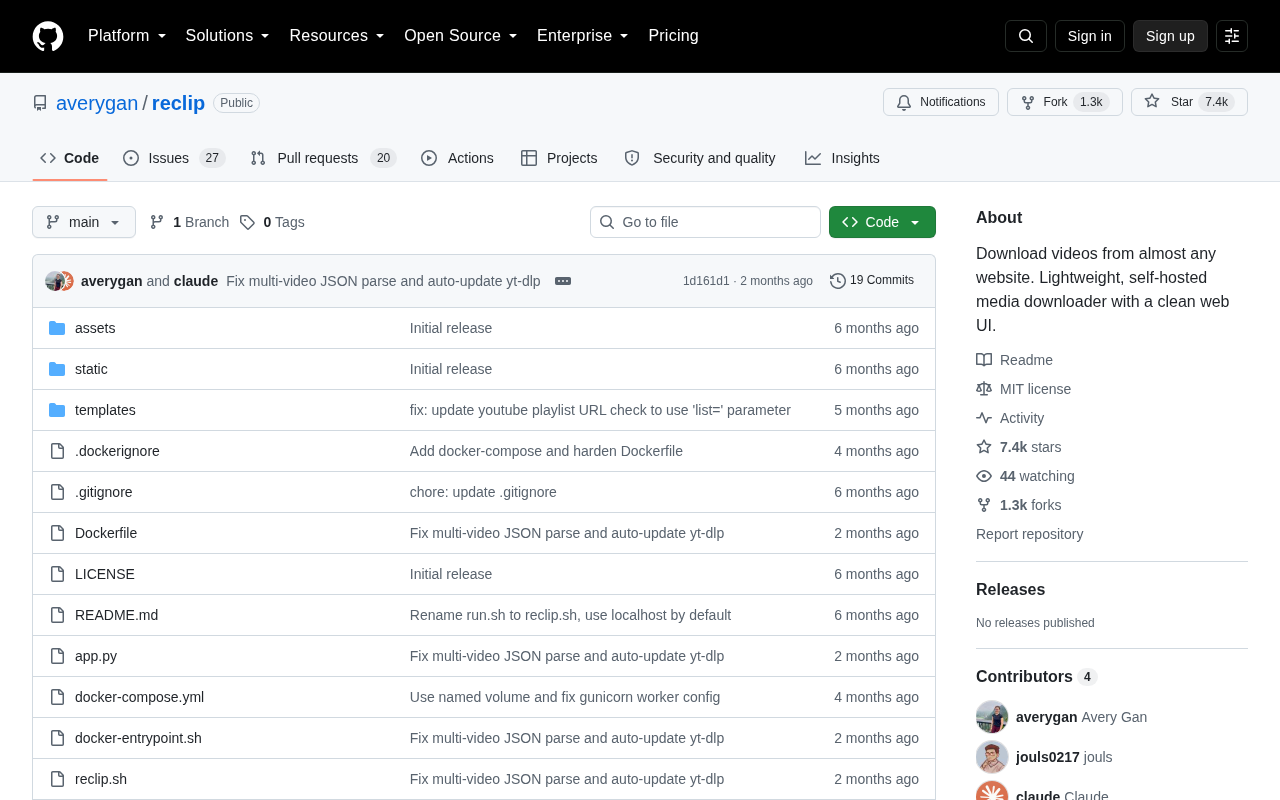
reclip is a lightweight self-hosted video downloader with a clean Web UI, built on yt-dlp to support downloads from almost any website. Easy deployment, privacy control, ad-free, ideal for NAS and VPS users.