MACTS-EM: A Deep Dive into the Multi-Agent Collaborative Time Series Forecasting Framework

MACTS-EM rebuilds time series forecasting with multi-agent collaboration and emergent memory, boosting cross-domain transfer by over 25%.
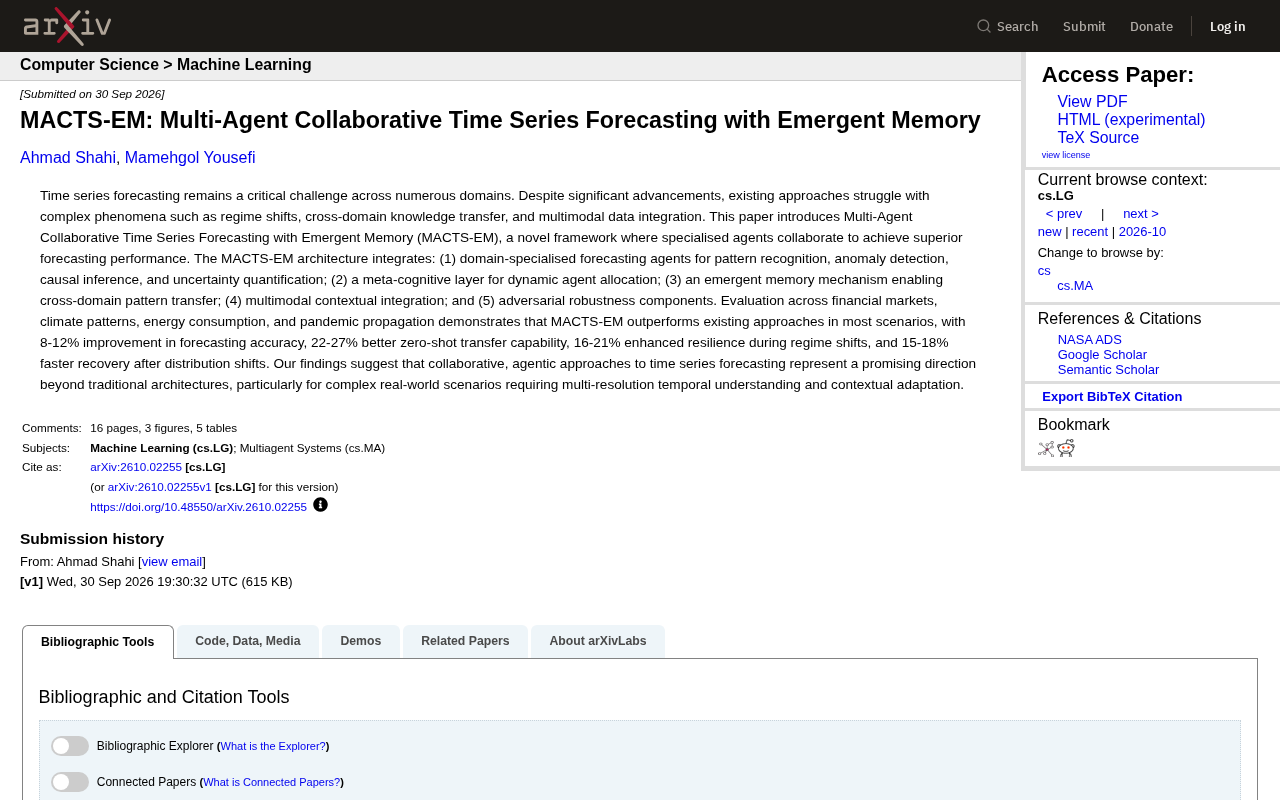
MACTS-EM is a multi-agent collaborative framework designed to address long-standing pain points in time series forecasting. Its core innovations include specialized forecasting agents, a meta-cognitive scheduling layer, an emergent memory mechanism for cross-domain knowledge transfer, multimodal context integration, and adversarial robustness. Validated across finance, climate, energy, and epidemic scenarios, it achieves 8–12% accuracy gains and 22–27% improvements in zero-shot transfer, with strong stability during regime shifts and distribution drift — positioning collaborative, agent-based methods as a promising successor to traditional monolithic architectures.
The Long-Standing Bottlenecks in Time Series Forecasting
Time series forecasting plays a critical role across finance, climate science, energy management, and public health — yet even after multiple generations of deep learning advances, existing methods still stumble in the face of certain complex phenomena. Three pain points stand out: regime shifts — sudden changes in a system's underlying dynamics; cross-domain knowledge transfer — the difficulty of reusing patterns learned in one domain in another; and multimodal data integration — combining numerical sequences with text, external context, and other heterogeneous inputs.
Traditional single-model architectures tend to excel at one type of task but struggle to simultaneously handle pattern recognition, anomaly detection, causal inference, and uncertainty quantification. A newly published arXiv paper, MACTS-EM: Multi-Agent Collaborative Time Series Forecasting with Emergent Memory, directly addresses this challenge by proposing a multi-agent collaborative approach to fundamentally rethink the technical roadmap for time series forecasting.
Regime shifts are among the most difficult phenomena in time series forecasting. They refer to structural discontinuities in a system's generative mechanism — moments when historical statistical patterns simply stop applying. Classic examples include sudden changes in asset correlations during financial crises, tipping-point transitions in climate systems, and rapid shifts in transmission parameters at the onset of an epidemic. Traditional deep learning models like LSTMs and Transformers perform well on stationary data, but their parameters are fixed after training, meaning they typically require full retraining or complex online learning mechanisms to adapt to regime shifts. Distribution shift — the broader, related problem where statistical distributions drift slowly over time even without abrupt changes — further erodes model reliability in production. Together, these two issues form the primary barrier between laboratory accuracy and real-world dependability.
The Five Core Components of MACTS-EM
The design philosophy behind MACTS-EM is to let multiple agents, each specialized in a different task, collaborate — rather than relying on a single monolithic model. The architecture consists of five mutually reinforcing modules.
Domain-Specialized Forecasting Agents
The framework deploys a set of agents, each with its own expertise, covering pattern recognition, anomaly detection, causal inference, and uncertainty quantification. This division of labor allows each agent to go deep on its specific sub-task, avoiding the compromise of a single model that's "okay at everything but great at nothing."
The Meta-Cognitive Layer and Dynamic Allocation
Above the agents sits a meta-cognitive layer responsible for dynamic scheduling and resource allocation. Depending on the current data context, the system determines which capabilities are most needed and adjusts agent participation weights accordingly. This mechanism keeps the framework adaptive under complex and changing conditions.
Meta-cognition originally refers to the human capacity to monitor and regulate one's own thinking — for example, deciding whether a problem calls for intuition or logical reasoning. In machine learning systems, the meta-cognitive layer plays a similar role to a "controller," monitoring the state of lower-level modules and dynamically intervening in resource allocation. Unlike traditional Mixture of Experts (MoE) models — which typically rely on a static gating network to select experts at inference time — the meta-cognitive layer is designed for continuous awareness of current task difficulty and data distribution, enabling real-time adjustment of agent weights throughout the forecasting process. This dynamism is especially critical for handling regime shifts: when a market suddenly transitions from low to high volatility, the system needs to rapidly shift more weight toward agents specialized in anomaly detection rather than holding to its initial configuration.
The Emergent Memory Mechanism
The most distinctive design in the paper is the emergent memory mechanism, which enables cross-domain pattern transfer. In other words, structural regularities learned from financial data can be transferred and applied to energy or climate scenarios, significantly improving zero-shot transfer performance.
The concept of "emergent memory" draws from cognitive science and complex systems theory. In the context of neural networks, "emergence" refers to capabilities that arise spontaneously during training without being explicitly programmed — for instance, the way large language models develop reasoning abilities once they reach sufficient scale. MACTS-EM's memory mechanism applies this idea to cross-domain knowledge storage: rather than maintaining separate parameter sets for each domain, the system uses a shared memory structure to capture structural commonalities across different time series (such as periodicity, trend breakpoints, and mean reversion), making these abstract patterns reusable across domains. This aligns with the "learning to learn" philosophy in meta-learning, with the key difference that memory formation here is distributed and dynamically updated, rather than dependent on an offline meta-training phase. The substantial improvement in zero-shot transfer (22–27%) is direct evidence of this mechanism's effectiveness.
Multimodal Context Integration and Adversarial Robustness
The framework also incorporates multimodal context integration — the ability to fold non-numerical contextual information into predictions — along with an adversarial robustness component that improves stability in the face of perturbations and distribution changes. Both features serve the same ultimate goal: making predictions more reliable in the noisy, unpredictable conditions of the real world.
Cross-Domain Experimental Results
The research team validated MACTS-EM across four markedly different domains: financial markets, climate patterns, energy consumption, and epidemic spread. These scenarios cover a wide range of challenges — high volatility, strong seasonality, and frequent external shocks — making them a robust and representative test bed.
The results show MACTS-EM outperforming existing methods in most scenarios, with key improvements as follows:
- Forecasting accuracy improved by 8–12%
- Zero-shot transfer capability improved by 22–27%
- Resilience during regime shifts improved by 16–21%
- Recovery speed after distribution drift improved by 15–18%
Notably, the improvement in zero-shot transfer is the most striking, approaching a quarter-point gain — directly reflecting the design goals of the emergent memory mechanism. The framework also demonstrated clear stability advantages in the two most challenging dynamic scenarios — regime shifts and distribution drift — confirming that multi-agent collaboration genuinely adds value when dealing with non-stationary data.
Implications for Time Series Forecasting
The experimental findings from MACTS-EM point toward a broader conclusion: collaborative, agent-based approaches may represent a promising path beyond traditional architectures, particularly for complex real-world scenarios that require multi-resolution temporal understanding and contextual adaptability.
This thinking aligns with the broader "multi-agent" wave currently sweeping the AI landscape. As large models grow more capable at reasoning, planning, and tool use, decomposing forecasting tasks into multiple specialized modules and then integrating them collaboratively is becoming a general-purpose paradigm for tackling complexity. Time series forecasting — with its intense engineering demands — stands to benefit from this philosophy: it preserves sub-task specialization while achieving overall gains through memory transfer and dynamic scheduling.
That said, as a newly published result, MACTS-EM's architectural complexity is non-trivial. The training costs of multi-agent coordination, inference latency, and the difficulty of production deployment all require further validation. But the directions it validates — replacing monoliths with collaboration, using memory to enable transfer, using meta-cognition to enable scheduling — offer a genuinely instructive framework for the next evolution of time series forecasting.
Summary
MAC TS-EM integrates multi-agent collaboration, emergent memory, and meta-cognitive scheduling into a unified framework, achieving consistent metric improvements across financial, climate, energy, and epidemic scenarios — with especially strong performance on cross-domain transfer and non-stationary adaptation. For researchers and engineers tracking the frontier of time series forecasting, this is an architectural reference well worth reading closely.
Related articles

Structuring Data for AI Agents: Five Approaches and a Selection Guide
There's no single best way to structure data for AI Agents. This article compares semantic models, knowledge graphs, RAG, Markdown+grep, and open formats, drawing on research from dbt, Microsoft, and Chroma to help you pick the right data architecture based on question type.

Fish Audio Drama 3 Open-Source Launch Sparks Debate: The 35B Speech Model's Selling Points and Licensing Controversy
Fish Audio Drama 3 sparks debate with 35B parameters and open weights, ranking first on pronunciation benchmarks with director-style control and word-level inpainting, but its community license restricts commercial resale, API prices are rising, and local runs need ~39GB VRAM.
LLM Gateway Selection Checklist: Evalu…
LLM Gateway Selection Checklist: Evaluate a Gateway in 10 Minutes
A 10-minute LLM gateway evaluation checklist: from protocol coverage, cache pricing, discount transparency, and credit terms to per-model SLAs and migration cost, filter out unreliable LLM gateways fast.