MagiCrew: Deep Dive into the Open-Source Multi-Agent AI Workforce Platform
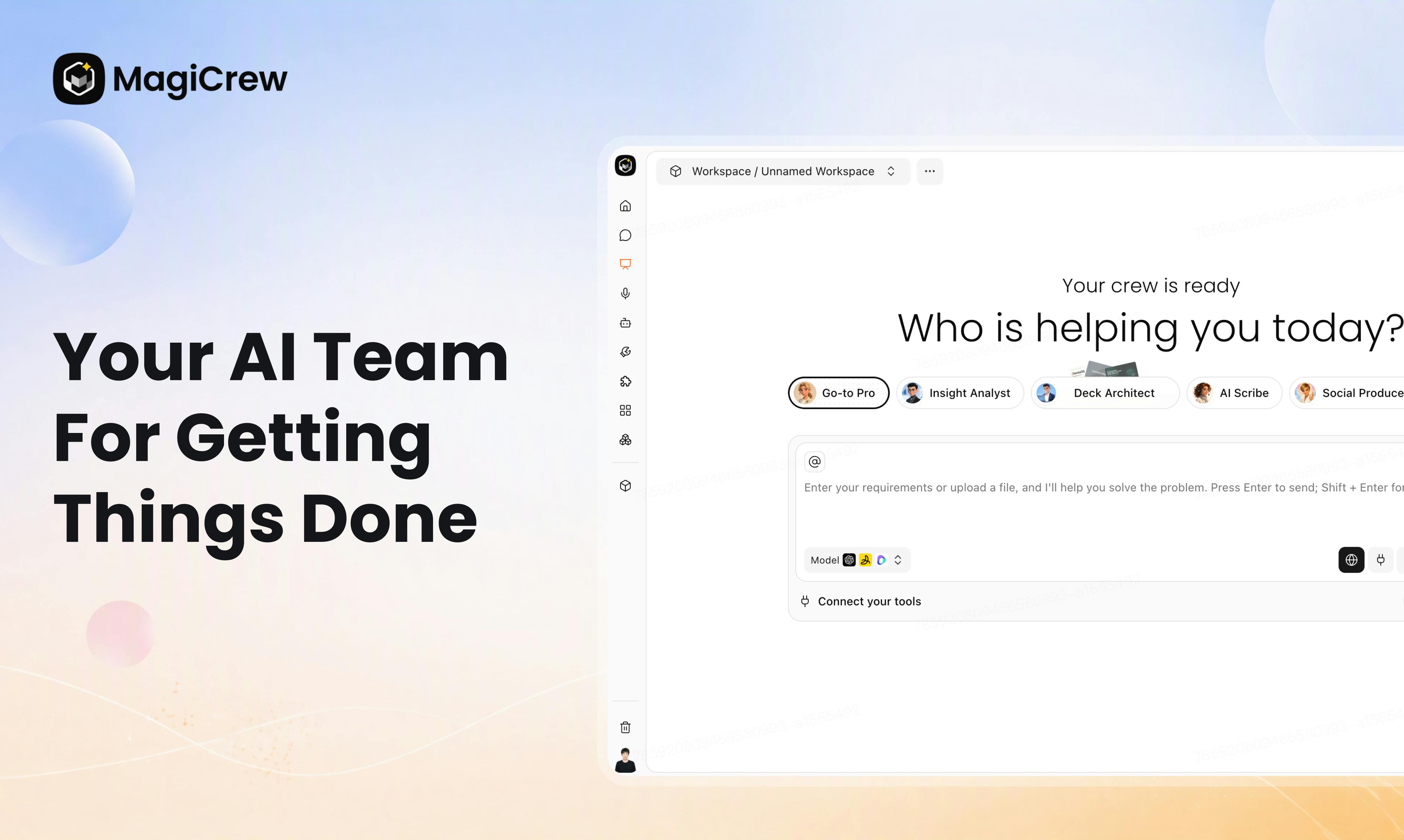
MagiCrew is an open-source platform for deploying and managing specialized AI agent teams as a digital workforce.
MagiCrew is an open-source multi-agent AI platform that lets users deploy specialized digital workers to collaborate on complex tasks. Unlike traditional AI chatbots, it offers enterprise-grade controls, deliverable-ready outputs like reports and presentations, and a multi-agent collaboration mechanism. The platform represents a shift from conversational AI to managed AI workforces, though challenges around reliability, cost, and human oversight remain.
From "Using AI" to "Managing AI": A Paradigm Shift
Over the past two years, most people's interaction with AI has remained at the "chat box" stage—opening a chat interface, typing a question, and getting an answer. While this interaction model is powerful, it's essentially still a glorified search engine or writing assistant. Recently, the open-source project MagiCrew surged to #2 on Product Hunt with 156 upvotes, aiming to break through this paradigm.
Its core proposition is crystal clear: Give everyone their own AI workforce. Rather than calling MagiCrew a chat tool, it's more accurate to describe it as a "digital workforce management platform"—you're no longer conversing with AI, but deploying, orchestrating, and managing a team of specialized AI digital workers.
This positioning aligns perfectly with the rising wave of "Agentic AI." Agentic AI has been one of the most important technology trends in the AI industry since 2024. Unlike traditional generative AI, it emphasizes AI systems that can autonomously plan, make decisions, and execute multi-step tasks, rather than merely responding to single prompts. The rise of this concept stems from significant improvements in large language model reasoning capabilities, the maturation of Function Calling and tool-use mechanisms, and the widespread adoption of reasoning frameworks like ReAct (Reasoning + Acting). Gartner has ranked Agentic AI as the #1 strategic technology trend for 2025, predicting that by 2028, at least 15% of daily work decisions will be made autonomously by AI Agents. As model capabilities grow sufficiently powerful, the industry's focus naturally shifts from "what the model can say" to "what it can do and deliver."
What Problem Does MagiCrew Actually Solve?
According to its official introduction on Product Hunt, MagiCrew is an open-source AI Agent platform whose core value can be broken down into three layers.
Specialized Digital Workers
Traditional AI assistants are "jacks of all trades"—they can chat about anything but lack professional depth and task continuity. MagiCrew advocates deploying specialized digital workers, with each AI employee taking on clearly defined responsibilities: some handle research, others analyze data, and still others generate reports and presentations.
This division-of-labor approach essentially replicates enterprise team structures at the AI level. You no longer need an "omnipotent" super assistant; instead, you configure different AI roles for different tasks, just like assembling a team. The theoretical foundation for this specialization design comes from the "expert systems" concept in cognitive science—by constraining an Agent's knowledge scope and behavioral boundaries, you can actually improve its performance quality and output consistency on specific tasks.
Multi-Agent Collaboration Mechanism
MagiCrew's most critical technical feature is multi-agent collaboration. A single Agent has limited capabilities, but when multiple specialized Agents work together, they can complete far more complex business processes.
The theoretical foundation of Multi-Agent Systems (MAS) dates back to distributed artificial intelligence research in the 1980s, but large language models have breathed new life into this field. Stanford's 2023 "Generative Agents" paper demonstrated 25 AI Agents autonomously socializing and collaborating in a virtual town, sparking widespread attention. Subsequently, frameworks like Microsoft's AutoGen, the open-source community's CrewAI, and LangChain's LangGraph emerged in quick succession, each proposing different orchestration paradigms ranging from linear pipelines to directed acyclic graphs (DAGs) to dynamic self-organization.
Here's a concrete example: completing a market analysis report might require the following pipeline—a Research Agent collects data → an Analysis Agent processes the data → a Writing Agent organizes the content → a Presentation Agent generates the slides. This pipeline-style collaboration is the essence of the "AI workforce" concept—it simulates the collaboration and handoff mechanisms found in real organizations.
Deliverable-Ready Output
A major pain point with many AI tools is that they produce "half-finished" work—they give you a block of text, but you still need to format, organize, and convert it yourself. MagiCrew emphasizes deliverable-ready outputs, directly producing usable reports, presentations, and other business deliverables, attempting to bridge the last mile between "AI-generated" and "actually usable."
Enterprise Controls: From Toy to Productivity Tool
MagiCrew places special emphasis on enterprise controls, which is a key differentiator from the many consumer-grade AI tools on the market.
For enterprises, the biggest concern about bringing AI into actual business processes often isn't capability—it's controllability and compliance. Who can access which Agents? How does data flow? How is output quality reviewed? These are all questions that must be answered for enterprise AI deployment. In fact, the governance challenges enterprises face when deploying AI systems are far more complex than those of individual users: the EU's GDPR, China's Personal Information Protection Law, and AI regulations emerging across various U.S. states all impose strict requirements on how AI systems process, store, and transmit data. Additionally, auditability—the ability to trace the complete reasoning chain of every AI decision for regulatory review and internal risk management—along with Role-Based Access Control (RBAC), output content moderation, and model version management are all essential requirements for enterprise-grade deployment. AI tools lacking these governance capabilities will struggle to truly penetrate an enterprise's core business processes.
By making "enterprise controls" a core selling point, MagiCrew signals that its target users aren't just individual developers, but also teams and organizations looking to manage AI workforces at scale. Its category tags on Product Hunt span Productivity, Artificial Intelligence, GitHub, and No-Code—a combination suggesting it targets both developers and aims to lower the barrier for non-technical users.
The Significance and Potential of Open Source
As an open-source project, MagiCrew's choice carries significant strategic implications.
In the AI Agent space, closed-source commercial products (such as various SaaS platforms) and open-source frameworks (like CrewAI, AutoGen, LangGraph, etc.) are in fierce competition. The current open-source AI Agent landscape is flourishing: CrewAI is known for its clean role definition and task assignment mechanisms, allowing developers to define an Agent's role, goals, and tools in just a few lines of code—ideal for rapid prototyping; AutoGen (from Microsoft Research) focuses more on conversation-driven multi-Agent collaboration, supporting complex group chat patterns and human-in-the-loop interaction; LangGraph is built on the State Graph concept, providing more granular workflow control suitable for complex workflows requiring conditional branching and loop logic. On the commercial side, Salesforce's Agentforce and ServiceNow's AI Agent platform represent the direction of enterprise-grade closed-source solutions.
MagiCrew's open-source approach brings at least two clear advantages:
- Transparency and Trust: Enterprises can audit the code, deploy independently, and avoid data leakage risks—a powerful complement to the enterprise controls value proposition.
- Community Co-creation: Open source means developers can contribute new Agent types and integrate additional tools, accelerating the growth of the platform ecosystem.
Interestingly, the name MagiCrew has a notable conceptual resonance with the well-known open-source framework CrewAI—"Crew" is a high-frequency term in the multi-agent collaboration space. This also reflects a broad industry consensus around the direction of "AI teamification."
Opportunities and Challenges: A Clear-Eyed View of AI Workforces
Despite the appealing concept, the practical implementation of "AI workforces" still faces significant real-world challenges that warrant a rational perspective.
Reliability is the primary concern. Multi-Agent collaboration means errors can propagate and amplify throughout the pipeline—a single data error in the research phase can contaminate the entire final report. Ensuring output quality at every stage is a common challenge faced by all multi-agent systems. This is known in academia as the "Error Cascading" problem. Current industry approaches include placing validation Agents at critical nodes, introducing human review checkpoints, and using multi-Agent cross-verification to reduce the impact of single-point failures.
Second is the cost issue. Multiple Agents working together drives higher token consumption and compute costs—a single report may involve dozens of model calls behind the scenes. Taking GPT-4o as an example, a single API call costs roughly $2.50 per million input tokens and $10 per million output tokens. A workflow involving 5-8 Agents in multi-round collaboration could consume tens of thousands to hundreds of thousands of tokens per task execution. For high-frequency use cases, these costs accumulate quickly. Current industry strategies include: using smaller but capable models (like GPT-4o-mini or open-source Llama models) for simpler subtasks, implementing caching mechanisms to reduce redundant calls, and optimizing prompts to minimize unnecessary context passing. It's worth noting that model inference costs have dropped by approximately 90% over the past year, a trend that is gradually easing cost pressures. Still, enterprises need to carefully weigh the return on investment.
Finally, there's the boundary of human-AI collaboration. "Deliverable-ready output" sounds wonderful, but in high-stakes scenarios (such as finance, legal, and strategic decision-making), human review remains indispensable. MagiCrew's value is more likely to manifest in "accelerating draft generation and boosting productivity" rather than "completely replacing human labor." The current industry consensus favors a "Human-in-the-Loop" model—letting AI handle the heavy lifting of information gathering and preliminary processing while humans make judgments at critical decision points, forming an augmentation relationship rather than a replacement one.
Conclusion: AI Applications Evolving from Conversation to Delivery
MagiCrew represents a clear direction in the evolution of AI applications: from tool to workforce, from conversation to delivery. Its strong ranking on Product Hunt also validates market appetite for the concept of a "manageable AI workforce."
For teams looking to explore Agentic AI while valuing open source and data sovereignty, MagiCrew is worth watching and trying out. Of course, "owning your own AI workforce" is still more of a vision being progressively realized—it points the way forward, but truly transforming AI from a "tool you use" into a "team you manage" still requires validation through both product maturity and real-world business scenarios.
Related articles
AI Agent Cost Optimization in Practice: Engineering Wisdom That Saved $1 Million in One Hour
Databricks eliminated $1M/year in wasted AI Agent spend in just one hour. Learn the root causes of Agent cost overruns and key strategies like model tiering, context pruning, and caching.
How the FDA Is Building an AI-Ready Data Foundation on Databricks
Explore how the FDA leverages Databricks for Government to build a unified Lakehouse architecture and AI-ready data foundation while meeting federal security and compliance standards.
The Power of Security Collaboration: Why Vulnerability Discovery Cannot Do Without Human Intelligence
Explore how security collaboration outperforms tool dependency, the value of vulnerability stories, cross-team knowledge sharing practices, and building stronger defenses by investing in people and collaboration.