Mailüfterl: The Birth and Legend of Europe's First Transistor Computer

The story of Mailüfterl, Austria's pioneering transistor computer that helped open Europe's computing era.
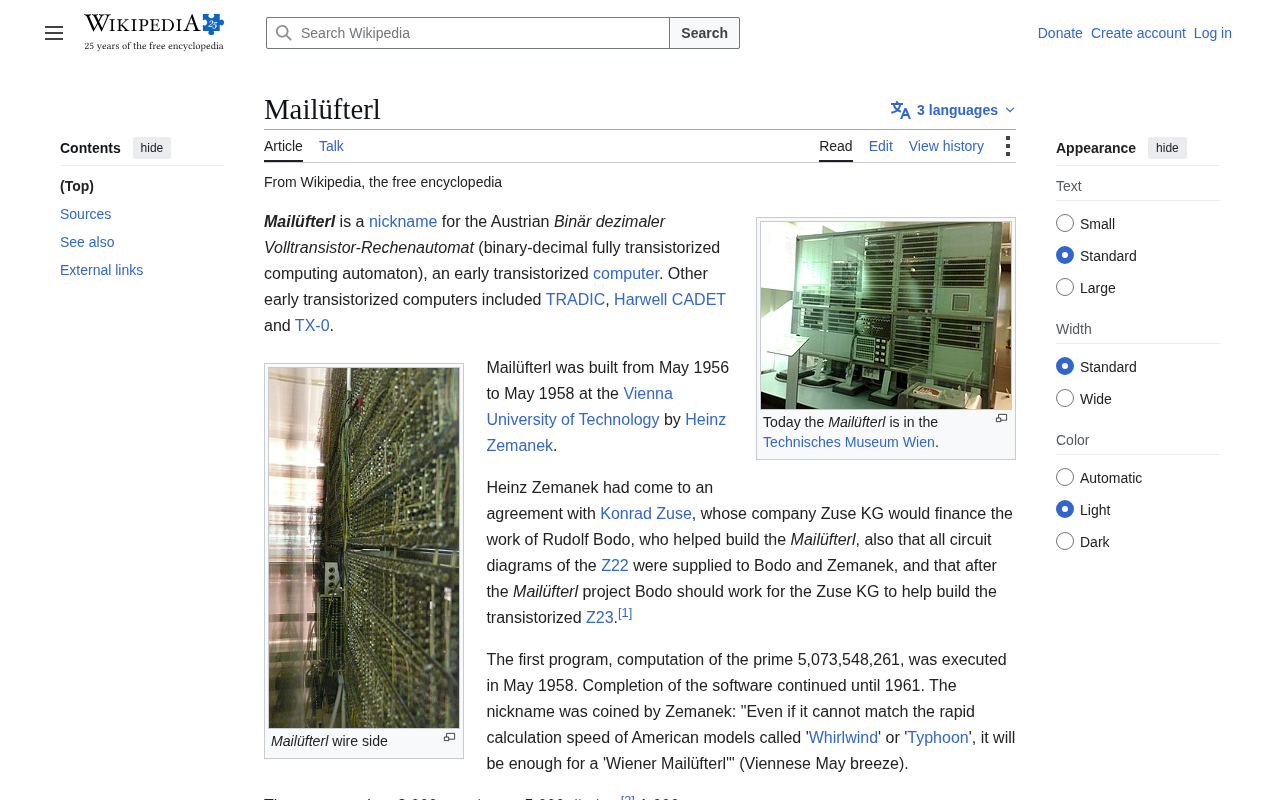
Mailüfterl, meaning "May breeze" in German, was one of Europe's earliest transistor computers, built between 1955-1958 at Vienna University of Technology under Heinz Zemanek's leadership. Using about 3,000 transistors in an era when most computers relied on vacuum tubes, this academic project demonstrated that transistor computing could be achieved even with limited resources. Zemanek later contributed to formal methods in computer science, making Mailüfterl both an engineering milestone and the starting point for important theoretical work.
A Computer Named After a Spring Breeze
In the narrative of computer history, we are most familiar with American machines like ENIAC and UNIVAC, or the commercial giant legend of IBM. ENIAC (Electronic Numerical Integrator and Computer) was completed at the University of Pennsylvania in 1945, using approximately 17,468 vacuum tubes, weighing 30 tons, occupying about 167 square meters, and is widely regarded as the first general-purpose electronic digital computer. UNIVAC was the first commercial computer, introduced in 1951 and developed by ENIAC's designers Eckert and Mauchly. These American machines have long dominated the core narrative of computer history due to their pioneering status and commercial influence.
However, Europe contributed equally significant forces in early computing. Austria's Mailüfterl is precisely such an underestimated pioneering device — it was one of the earliest computers on the European continent to adopt transistor technology.
"Mailüfterl" means "May breeze" in German, and there's a fascinating story behind this poetic name. The machine was developed between 1955 and 1958 at the Vienna University of Technology by a team led by Austrian engineer Heinz Zemanek. The naming inspiration reportedly came from those imposingly named large American computers of the era — such as "Whirlwind." Whirlwind was a real-time computer completed at MIT in 1951, originally designed for a U.S. Navy flight simulator project and later becoming the core prototype for America's SAGE air defense system. It was the first computer capable of real-time data processing, with computing speed at the top tier for its time. Zemanek humorously remarked that their machine had limited computing power, worthy of being called only a "May breeze" rather than a violent whirlwind — this was both self-deprecating and reflected the humor and composure of European scholars facing American technological hegemony.
A European Trailblazer in the Transistor Era
The Pioneering Significance of Transistor Technology
Mailüfterl's historical significance lies primarily in its adoption of transistors. In the mid-1950s, the vast majority of computers still relied on vacuum tubes that were bulky, generated excessive heat, and were prone to failure. The transistor was invented at Bell Labs by Bardeen, Brattain, and Shockley in 1947, earning them the 1956 Nobel Prize in Physics. Vacuum tubes required heating a cathode to release electrons, resulting in extremely high power consumption, short lifespans (averaging only a few thousand hours), and large physical size — a vacuum tube computer like ENIAC consumed approximately 150 kilowatts of power per second and frequently suffered tube burnout failures. Transistors, as solid-state semiconductor devices, required no heating, switched faster, lasted decades, and consumed only one-hundredth the power of vacuum tubes. These overwhelming advantages meant that transistors represented the future direction of computing hardware.
According to historical records, Mailüfterl was equipped with approximately 3,000 transistors and thousands of diodes. In an era when transistors themselves were scarce and expensive components, building a complete, operational transistor computer was a remarkable engineering achievement. This machine placed Austria among the earliest nations in the world to explore transistor computing.
The Global Transistor Computer Race
During the same period as Mailüfterl's development, multiple countries worldwide were exploring transistor computers. The University of Manchester in England completed a transistor computer prototype in 1953, Bell Labs' TRADIC (1954) is considered the first fully transistorized computer, and IBM launched the commercial transistor computer IBM 608 in 1957. In this context, Mailüfterl's significance as one of the earliest transistor computers on the European continent (excluding Britain) lies in proving that transistor computing could be achieved even in the relatively resource-scarce academic environment of Central Europe.
An Engineering Feat from Scratch
It's worth emphasizing that this project was completed in a relatively resource-limited academic environment. Unlike American institutions such as IBM and Bell Labs, which had substantial funding and industrial support, the Zemanek team relied primarily on their own engineering ingenuity and limited budget to transform a transistor computer from design blueprints into reality. This spirit of "small team, big dream" is a hallmark of the pioneering era of early computing.
Heinz Zemanek and His Team
Heinz Zemanek, the central figure behind Mailüfterl, later became an influential figure in computer science. He not only led the development of this machine but also made significant contributions to formal language description and programming language semantics in his subsequent career. He joined IBM and established the IBM laboratory in Vienna, participating in the formal definition of the PL/I programming language — this was the origin of the famous "Vienna Definition Language" (VDL).
PL/I was a general-purpose programming language designed by IBM in 1964, attempting to unify scientific computing (FORTRAN's domain) and business data processing (COBOL's domain), but its extreme complexity made precise formal definition particularly important. The Vienna Definition Language was born to address this challenge, providing a rigorous set of mathematical tools to describe the meaning of programming languages. VDL later evolved into VDM (Vienna Development Method), becoming an important school of formal methods in software engineering. It influenced subsequent formal specification techniques such as the Z notation and the B-method, and continues to play a role in software development for safety-critical systems in aerospace, nuclear power, and other fields.
From Mailüfterl to formal methods, Zemanek's career trajectory itself reflects an important thread in computer science's evolution from hardware engineering toward theory and software methodology. One could say that this "May breeze" was not merely a machine, but a starting point that incubated subsequent important academic achievements.
Why This Computer Was Overlooked by History
Why is such an important machine rarely mentioned in mainstream computer history? Part of the reason lies in narrative centralization — the writing of early computer history has long been dominated by the United States, and the achievements of Europe, especially small Central European nations, have often been marginalized. Furthermore, Mailüfterl was an experimental, educational machine that was never commercialized at scale, giving it a weaker "presence" at the industrial history level.
In fact, Mailüfterl is not the only overlooked European computing pioneer. Germany's Konrad Zuse completed the Z3 in 1941, considered the world's first programmable automatic computer; Britain's Colossus (1943) was used to break the German Lorenz cipher but remained unknown for decades due to secrecy; Sweden's BESK (1953) was briefly the world's fastest computer. These cases collectively demonstrate that the invention of the computer was not the achievement of a single nation, but rather a simultaneous technological breakthrough occurring at multiple points globally. However, America's industrial dominance and discursive power during the Cold War highly concentrated the narrative around the United States.
Nevertheless, from the perspective of technological history, it is precisely these exploratory projects scattered around the world that together constitute the rich landscape of the computer revolution. Mailüfterl proved that transistor computing was not the exclusive patent of a few giants, but a technological wave jointly advanced by engineers worldwide.
Lessons for Today
Looking back at early computer projects like Mailüfterl still holds inspirational value for us in today's era of AI and computing power surges. Today we discuss trillion-parameter models, GPU clusters, and data centers, but fundamental progress in computing often begins with bold exploration of basic components and architectures.
The replacement of vacuum tubes by transistors was a paradigm shift; and machines like Mailüfterl were specific nodes in that transition. It reminds us that technological history belongs not only to the most famous names, but also to teams that persisted in innovation under limited conditions. When we use slim laptops or cloud-based AI services today, behind them lies the foundation laid by countless pioneers like the Zemanek team — from 3,000 transistors to the tens of billions of transistors on a single chip today, this path of exponential growth began with those unassuming first steps.
The "May breeze" may have been computationally weak, but it opened the door to Europe's computer age.
Related articles

AgentCore in Practice: Connecting Custom Tools and MCP Servers to Agents
DebuggerCafe tutorial shows how to connect custom tools and MCP servers to Amazon Bedrock AgentCore agents, covering tool contract design, MCP reuse, and production concerns.

816B Parameters Scores Only 39? The Real Cost-Effectiveness of the Open-Source LLM Parameter Race
Meta's 816B Muse Spark Open scores just 39 on Artificial Analysis, while 180B Qwen3.8-Flash-Next scores 40. This article analyzes 11 open-weight models' parameters vs. scores, exploring the real impact of activated parameters, quantized size, and deployment cost.

Aerial Manipulators: The Next Step for Drones from 'Seeing' to 'Changing'
Starting from a Reddit discussion, this article analyzes the technical challenges, potential applications, and deployment bottlenecks of aerial manipulators, exploring the key challenges for drones moving from environmental perception to physical manipulation.