Making $20K/Month Building Apps with AI: A Complete Playbook for Non-Technical Founders

Non-technical founder uses AI tools to build an app in 3 days, hitting $20K/month in 6 months.
Mal Barron, with a finance background, used AI coding tools like Cursor to build Prayer Lock — a prayer-focused screen lock app — in just 3 days. Within 6 months, it reached 58K downloads and over $20K in monthly revenue. His methodology includes improving already-validated products instead of inventing from scratch, radical feature minimalism, subscription-based monetization, and brute-force testing organic TikTok content to find effective growth channels.
Introduction: A Non-Technical Founder's Breakthrough
Someone with a finance background and zero development experience used AI tools to build an app in 3 days, reaching over $20K in monthly revenue within 6 months — this isn't a feel-good story, it's a replicable methodology.
Mal Barron's Prayer Lock app accumulated 58,000+ downloads, 6,700+ reviews, and a 4.9-star rating in just six months, with an impressive 43% conversion rate. Even more striking is his monthly revenue growth trajectory, showing 50%+ month-over-month increases: $10K in October, $15K in November, and $21K in December.
The core insight from this case isn't about "using AI to write code" per se — it's about a complete system for discovering opportunities, building quickly, and scaling growth.
Product Strategy: How Minimalism Beats Feature Bloat
Find a Validated Market, Then Do It Better
Mal didn't invent a new category out of thin air. He discovered a competitor called Pray Screen — an app that locks your phone before you pray. By analyzing its design, features, and distribution strategy, he concluded he could do it better.
This is a critical decision: don't invent from scratch — improve a product the market has already validated. He recommends using tools like Sensor Tower to find niche apps generating over $50K in monthly revenue, then identifying products where you can make meaningful improvements.
Sensor Tower is a leading mobile app market analytics tool that provides download volumes, revenue estimates, keyword rankings, ad creative analysis, and more for both the App Store and Google Play. Its core value lies in making otherwise opaque app store data visible, allowing founders to assess market size before investing in development. Similar tools include data.ai (formerly App Annie) and MobileAction. For indie developers, the strategic significance of these tools is transformative: they convert the subjective judgment of "I think this need exists" into the objective validation of "apps in this niche are already generating $X per month in revenue," fundamentally reducing the probability of directional mistakes.
Radically Simplified Product Features
Prayer Lock's functionality is extremely simple: select apps to lock → when you open a locked app, two questions pop up → an AI-generated prayer is created based on your answers → the app unlocks after you finish reading the prayer aloud.

Even more aggressive: the app has no user authentication system and no database. All data is stored locally on the device. Mal's logic: reduce user friction (no sign-up required) while lowering operational costs (no paid database needed). What about losing data when switching phones? He considers that an edge case too rare to justify raising the barrier to entry for all users.
The business model uses subscriptions: $49.99/year or $9.99/week, with an average revenue per paying user of $23.60. Subscriptions have become the dominant monetization model for mobile apps — Apple's App Store takes a 30% commission in the first year, dropping to 15% on renewals. Prayer Lock's "annual + weekly" dual-tier pricing is a proven anchoring strategy: the expensive weekly option makes the annual plan look like a great deal, guiding users toward annual subscriptions and boosting LTV (Lifetime Value). An average revenue of $23.60 per user indicates most users chose the annual plan — and only when LTV significantly exceeds CAC (Customer Acquisition Cost) can paid advertising remain sustainably profitable.
AI Development in Practice: The Tech Stack Behind a 3-Day Build
Tools and Development Strategy
Mal's tech stack is surprisingly lean:
- Cursor ($20/month): Primary AI coding tool, using the Claude Sonnet model
- ChatGPT ($20/month): For asking questions and making simple code changes
- Codex CLI: For handling more complex development tasks
- Google Gemini Flash 2.5 (~$9/month): In-app AI prayer generation
- AWS (~$2/month): Backend services and web hosting
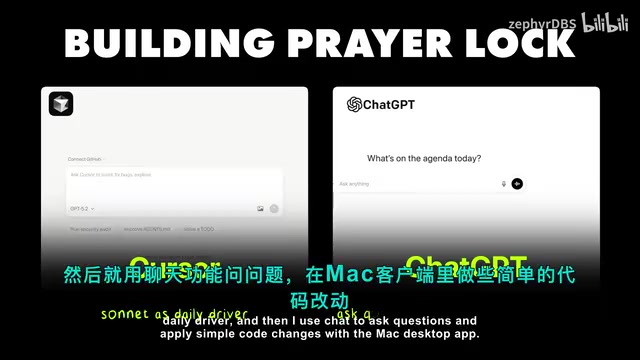
Cursor is an AI-native code editor built on VS Code. Its core capability is the deep integration of large language models (LLMs) into the development workflow. The key difference from tools like GitHub Copilot is that Cursor supports context-aware, multi-file editing across an entire codebase (Composer mode) — it understands project structure and coordinates changes across files, rather than just completing single lines of code. The underlying Claude Sonnet model excels particularly at code generation tasks, with strong instruction-following abilities and long-context processing. For non-technical founders, Cursor's value goes beyond "writing code" — it translates product requirements described in natural language directly into functional modules, dramatically compressing the time from idea to prototype.
Total monthly operating costs are under $60, which means margins are extremely high.
Practical AI Development Tips for Non-Technical Founders
- Skip the design mockups: Study the interfaces of the best apps in your category, collect the best onboarding designs using Canva, then code directly
- Don't try to generate the entire app at once: Break the app into feature modules and build each one with AI individually
- Spread usage across different AI tools: Avoid burning through too many tokens on a single tool
- Set a hard two-week deadline: Going beyond this leads to an infinite optimization trap
The actual coding took 3 days, but App Store review took over a week. This is a reminder: technical development is no longer the bottleneck — distribution and growth are the real challenges.
Growth Engine: The Complete Path from Organic Content to TikTok Paid Ads
Phase One: Brute-Force Testing Organic Content
In the early days, Mal had no idea what would work, so he adopted an extreme "quantity breeds quality" strategy: 12 accounts, publishing 40 pieces of content per day.

After testing 40 posts, he finally found an effective content format — UGC female reaction videos paired with product demos. UGC (User Generated Content) marketing has become one of the lowest-cost acquisition channels for mobile apps in recent years. Reaction videos, as a specific UGC format, derive their viral effectiveness from the psychological concept of "vicarious experience."
Related articles
 Tutorials
ChatGPT Plus Subscription Guide: Are GPT-5.5, image-2, and Codex Worth the Upgrade?
A detailed look at ChatGPT Plus features — GPT-5.5, image-2, and Codex — with a Plus vs Pro comparison and a complete step-by-step subscription guide for users outside the US.
 Tutorials
Harness AI Engineering in Practice: Using Claude Code to Master Enterprise-Level E-Commerce Development
Deep dive into Harness AI Engineering: master enterprise e-commerce development with Claude Code using the Rules, Skills, Wiki, and Changes framework.
 Tutorials
Cursor + Codex Dual-IDE Collaboration: A Practical Methodology for Open-Source Project Customization
A complete methodology for open-source project customization based on real-world experience, detailing the Cursor+Codex dual-IDE workflow, seven-stage process, MVP validation, and AI source code reading techniques.