mamitsu: An API and MCP That Automatically Converts Social Videos into JSON
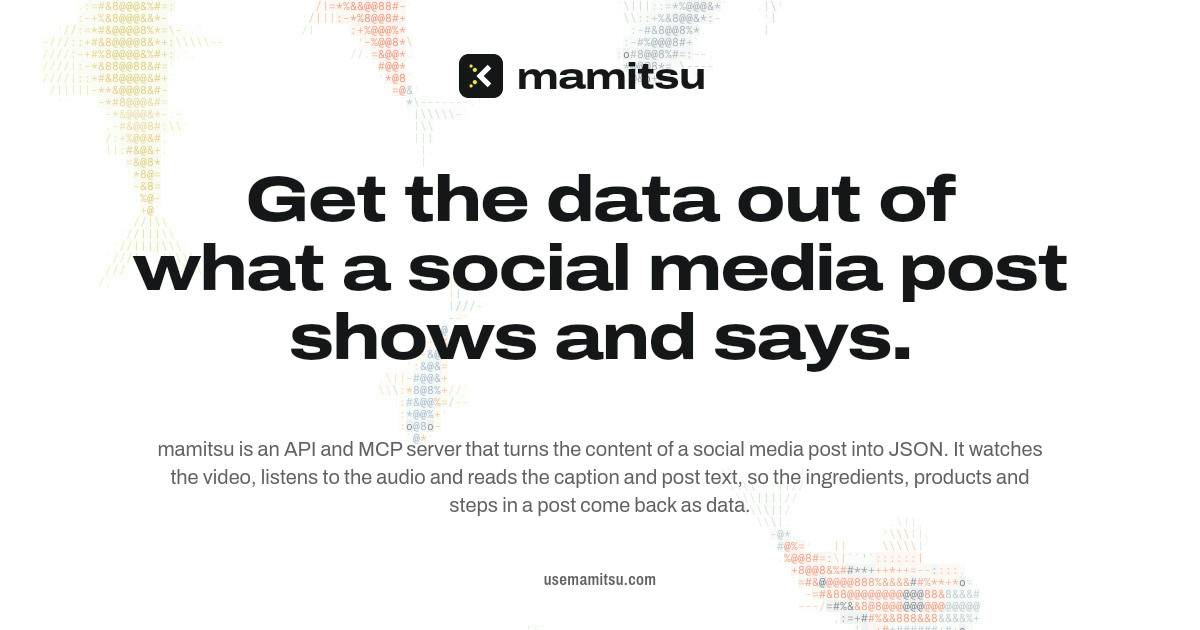
mamitsu converts social videos into structured JSON data via API and MCP, targeting AI workflows.
mamitsu is a developer-facing tool that converts content from social media videos into structured JSON data through two forms: an API and an MCP server. Its core method is multimodal fusion: it simultaneously parses video frames, audio, and caption text to fully reconstruct content intent, and it currently focuses on extracting recipe ingredients and steps, product information, and other tutorial-type content. The MCP form allows it to be called directly by AI Agents, targeting the infrastructure layer of AI applications. The product is at an early stage, has low traction on Product Hunt, and has not published accuracy data; recognition quality is affected by video shooting conditions and colloquial expressions, and users must also handle platform terms and copyright compliance on their own.
Social platforms generate massive amounts of video content every day, from cooking tutorials to product unboxings, with extremely high information density—but for developers, this content is almost unusable: it's unstructured pixels and audio. A new product on Product Hunt called mamitsu aims to solve this problem: through an API and an MCP (Model Context Protocol) server, it converts video content in social media posts into JSON data, turning recipe ingredients and steps, or product information, into structured data that can be processed directly.
How It Works: Parsing Three Streams of Information Simultaneously
mamitsu's core approach is multimodal understanding. According to its Product Hunt page, it "watches the video, listens to the audio, and reads the captions and post text," fusing all three streams of information before outputting JSON. This means it doesn't rely on a single modality; instead, it integrates the actions on screen, the narration in the audio, and the supplementary information in the text.
This design makes practical sense. The key information in a cooking video may be scattered across different places: the ingredient list appears in the subtitles, the step demonstrations are in the visuals, and quantity adjustments are written in the caption. Analyzing only one of these streams would lose information. By processing all three simultaneously, mamitsu can theoretically reconstruct the content's intent more completely.
The output targets structured fields such as "ingredients, products, and steps," indicating that it currently focuses on tutorial-type and review-type content, where the entities and processes are relatively well-defined and the conversion difficulty is manageable.
Multimodal understanding refers to a model's ability to simultaneously process and correlate multiple types of input (such as vision, speech, and text), rather than processing them separately and then simply concatenating the results. In video scenarios, this capability typically relies on a visual encoder to extract frame features, speech recognition (ASR) to convert audio into text, and a text encoder to process captions, followed by a fusion layer that aligns the correspondence between different modalities along the timeline. The real challenge lies in cross-modal alignment: for example, when the audio says "add two spoonfuls of salt," the video may be showing someone chopping vegetables, and the model needs to determine whether this sentence describes a later step or the current action. mamitsu's claim of simultaneously watching, listening, and reading is essentially performing this kind of temporal alignment and semantic fusion, and its output quality depends heavily on the recognition accuracy of each modality and the design of the fusion strategy—which is also the main source of accuracy differences among similar tools.
Dual Form: API and MCP, Serving Developers and AI Workflows
mamitsu offers two ways to integrate. The API suits traditional development scenarios: developers can submit a social video link, receive a JSON response, and plug it into their own applications. MCP is designed for AI workflows—MCP is a protocol that lets large models call external tools and data. By packaging itself as an MCP server, mamitsu allows AI assistants to call it directly during a conversation to "watch" a video and obtain structured results.
This dual-form strategy is worth noting. The API targets developers who know exactly what they want to do, while MCP targets teams building AI Agents who want models to autonomously obtain video information. The latter is a fast-growing demand, and mamitsu offering MCP support at launch shows it's aiming not just at data extraction but also at the infrastructure layer of AI applications.
In terms of product categorization, it's listed under API, social media, and developer tools, with a clear positioning: it's not a consumer-facing product but a data conversion component in developers' hands.
MCP (Model Context Protocol) is an open protocol proposed by Anthropic in late 2024 to standardize how large language models connect to external tools and data sources. Before MCP, developers who wanted models to call external services typically had to write separate function-calling adapter layers for each model or framework, resulting in inconsistent interfaces. MCP abstracts these connections into a unified client-server model: tool providers implement an MCP server that exposes resources, tools, and prompt templates; AI clients that support MCP (such as Claude Desktop and various Agent frameworks) can then directly discover and invoke these capabilities without writing custom code for each tool. For a data conversion service like mamitsu, adopting MCP means it doesn't have to be tied to a single model vendor but can plug into any MCP-compatible AI workflow as a general capability, which lowers integration costs and expands the range of potential callers.
Use Cases and Potential Limitations
The most direct use case is recipe extraction. Converting large numbers of cooking videos into structured recipes in bulk can be used to build recipe databases, nutrition analysis tools, or smart kitchen assistants. Product unboxing and review videos are also a good fit: extracting product names, specifications, and key review points can be used for e-commerce price comparison or content aggregation.
However, the limitations of such tools are also obvious. The shooting quality of social videos varies widely, and accents, background noise, and visual obstructions all affect recognition accuracy. Colloquial expressions and implicit contextual information (such as references like "the same as last time") remain challenges for structured extraction. mamitsu has not published accuracy data, so developers need to verify its actual performance themselves.
Another consideration is compliance and platform policies. Scraping video content from social platforms involves platform terms and copyright issues. mamitsu itself is a tool, but users need to handle these boundaries on their own.
Signals Worth Watching
mamitsu received 6 votes and 3 comments on Product Hunt, ranking 18th. Its popularity isn't high—it's an early-stage product. But its direction is worth watching: as AI Agents and automated workflows develop, the demand to "turn unstructured content into structured data" will persist, and video is the hardest nut to crack. mamitsu enters with a combination of API and MCP, and its approach is clear.
For developers, if your workflow needs to understand social video content at scale, mamitsu offers a ready-made starting point. It's advisable to first test its parsing quality on a small dataset before deciding whether to integrate it into production pipelines.
One-line Summary
mamitsu converts social videos into structured JSON data via API and MCP, targeting AI workflows.
Paragraph Summary
mamitsu is a developer-facing tool that converts content from social media videos into structured JSON data through two forms: an API and an MCP server. Its core method is multimodal fusion: it simultaneously parses video frames, audio, and caption text to fully reconstruct content intent, and it currently focuses on extracting recipe ingredients and steps, product information, and other tutorial-type content. The MCP form allows it to be called directly by AI Agents, targeting the infrastructure layer of AI applications. The product is at an early stage, has low traction on Product Hunt, and has not published accuracy data; recognition quality is affected by video shooting conditions and colloquial expressions, and users must also handle platform terms and copyright compliance on their own.
Related articles

Hermes Agent Beginner's Guide: Hands-On with a Self-Evolving AI Agent
A beginner's guide to Hermes Agent, the open-source self-evolving AI agent that gained 41.7K GitHub stars in two months—covering Harness Engineering, the learning loop, three-layer memory, WSL installation, and hands-on configuration.

AI Agent in Action: Building a Smart Office Assistant with WorkBuddy
A practical case study shows how Tencent WorkBuddy batch-converts and archives files, compares chat LLMs with AI Agents, and analyzes WorkBuddy's credit system, use cases, and positioning for office automation selection.

From Single-GPU Bottlenecks to Hundreds of Billions of Parameters: 6 Key Questions in Large Model Distributed Parallelism
Based on a Bilibili tutorial, this article organizes core knowledge of large model distributed parallelism: starting from decoder-only architecture's token-by-token generation and the essence of X times W computation, it analyzes six key questions including data parallelism, tensor parallelism, and pipeline parallelism under single-GPU bottlenecks. Suitable for learners in private deployment and model training scenarios to build systematic understanding.