ManagedAgents.sh: A Deep Dive into the Model-Agnostic Open-Source Managed Agent Platform

A model-agnostic open-source managed agent platform supporting multiple runtimes and channels to avoid AI vendor lock-in.
ManagedAgents.sh, from the OpenComputer team, is a model-agnostic managed agent platform supporting Claude, Pi, and Codex runtimes. It offers Slack and GitHub channel integration plus a Playground for quick experimentation, built on a durable sessions API to help developers avoid AI vendor lock-in.
An Open-Source Managed Agent Platform Emerges
Recently, the OpenComputer team introduced a new tool called ManagedAgents.sh on Reddit's r/LangChain community, positioned as a "model agnostic" alternative for Managed Agents. According to the developer (Reddit user /u/DiggerHQ), the project was put together almost "overnight"—the team built a Playground (an interactive experimentation environment) for quickly setting up managed agents, on top of their own "durable agent sessions API."
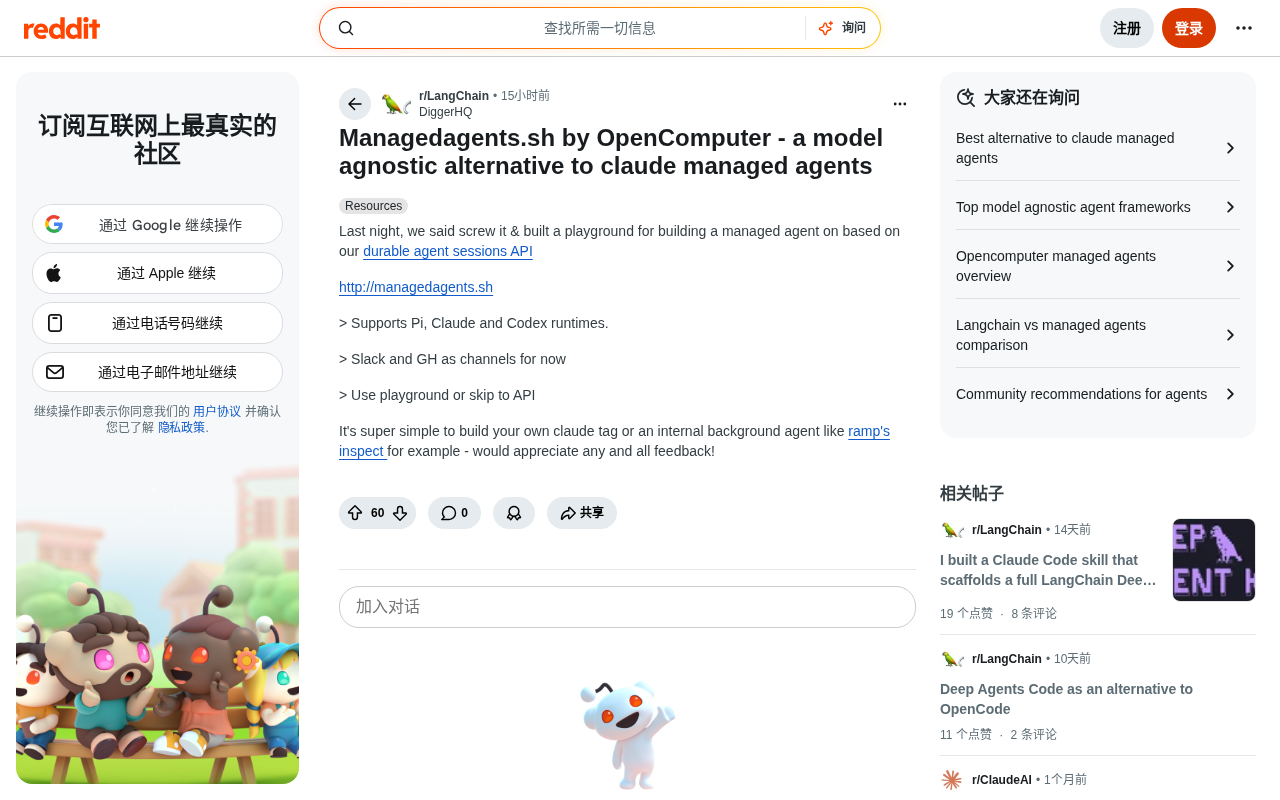
A "managed agent" can be understood as an AI Agent whose execution, state management, and scheduling are handled by the platform. Compared to developers building the agent loop from scratch, maintaining session state, and handling message channel integrations themselves, managed solutions "package and host" this infrastructure, letting developers focus their energy on the business logic itself.
Traditional agent implementations require developers to manage the "Agent Loop" themselves—the iterative process of perceive → reason → act—while also handling complex engineering problems like state persistence, error retries, and timeout control. The "Durable Sessions" technology that ManagedAgents.sh relies on draws its core idea from the concept of "durable workflows" in distributed systems—a well-established engineering paradigm already mature in large-scale internet systems.
Durable Workflow is a core paradigm refined over more than a decade of engineering practice in the distributed systems field. Its essence is elevating "execution progress" from in-process memory state to a first-class citizen in persistent storage, so that after any node failure, the system can recover from the most recent checkpoint rather than the task's starting point—an idea directly inherited from the database field's WAL (Write-Ahead Logging) mechanism. WAL's core principle is "write the log first, then modify the data"; by recording every change operation as an immutable append-only log entry, the system can precisely replay to its pre-failure state during crash recovery. Mainstream databases like PostgreSQL and MySQL build their ACID transaction guarantees on this foundation.
It's worth mentioning that combining the WAL mechanism with the principle of "Idempotency" is especially important in AI Agent scenarios. Idempotency requires that executing the same operation multiple times has the same effect as executing it once—when an Agent recovers and replays historical steps, if tool calls (such as sending emails or writing to a database) lack idempotency guarantees, log replay may cause side effects to be triggered repeatedly. This problem is solved in the database field through sequence-based deduplication and two-phase commit, while in AI Agent frameworks it typically requires explicitly declaring idempotency identifiers at the tool level or introducing external deduplication tables. This is an engineering detail that durable workflow frameworks must handle additionally when applied to AI scenarios.
AWS Step Functions introduced this idea into cloud-native workflows, persisting each step's execution result to managed storage through a state machine model; Temporal adopts an "Event Sourcing" mechanism, recording all function call history as an immutable log that can be replayed at any time to recover to the exact execution position. Notably, Temporal's predecessor was the Cadence project incubated internally at Uber, whose design goal was to solve consistency problems for long-running cross-service transactions in microservice architectures—engineeringly highly isomorphic to the multi-step task scenarios of AI Agents. In AI Agent scenarios, the value of this technology is further amplified: traditional stateless API calls are easily interrupted by timeouts when facing multi-step tasks like "search → analyze → write report" that span minutes or even hours, whereas the durable session mechanism brings the Agent's memory, tool call records, and intermediate reasoning results all into managed state, fundamentally decoupling the binding relationship between "task execution duration" and the "single HTTP request window," avoiding the problem of long tasks losing progress due to network interruptions or timeouts. The Claude-related managed capabilities recently launched by Anthropic are representative of this approach, and ManagedAgents.sh is clearly aiming at the pain point of "not being locked into a single model vendor."
Core Features: Multi-Runtime and Multi-Channel
Based on the release information, ManagedAgents.sh currently has the following key capabilities.
Support for Multiple Model Runtimes
The platform supports three runtimes: Pi, Claude, and Codex. This means developers building agents don't have to be bound to a single model vendor's tech stack and can flexibly switch the underlying model based on cost, capability, or compliance needs.
Vendor Lock-in has long been a familiar topic in traditional software, but it presents new complexity in the era of large AI models. Implementing a "Model Agnostic" architecture is far more complex than the concept itself: different model vendors have multi-dimensional differences at the API level. OpenAI's Function Calling uses JSON Schema to define tool parameters, Anthropic's Tool Use protocol is structurally similar but has subtle differences in semantics and field naming; Gemini introduces unique mechanisms like Parallel Function Calling.
At a deeper engineering level, "model agnostic" also faces challenges at the inference behavior level: different models vary significantly in output format stability, compliance rate with structured output instructions, and fallback strategies when tool calls fail. This means a truly robust model-agnostic architecture requires not only a unified API call layer but also model-aware adaptation in prompt templates, output parsers, and error handling logic—precisely the core technical challenge that projects like LiteLLM continuously iterate on. The optimal way to write system prompts varies greatly depending on the model's training data and RLHF strategy; directly reusing them often leads to performance degradation. In addition, context length strategies (such as GPT-4o's 128K vs. Claude 3.5's 200K window) and inconsistent pricing units are also details that need careful handling at the engineering level. LiteLLM solves API-level differences by unifying calls for 100+ models into an OpenAI-compatible interface; LangChain introduces the ChatModel abstraction at a higher level to shield the underlying implementation—ManagedAgents.sh's "model agnostic" positioning shares the same design philosophy as these projects, representing the core value proposition of the emerging AI Middleware infrastructure track. In an era of rapid model iteration and fierce price competition, avoiding vendor lock-in has become an important consideration in many teams' technology selection.
It's worth mentioning that the proposition of "model agnostic" also involves a dimension often overlooked in actual engineering: the portability of the evaluation system (Evaluation). When the underlying model is switched, existing evaluation benchmarks built on specific model output characteristics often need to be recalibrated. This means truly model-agnostic operation also requires establishing model-agnostic abstractions at the observability and continuous evaluation levels. Specifically, if a team relies on a particular model's specific JSON field naming conventions or specific error message formats to drive downstream evaluation logic, these assumptions may all fail after switching models. LLM Ops tools like LangSmith and Langfuse are attempting to fill this gap by establishing model-neutral Trace formats and evaluation metric systems, making cross-model performance comparison possible—and this is also a direction that platforms like ManagedAgents.sh may need to explore in the future.
Furthermore, from a broader industry perspective, "multi-runtime" support also implies an important space for load balancing and fallback strategies. When a model API experiences rate limiting or service interruption, a platform with multi-runtime capabilities can automatically route requests to a backup model, achieving near-transparent failover. The value of this capability in production environments far exceeds everyday model-switching needs—in 2023, OpenAI experienced several large-scale API service outages, directly affecting numerous production systems relying on a single model. A truly "model agnostic" architecture therefore also means higher system availability guarantees, which is crucial for enterprise-grade SLA (Service Level Agreement) commitments.
Dual Channel Integration with Slack and GitHub
Currently the platform provides two channels for integration: Slack and GitHub, which is a fairly pragmatic choice. Slack is the most common entry point in team collaboration scenarios, suitable for deploying conversational assistants for internal employees; GitHub naturally fits engineering scenarios and can be used to build developer agents for code review, issue handling, automated background tasks, and more.
The engineering significance of these two channels is worth understanding in depth. The technical value of the GitHub channel is particularly prominent: GitHub Webhook is GitHub's core mechanism for pushing repository events to external services, supporting dozens of event types such as Pull Request open/update, Issue creation/comment, code push, and CI status changes.
From an architectural perspective, the event-driven pattern has a decisive advantage over polling in AI Agent scenarios: the end-to-end latency of Webhook push is typically within 500ms, while a safe polling interval usually needs to be set above 30 seconds to avoid triggering GitHub API rate limits (default 5000 requests/hour). More critically, the event payload pushed by Webhook naturally carries complete contextual information—for example, a PR event payload contains the list of changed files, commit records, PR description, and comment thread simultaneously, allowing the Agent to obtain sufficient decision-making information without additional API calls, significantly reducing the LLM inference "cold start" cost. When the Agent platform registers as a GitHub App and subscribes to the corresponding Webhooks, it can build a truly asynchronous, event-driven automation pipeline. Taking a code review Agent as an example, its complete workflow might include: receiving PR Webhook → pulling the Diff → calling the LLM to analyze code quality → retrieving the internal code standards knowledge base → generating structured review comments → writing comments back via the GitHub API. The entire process might take 2-5 minutes with no user intervention required throughout. This paradigm belongs to the same technical paradigm as recently popular products like GitHub Copilot Workspace and Devin, representing the key path in the evolution of AI Agents from "conversational assistants" to "autonomous executors." The durable session mechanism is especially critical in this scenario, ensuring that even if an infrastructure failure occurs during Webhook processing, the Agent will not lose completed intermediate steps.
From a broader industry perspective, the value of the GitHub channel is also reflected in the fine-grained management of the permission model. Compared to traditional Personal Access Tokens (PAT), GitHub Apps provide a fundamentally different authorization architecture: a PAT inherits all permissions of the creator's account, and once leaked, it means the entire account's repository access is exposed; whereas a GitHub App decouples "application identity" from "user identity" through the Installation mechanism, supporting on-demand requests for independent permission scopes such as "read code," "write PR comments," and "manage Actions," with permissions limited to the specific set of repositories where the App is installed. This is crucial for deploying AI Agents in enterprise environments—security teams can precisely audit the operational boundaries the Agent possesses, avoiding security risks from over-authorization, while also meeting the compliance audit requirements of SOC 2 and others regarding the Principle of Least Privilege. Notably, a GitHub App's Installation Access Token is only valid for 1 hour and needs to be periodically refreshed via JWT signing. This short-lifecycle design further limits the blast radius of credential leaks—even if a Token is intercepted at some moment, the attacker's exploitable window is extremely limited. This feature makes the GitHub channel not just a functional integration point, but also an important foundation for enterprise-grade compliant deployment.
The Slack channel connects the Agent to the "nerve center" of team collaboration, enabling it to respond to @mentions, join specific channels, and even proactively push task progress, achieving a closed loop of human-machine collaboration. From the perspective of Slack platform architecture, Slack Apps also provide fine-grained permission control based on OAuth 2.0; through Bot Token Scopes, one can precisely limit which channels the Agent can read, whether it can upload files or invoke workflows, and other operations—highly consistent with the design philosophy of GitHub Apps, together forming the security governance framework behind ManagedAgents.sh's "multi-channel integration." The developer specifically mentioned that it can be used to easily build a "Claude tag-style" agent, or a background agent similar to Ramp's internal Inspect.
Getting Started via Playground and API
ManagedAgents.sh offers two paths to get started: you can quickly experiment through a visual Playground, or skip the graphical interface entirely and integrate it into your own system via the API. This combination of "low-barrier experience + high-freedom integration" is friendly to users at different stages—those who want to quickly validate an idea can play with the Playground first, while those who need production deployment can directly connect to the API.
The Playground mode is becoming a standard design language in AI infrastructure tools, and the product logic behind it deserves attention. From OpenAI's Playground to Anthropic's Claude.ai Workbench, to the online experience interfaces of various vector database vendors, the "visual experimentation environment" has become a core component of Developer Experience (DX) design. There is deep engineering epistemological logic behind this trend: the "understandability" of complex systems is often harder to achieve than "usability." By visualizing internal state, the Playground transforms execution processes originally hidden in log files and debug output into an interactive interface, essentially bringing "Observability" forward to the product experience layer. For complex systems like AI Agents involving multi-turn interactions, tool calls, and state management, this visualization is especially critical: developers can intuitively observe the Agent's reasoning chain, tool call sequence, and intermediate state without writing any code, which is extremely efficient for debugging prompt strategies and understanding the Agent's behavioral boundaries.
From a deeper cognitive science perspective, the value of the Playground also lies in reducing the cost of "building a mental model." For systems like AI Agents whose behavior carries a certain degree of uncertainty, developers need to establish an intuitive understanding of their behavioral boundaries, failure modes, and typical response patterns before integrating them into production pipelines—and building this understanding is naturally suited to exploratory learning through repeated interaction, rather than reading API documentation. This product logic parallels the success of Jupyter Notebook in the data science field: an interactive "computational narrative" environment compresses the iteration cycle of data exploration from the batch-processing mode of "write → run → wait → view output" to a near-real-time interactive experience, fundamentally changing how practitioners work. From a product growth perspective, the Playground also acts as an accelerator for "viral spread"—a low-friction experience path significantly reduces the conversion cost from "interested" to "trying it out," which is precisely the core reason many developer tools choose a Playground-first product strategy.
Why "Model Agnostic" Is Worth Watching
The managed agent track is heating up rapidly. Leading vendors like Anthropic and OpenAI are launching their own Agent hosting capabilities, but they naturally tend to keep developers within their own ecosystems. What ManagedAgents.sh is trying to enter is precisely the "neutral ground" between these solutions.
For enterprise users, model agnosticism means stronger bargaining power and lower migration risk. When a model raises prices, imposes rate limits, or shows capability shortcomings, teams can theoretically switch the underlying model without rewriting the entire Agent architecture. The "durable session" design solves a long-standing engineering challenge in Agent applications—how to stably maintain state and context across multi-turn, long-running tasks.
You may not have noticed that this project was released in the LangChain community, which itself reflects a trend: the tool ecosystem around Agent orchestration is flourishing, and developers' demand for "not being held hostage by a single framework or model" is growing increasingly strong. Since Harrison Chase released LangChain in October 2022, it became one of the fastest-growing AI open-source projects on GitHub within less than a year, with peak Star counts exceeding 90,000, thanks to its high-level abstraction of high-frequency scenarios in LLM application development such as chained calls, tool integration, and memory management. However, as the project has expanded in scale, criticism of "over-engineering" has grown: overly deep nested abstraction layers make debugging difficult, frequent breaking API changes (the migration cost from v0.0.x to v0.1 and v0.2 is significant) deter many teams, and the lag between documentation and actual code is often criticized.
This shift in community sentiment shows clear signs in developer communities like Hacker News and Reddit: more and more posts discuss the possibility of replacing LangChain with "native SDK + a small amount of glue code"; "LangChain is too complex" has become a common topic in communities like r/LocalLLaMA. This backdrop has given rise to competitors in specialized directions such as LlamaIndex (focused on RAG data pipelines), CrewAI (multi-Agent collaboration), and AutoGen (a conversational Agent framework from Microsoft). Against this backdrop, the positioning of "hosting infrastructure rather than orchestration frameworks" represents a more pragmatic layered approach—decoupling "how to run it" (infrastructure layer) from "how to orchestrate the logic" (application layer), giving developers maximum freedom at the application layer while pushing operational complexity down to the platform layer.
This layered approach is highly similar to the evolutionary trajectory of the cloud computing field: from IaaS (Infrastructure as a Service) to PaaS (Platform as a Service) to SaaS (Software as a Service), a progression of abstraction levels. The AI Agent infrastructure field is undergoing similar differentiation—the underlying model API corresponds to IaaS, the Agent runtime and hosting platform correspond to PaaS, and vertical Agent products targeting specific business scenarios correspond to SaaS. The formation of this stratification is no accident: cloud computing took about a decade of infrastructure maturation, from the release of AWS EC2 (2006) to the rise of PaaS platforms like Heroku (2008), to the scaling of vertical SaaS like Salesforce. The stratification of AI Agent infrastructure has been much faster—from the opening of the GPT-3 API (2020) to the rise of frameworks like LangChain (2022), to the emergence of hosted runtime platforms today, it has taken less than four years. Behind this acceleration is the simultaneous bet placed by open-source communities, venture capital, and major cloud vendors on the AI infrastructure layer.
It's worth specifically noting that this accelerated stratification is also driven by the evolution of standardization protocols. The emergence of the Model Context Protocol (MCP) is attempting to establish a unified interface specification for the interaction between Agents and tools, similar to how the USB protocol unified hardware peripheral interfaces—once the tool layer is standardized, the replaceability of Agent runtime platforms will further increase, and the engineering cost of model-agnostic architectures will decrease accordingly. This standardization trend is an important signal that AI infrastructure is maturing, and it is also an external driving force for the continuous improvement of the ecosystem in which platforms like ManagedAgents.sh operate. ManagedAgents.sh clearly stands at the PaaS layer, trying to provide standardized runtime abstractions for upper-layer application developers rather than binding to any specific application scenario or model choice. The positioning represented by ManagedAgents.sh precisely aligns with the trend of community sentiment shifting from "full-stack frameworks" to "lightweight infrastructure." Choosing to debut in the r/LangChain community is both a precise choice for reaching the target audience and a reflection of that community's developers' potential demand for "lighter-weight infrastructure."
An Early-Stage Project, Viewed Rationally
It should be objectively pointed out that this is a very early-stage project. The developer describes it as being built "overnight" and clearly states that "channels are currently only Slack and GitHub," while openly soliciting feedback from all sides. This means the current version is more of a proof-of-concept and early experimental platform, likely still some distance from production-grade stability, complete documentation, and enterprise-grade security guarantees.
From the perspective of engineering maturity assessment, judging whether an early-stage AI infrastructure project is worth following usually requires attention to several dimensions: first, the implementation choice of the persistence layer—whether the underlying storage engine is self-developed or based on mature solutions like PostgreSQL or Redis, which directly affects the reliability of failure recovery; second, the multi-tenant isolation mechanism—on a hosting platform, whether different teams' Agent sessions achieve complete isolation at the storage and compute levels, which is a basic prerequisite for enterprise-grade deployment; third, the observability toolchain—whether it provides structured Trace output and metric interfaces so that Agent behavior in production environments can be audited and monitored. These technical details cannot be assessed from the current public information and are important reference dimensions for interested developers to investigate in depth.
In addition, for hosting platforms, there is another key dimension often underestimated in early-stage projects: Data Sovereignty and privacy compliance. When an Agent's intermediate reasoning process, tool call parameters, and conversation history are all persisted to the platform's managed storage, the ownership of this data, encryption strategies, cross-border transfer compliance (such as GDPR's requirements for EU user data), and whether the platform can access the execution content of users' Agents are all compliance issues that enterprise users must scrutinize during technology selection. Mature hosting platforms typically offer "Bring Your Own Key (BYOK)" encryption options and clear Data Processing Agreements (DPA)—the absence of these capabilities is often one of the core obstacles preventing enterprise users from moving from experimentation to production.
Moreover, since the information comes only from a single Reddit post, the specific meaning of the Pi runtime, the technical implementation details of the durable sessions API, and the platform's pricing and open-source license situation all currently lack further public documentation to corroborate. Interested developers are advised to rely on actual information from official channels.
Summary
ManagedAgents.sh represents a clear direction in the AI Agent infrastructure field: providing a neutral hosting abstraction layer in an era of rapid model commoditization. It attempts to let developers enjoy the engineering convenience brought by managed agents without sacrificing the freedom to choose the underlying model.
For teams exploring internal agents, code assistants, or background automation tasks, this tool—which supports multiple runtimes, multiple channels, and provides a Playground for quick experimentation—is worth adding to the watch list for technology selection. Of course, given its early stage, its maturity and stability still need careful evaluation before actual production deployment.
Key Takeaways
Key Takeaways
Related articles
Insufficient Source Material: A Tweet With No Substantive Content
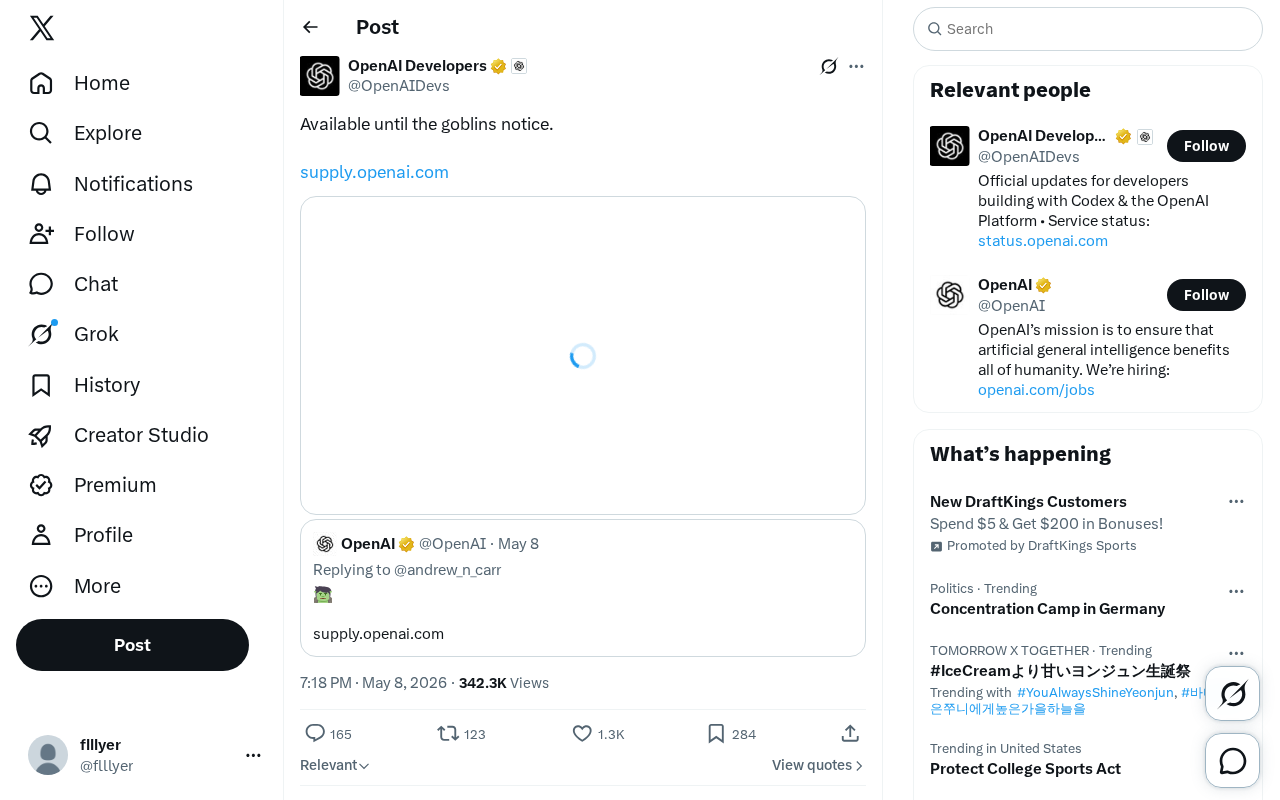
A single tweet reading 'Available until the goblins notice.' with two unexpanded links provides no substantive content to write an article from.
Google Jules AI Coding Assistant: A Quick Look at an Open-Source Practice Repo
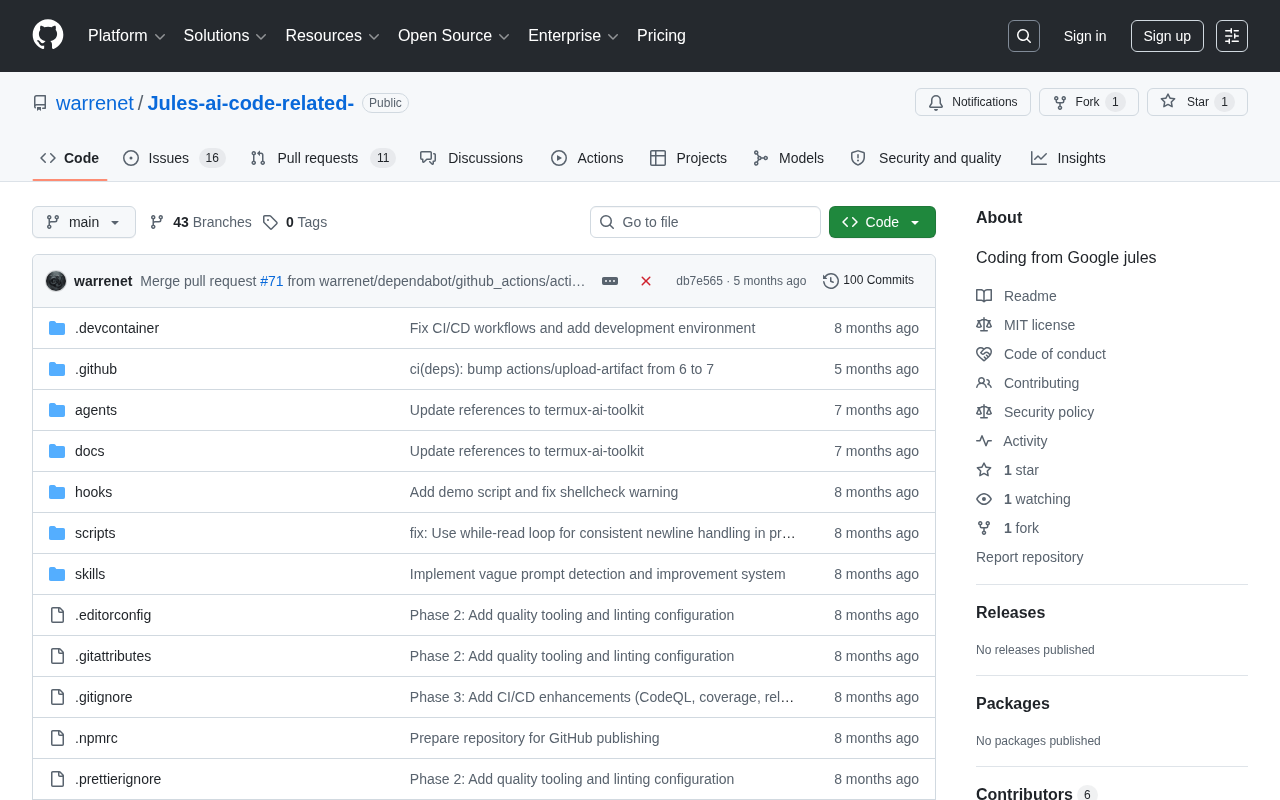
A look at a small GitHub repo centered on Google Jules, an autonomous AI coding agent. Explores what Jules does, the repo's practical value, and how to evaluate early-stage AI tool projects.
GitHub Project Overview: prateek0221/jules — Critically Lacking Information
The GitHub repo prateek0221/jules has only 1 star, no code, and no README. We review available info and provide background on Google's Jules AI coding agent.