Mark Wahlberg on AI in Film: 'Use It Right' — and He's Open to an AI Clone Carrying On His Legacy

Wahlberg says AI in film must be used 'the right way' — and he's open to an AI clone extending his screen legacy.
Mark Wahlberg weighed in on AI in film, arguing the key is using it 'the right way' — to enhance creation rather than replace humans — and expressing openness to an AI clone continuing his screen legacy. His stance reflects Hollywood's shift from all-out resistance to a pragmatic 'how to manage it' debate. The article examines unresolved legal and ethical issues around AI cloning, including likeness and performance rights, and notes the industry urgently needs clear authorization mechanisms and ethical norms. For content creators, the pragmatic approach is to identify where AI can enhance work and where human judgment must remain — figuring out your own 'right way' matters more than following panic or embracing blindly.
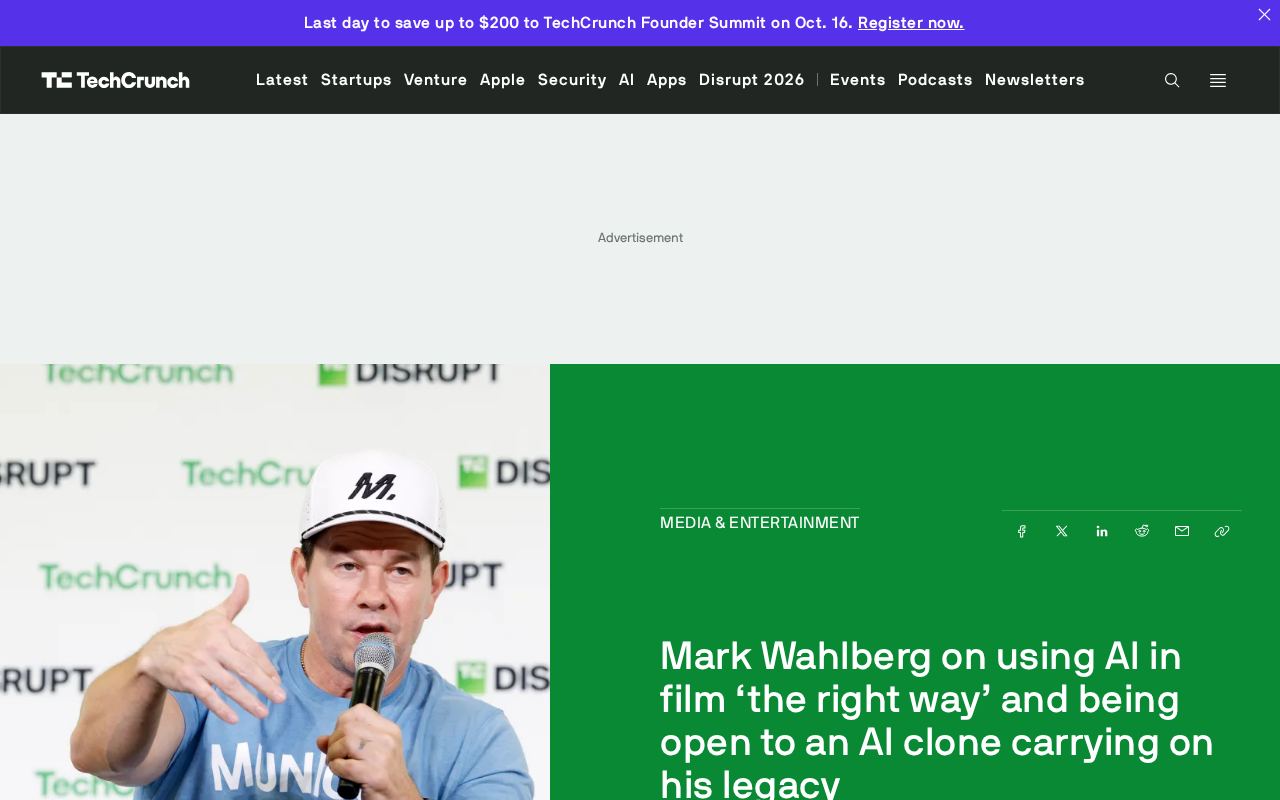
Mark Wahlberg recently shared his views on the use of AI in the film industry. The actor and angel investor said he's not opposed to using AI in filmmaking — as long as it's done the "right way," meaning using AI to "enhance what you're doing" rather than replace it.
More notably, Wahlberg also said he'd be open to having an AI clone continue "performing" after he's gone, extending his on-screen legacy. That statement has reignited discussions about "digital immortality" and actors' rights.
Wahlberg's Position: Enhance, Don't Replace
Wahlberg's core point is actually quite simple: technology itself isn't good or bad — what matters is how it's used. When he refers to "the right way," he's taking an instrumentalist stance — AI is a tool to assist creators, not a shortcut to replace human creativity.
This attitude isn't isolated in Hollywood. From directors to studios, the industry's stance on AI is shifting from initial panic to a more pragmatic discussion about "how to use it." As an actor who also works in investment, Wahlberg may be more attuned to this issue than pure filmmakers — he understands both the creative side's concerns and the technology's commercial potential.
AI Clones Carrying On a Legacy: Romantic Vision or Rights Concern?
Wahlberg's openness to AI clones deserves a closer look. He's not just saying "I don't mind being digitized after I die" — he's expressing an active willingness. If technology can let his performances continue in some form, he personally is fine with it.
The issues behind this are far more complex than "whether an individual is willing." How do actors' likeness rights and performance rights get defined in the digital age? Who owns the "new performances" generated by an AI clone? Who decides whether to authorize use of a deceased actor's likeness? These questions currently have no unified answer anywhere in the world. Wahlberg's statement can be seen as a reference sample from an artist's perspective, but the industry is still far from consensus.
The Technical Basis of Digital Twins and AI Clones
AI clone actors typically rely on two core technologies: first, digital scanning and modeling, which uses high-precision facial capture and volumetric capture to build three-dimensional digital assets of an actor; second, generative AI, which trains models on an actor's past footage and voice data so they can generate new lines, expressions, and movements. Deepfakes, NeRF (Neural Radiance Fields), and recent video diffusion models are all key technologies in this chain.
A distinction needs to be made between "digital doubles" and "AI clones": the former is mostly used for dangerous stunts or de-aging, usually with the actor's involvement and authorization; the latter can independently generate "new performances" when the actor can't participate (or has even passed away). Technical feasibility doesn't equal ethical and legal legitimacy — the source of training data, ownership of generated content, and whether it infringes on an actor's personality rights are all unresolved points of contention.
Why Are Actors' Attitudes Softening?
Hollywood's resistance to AI was once fierce — AI was one of the core issues in the writers' and actors' strikes. But voices like Wahlberg's — "conditional acceptance" — are growing. The reasons aren't hard to understand:
On one hand, AI's penetration into post-production, visual effects, and voice work is already a done deal — complete rejection isn't realistic. On the other hand, people like Wahlberg who are both actors and investors naturally tend to find a controllable way to participate in the tech wave rather than stand in opposition.
The phrase "the right way" is key because it shifts the discussion from "whether to use AI" to "how to manage AI" — which is exactly the practical question the industry must face next.
AI Issues in the 2023 Hollywood Strikes
In 2023, the Writers Guild of America (WGA) and the Screen Actors Guild (SAG-AFTRA) went on strike one after another, with AI as a core point of contention. Writers feared generative AI would be used to rewrite or cheaply replace scripts, and ultimately won restrictions on the use of AI-generated material and credit protections. Actors focused on "digital replicas": could studios scan an actor's likeness and use it indefinitely while paying only a day's wages? The final agreement required explicit consent and appropriate compensation for the use of digital replicas.
The significance of these strikes is that they turned AI from a "technical issue" into a "labor relations and copyright issue." The softening of attitudes among actors like Wahlberg came after this institutional framework was initially established — when the rules became clearer, "conditional acceptance" became possible.
What This Means for Content Creators
Wahlberg's stance also has reference value for content creators more broadly. Whether you do video, writing, or design, AI tools are rapidly entering workflows. Complete rejection and full embrace are both likely not optimal.
A more pragmatic approach might be: identify which parts of the process AI can enhance your output (like organizing materials, generating first drafts, format conversion), and which parts must retain human judgment (like final creative decisions, emotional expression, value orientation). When Wahlberg says "enhance what you're doing," that's essentially what he means.
The ethical and legal framework for AI clones is still being built, but tool-level applications are already within reach. For creators, figuring out your own "right way" is more important than following the panic or embracing blindly.
A New Proposition for Digital Legacy
Wahlberg's willingness to let an AI clone extend his on-screen life touches on a bigger question: in the AI era, what does a person's "legacy" actually mean?
Traditional legacy is work and reputation. But if AI can generate new "performances," do those count as part of the legacy? Is the audience seeing Wahlberg, or a model trained on Wahlberg's data? This ambiguity is both an opportunity and a risk.
For now, the industry needs not just technical solutions but clear authorization mechanisms and ethical norms. Wahlberg's personal openness is a signal, but what truly determines how far AI clones can go is the co-evolution of legal frameworks and audience acceptance.
Existing Legal Practice for Commercial Use of Deceased Figures' Likenesses
AI cloning doesn't start from a legal vacuum. California and other U.S. states already have "right of publicity" legislation requiring authorization from estate administrators for commercial use of a deceased person's likeness, name, and voice, with protection periods in some states lasting decades. For example, Robin Williams' estate explicitly prohibited use of his digital likeness for 25 years after his death, while Peter Cushing and Carrie Fisher "returned" to film and television through estate authorization.
These cases reveal a key disagreement: who has the right to decide a deceased person's digital likeness — the person's will, family, or estate trust? Once AI cloning makes "new performances" possible, existing laws become even more inadequate, because they assume "reproducing existing footage" rather than "generating performances that never existed." This gap is exactly what the industry urgently needs to fill.
Related articles

Beyond the Mainstream World: Security and Privacy Struggles in Overlooked Regions
Human-centered security research has long focused on the West, causing security solutions to fail in the mainstream world. Researcher Collins Minando draws on Kenyan mobile loan apps, internet café authentication dilemmas, and local expert studies across nine countries to reveal how socioeconomic constraints reshape privacy practices, and proposes mobile money privacy redesign and PETs deployment pathways.

Claude Reportedly Able to Hide Secret Messages in Benign Images
A Reddit post claims Claude Fable 5.1 can hide secret messages in benign images. This article reviews the background, image steganography principles, and potential security risks, and suggests a testing path from rumor to verification.

Federal Government Awards $85 Million; CFS to Develop Fusion-Specific Semiconductors
The federal government awards $85 million to Commonwealth Fusion Systems to develop conductors and power semiconductors for fusion plants. This article analyzes the significance of this funding for the fusion supply chain and commercialization path.