MaRN Open Source: A PyTorch Library for Training Neural Networks with Low-Dimensional Parameter Mapping
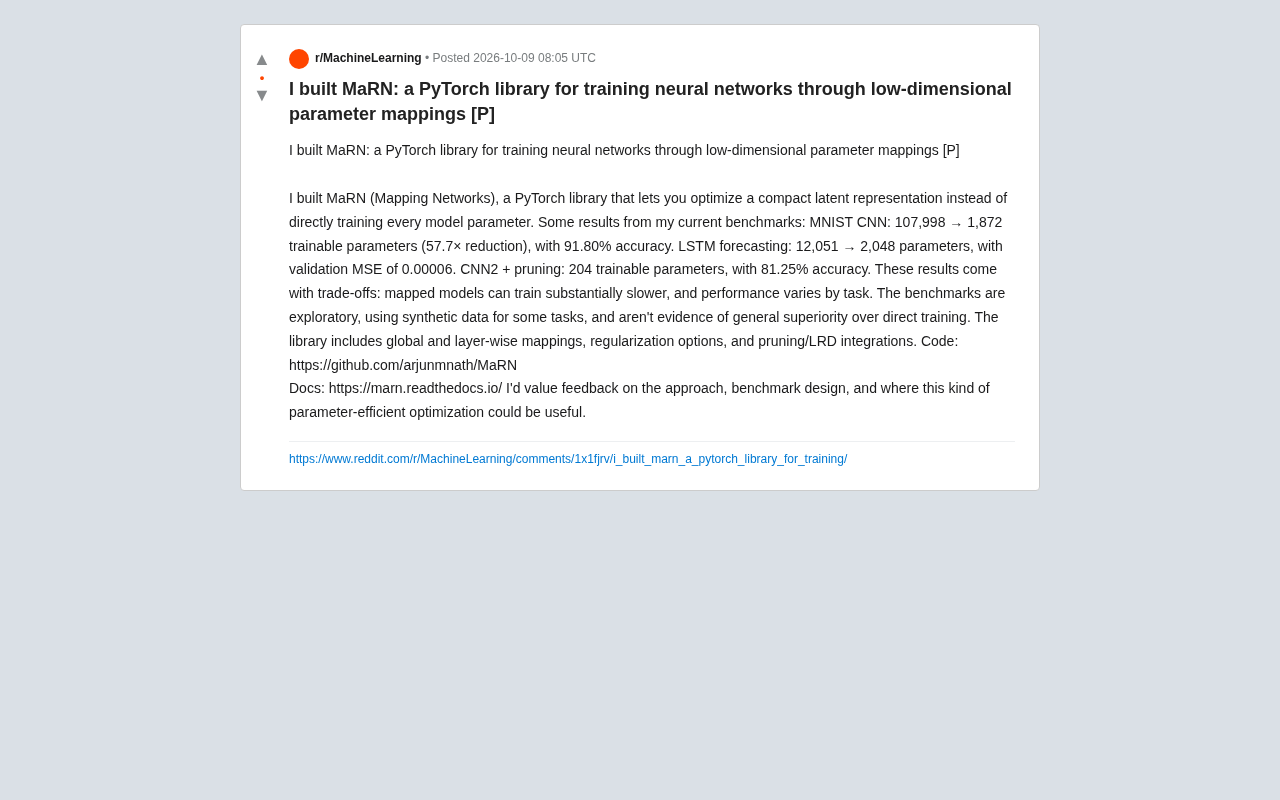
MaRN compresses neural network parameters up to 57x by optimizing in low-dimensional latent space, at the cost of slower training.
MaRN (Mapping Networks) is an open-source PyTorch library by developer arjunmnath that optimizes neural networks in a low-dimensional latent space rather than directly training all parameters, then maps the result back to full weights. Benchmarks show ~57.7x parameter compression on MNIST CNN (107,998 → 1,872) while preserving 91.80% accuracy, with pruning pushing parameters as low as 204. The trade-off is significantly slower training, and current benchmarks rely on synthetic data, making this exploratory rather than production-ready. It supports global/layer-wise mapping, regularization, pruning, and LRD integration — best suited as a research platform for studying parameter compressibility.
MaRN: A Different Way to Train Neural Networks
Traditional neural network training directly optimizes every model parameter — when parameter counts run into the hundreds of thousands or millions, this creates both a computational burden and a source of overfitting risk. Developer arjunmnath shared an open-source project on Reddit called MaRN (Mapping Networks) that proposes an alternative: instead of directly training all parameters in the network, you optimize a more compact low-dimensional latent representation, then expand it into the full set of model parameters through a mapping function.
In other words, MaRN introduces an additional "mapping" layer outside the original parameter space. What you optimize is that compressed small space, while the mapping network is responsible for restoring it into the weights actually used for inference. This approach falls under the umbrella of parameter-efficient optimization, sharing motivational similarities with recently popular low-rank methods like LoRA — but MaRN packages this idea into a general-purpose PyTorch library.

The core idea behind low-dimensional latent representation is that effective solutions in high-dimensional parameter spaces tend to concentrate on a much lower-dimensional manifold. MaRN exploits this assumption — suppose a network with a million parameters has only a few thousand "truly useful" degrees of freedom. The mapping function acts as a decoder, expanding this compact latent vector into the full weight matrices, with the entire training process performing gradient descent only in the low-dimensional space. This is closely related to the HyperNetwork concept: using a small network to generate the weights of a larger network, with the distinction that MaRN focuses more on parameter efficiency rather than conditional generation. LoRA (Low-Rank Adaptation) is another close relative — it assumes that weight update matrices are low-rank, approximating them through the product of two small matrices, which is essentially also optimization in a compressed space. The main difference between MaRN and LoRA is that LoRA targets fine-tuning scenarios for existing pretrained models, while MaRN is positioned for parameter compression when training from scratch.
Benchmarks: Significant Parameter Reduction, Varying Accuracy
The author provides three exploratory benchmarks, with the core selling point being significant parameter compression:
MNIST CNN
Compressed from 107,998 trainable parameters down to 1,872 — a ~57.7x reduction — while maintaining 91.80% accuracy. For a classic MNIST convolutional network, achieving over 90% recognition accuracy with less than 2% of the original parameter count vividly demonstrates the compression potential of low-dimensional mapping.
LSTM Time-Series Prediction
Parameters reduced from 12,051 to 2,048, with a validation MSE as low as 0.00006. This result shows that the mapping approach isn't limited to visual convolutional networks — it can also converge to comparably low error on sequence modeling tasks.
CNN2 + Pruning
After stacking pruning on top, trainable parameters were compressed to an extreme of 204, with an accuracy of 81.25%. This is a striking figure — over two hundred parameters still completing meaningful classification tasks, demonstrating the extreme compression capability when mapping is combined with pruning.
It's important to emphasize that the author himself remains measured about these numbers. He explicitly notes that some tasks use synthetic data, that the benchmarks are "exploratory" in nature, and that they do not constitute proof of universal superiority over direct training methods.
Costs and Trade-offs: No Free Lunch
The MaRN author honestly lists the method's limitations in the post — a pragmatic stance worth acknowledging:
- Training is significantly slower: Training mapping models is often much slower than direct training. Fewer parameters doesn't mean less computation; the forward/backward passes through the mapping network itself introduce additional overhead.
- Performance varies by task: Results vary considerably across different tasks, and the mapping approach is not a universally optimal solution.
- Benchmarks remain immature: The use of synthetic data and exploratory design means these results are more like "proof of concept" than conclusions directly applicable to production environments.
This kind of trade-off is quite typical in parameter-efficient methods — trading training time or engineering complexity for gains in parameter scale, storage overhead, or generalization. The key is finding specific scenarios where compression gains outweigh speed losses.
The fundamental reason training slows down is the increased complexity of the computation graph. In direct training, gradients flow directly to the target weights; with a mapping network, each update requires first doing a forward pass through the mapping function to generate weights, then running those weights through the target network's forward pass, and during backpropagation the gradients must chain back through the mapping function to the low-dimensional space. This effectively doubles the length of the computation graph. Additionally, the mapping function itself has parameters to maintain, so memory usage doesn't necessarily decrease proportionally just because the "target parameters" are fewer. As a result, MaRN's advantages primarily manifest at inference time (costs of parameter storage, transmission, and deployment) rather than during training — this is an important dimension to distinguish when evaluating the method's practical value, and it differs from LoRA's approach of merging weights after fine-tuning to eliminate inference overhead.
Library Feature Overview
From the author's description, MaRN is not a single-point experiment script but a library with reasonable engineering completeness, primarily including:
- Global and layer-wise mappings: You can apply unified mapping to the entire model or handle each layer separately, providing different levels of granularity.
- Regularization options: Apply constraints in the low-dimensional space to help control model complexity and generalization.
- Pruning and LRD integration: Connected with pruning and LRD (low-rank decomposition related techniques), supporting further combined parameter compression.
The project is open-sourced on GitHub (arjunmnath/MaRN) and comes with ReadTheDocs documentation, making it easy for the community to try and reproduce.
Where This Approach Might Be Useful
At the end of the post, the author actively seeks community feedback, particularly around "where parameter-efficient optimization is genuinely useful." Given the method's characteristics, several potential directions are worth considering:
- Edge devices and embedded deployment: The extremely small trainable parameter footprint means lower storage and transmission costs, suitable for resource-constrained environments.
- Small-data tasks sensitive to overfitting: Low-dimensional representations naturally limit model capacity, potentially providing a regularization effect when data is scarce.
- Model compression and distillation research: As a complementary tool alongside pruning and low-rank decomposition, adding it to the compression toolbox.
Of course, the disadvantage in training speed means it's unlikely to replace large-scale direct training anytime soon. A more realistic positioning is as an experimental platform for researchers exploring "the compressibility of parameter spaces." For developers who care about model efficiency and parameter-efficient training, MaRN provides a ready-to-use, conceptually clear starting point — worth watching for its future performance on real-world datasets.
Related articles

AI + SRC Automated Vulnerability Hunting: Rebuilding the Three-Step Method with AI Agents
A complete guide to AI+SRC automated vulnerability hunting — comparing traditional methods with AI Agent-powered workflows covering asset recon, false positive filtering, and report generation.

Testing DeepSeek Desktop Agent: Auto-Generate a Full Video for Just $0.35
A blogger tested DeepSeek Harness desktop Agent: auto-generated a full video for $0.35, built a daily briefing, and an app from plain English — all for $0.59 total.

Antigravity 2.0 Complete Guide: MCP, Skills, and Automation Explained
A complete guide to Antigravity 2.0 covering Projects/Conversations/Agents, MCP with Figma, Skills, automation, and 6 real-world use cases including design-to-code and Android app generation.