Mars' Atmosphere Is Only 1% as Thick as Earth's: Why Strong Winds Can't Knock You Down
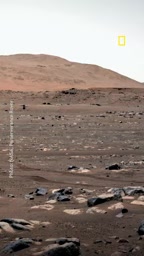
Mars' atmosphere is only 1% of Earth's; at the same wind speed, wind pressure is tiny, so dust storms can't overturn spacecraft, but dust hazards are real.
Starting from the classic scene in The Martian where a dust storm overturns a spacecraft, the article points out that Mars' atmosphere is only 1% as thick as Earth's, with atmospheric density of about 0.02 kg/m³ versus Earth's 1.2 kg/m³. Because wind pressure is proportional to density, Martian wind pressure at the same wind speed is only about 1/60 of Earth's, so strong Martian wind feels more like a gentle breeze and cannot overturn a spacecraft. However, Martian dust is fine and easily clings to solar panels, and dust storms can last for weeks and cover the entire planet, posing a real threat to probe power generation, communications, and energy supply. The article emphasizes that understanding the thin nature of Mars' atmosphere has practical significance for crewed missions: astronauts need not worry about being blown away by wind, but must guard against dust hazards to equipment and health, and it reminds people that Earth-based intuition may completely fail on other planets.
Mars' Atmosphere: So Thin It Defies Intuition
You've probably seen scenes like this in The Martian: a dust storm roars in and shakes the spacecraft to its breaking point. But a science communicator pointed out a key fact in a video — Mars' atmosphere is only 1% as thick as Earth's. This means that at the same wind speed, the force exerted by Martian wind is far smaller than that of wind on Earth. In other words, even if a "strong wind" blows on Mars, you won't be knocked over the way you would by a typhoon on Earth.
This simple comparison reveals a commonly overlooked fact in planetary science: atmospheric density determines the "power" of wind. Earth's atmospheric density at sea level is about 1.2 kg/m³, while Mars' atmospheric density is only about 0.02 kg/m³. When wind speed is the same, wind pressure is proportional to density, so wind pressure on Mars is only about 1/60 of that on Earth. This is why the scene of a spacecraft being blown over in the movie is almost impossible in reality — its dramatic effect far exceeds its scientific accuracy.
The physical relationship between wind pressure and atmospheric density: Wind pressure (dynamic pressure) is determined by the formula q = ½ρv², where ρ is air density and v is wind speed. This means wind pressure is proportional to density and to the square of wind speed. Earth's sea-level density is about 1.2 kg/m³, and Mars' is about 0.02 kg/m³, a difference of about 60 times; therefore, at the same wind speed, Martian wind pressure is only about 1/60 of Earth's. If Martian wind reaches 30 m/s, the speed of an Earth typhoon, its dynamic pressure is about 9 Pa, while at the same wind speed on Earth it is about 540 Pa — the former is roughly equivalent to a light breeze felt on your face. This explains why Martian wind is fast but "feeble."
The Gap Between Movies and Reality
The dust storm scene in The Martian is an exaggeration made by science fiction films for visual impact. The video's creator points out that although Martian wind can stir up dust, its momentum transfer efficiency is extremely low because the air is thin.
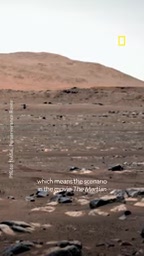
In reality, wind on Mars does exist, and sometimes the wind speed is not low. But as the video says, "a storm in air as thin as Mars' would feel like..." The conclusion is: it feels more like a gentle breeze than a gale that can overturn a spacecraft. Data sent back by Mars probes also support this — Martian wind speeds can reach tens of meters per second, but because of the low density, the wind load produced is far smaller than at the same wind speed on Earth.

The Real Threat of Martian Wind and Dust
Although Martian wind won't directly blow people over, the dust problem it brings should not be underestimated. Martian dust particles are fine and easily cling to solar panels, reducing power generation efficiency. This is also one of the practical challenges faced by Mars probes. In addition, dust storms can last for weeks and blanket the entire planet, affecting communications and energy supply.
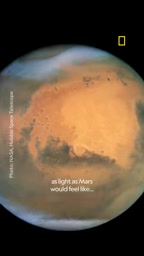
The video's creator also mentions that his new book Lost in Space includes more similar space trivia. For space enthusiasts, this kind of comparison helps us understand the environmental differences between planets more accurately.
The real impact of Martian dust on solar panels: Martian dust particles have an average diameter of only about 1.5–3 micrometers, far smaller than Earth sand grains, so they are more easily suspended and electrostatically attracted to solar panel surfaces. NASA's Opportunity and Spirit rovers both experienced reduced power generation due to dust accumulation, and mission teams had to rely on occasional "dust devils" to clean the panels; in 2018, Opportunity lost contact because a global dust storm blocked sunlight. During dust storms, atmospheric optical depth can rise above 5, and sunlight reaching the surface is less than a few percent of normal, putting solar-powered probes in a severe energy crisis. This also suggests that future crewed missions will need to design dust-resistant coatings or nuclear power backups.
Why Does This Fact Matter?
Understanding the thin nature of Mars' atmosphere is not only relevant to the plausibility of science fiction films, but also has practical significance for future crewed Mars missions. When astronauts operate on Mars, they do not need to worry about being blown away by wind, but they do need to guard against the hazards of dust to equipment and health. At the same time, this also reminds us: physical experience formed by intuition on Earth may completely fail on other planets.
The video summarizes it in one concise sentence: "You can't breathe oxygen on Mars, but strong wind won't blow you over either." This sentence precisely captures two key features of the Martian environment: lack of oxygen and low-pressure wind. For science communicators, this kind of comparison based on physical principles is an effective way to correct public misunderstandings.
Related articles

Nvidia CEO Removal Saga: Trump Intervenes Over the Weekend, Jensen Huang Reinstated Monday
Vergecast podcast reveals Nvidia CEO drama: earnings call said he wouldn't return and a new CEO was being sought; Trump intervened over the weekend, with J.D. Vance brokering a security guarantee to the board; Jensen Huang reinstated at 9 a.m. Monday.
Semantic Caching Explained: Reusing the Same Answer for Similar Questions
Semantic caching uses embeddings to judge whether queries are similar in meaning and reuses cached results for similar prompts. This article explains how it works, the difficulty of threshold tuning (such as the risk of misjudging negations), and its applicable boundaries.

How Did Trump Personally Turn Nvidia into the "Twelfth Board Member"?
A YouTube political commentary offers a sharp view: behind Nvidia's market cap milestone, Trump's deep involvement earns him the title of "twelfth board member." The article breaks down the commentator's logic on stock market achievements, the break from small-government tradition, and power display.