Mathematical Foundations for Machine Learning: A Complete Learning Path from Linear Algebra to Probability Theory

A complete guide to the essential math foundations and free resources for learning machine learning.
This article systematically outlines the three core mathematical pillars for machine learning—linear algebra, calculus, and probability & statistics—explaining their roles in ML algorithms. It recommends community-verified free resources including the Mathematics for Machine Learning textbook, 3Blue1Brown videos, and Coursera's Imperial College specialization, while providing an effective learning strategy that combines theory with hands-on Python practice.
Why Mathematics Is the Cornerstone of Machine Learning
In Reddit's machine learning community, a beginner raised a question that nearly every newcomer encounters: "Can you recommend the best resources for learning math for machine learning? Where should I start?"
This seemingly simple question actually touches on the most critical—and most easily overlooked—aspect of the machine learning learning path. Many beginners rush to get hands-on with frameworks like TensorFlow or PyTorch, only to hit a wall when encountering concepts like gradient descent, backpropagation, and eigenvalue decomposition. TensorFlow was developed by the Google Brain team, and PyTorch by Meta's AI research team—both are currently the most mainstream deep learning frameworks, encapsulating vast amounts of underlying mathematical operations so developers can build complex models with just a few lines of code. However, when a model underperforms expectations, understanding the underlying mathematical principles—such as why the loss isn't converging or why gradients are vanishing—is what truly enables you to locate and solve problems. The reason is straightforward: machine learning is fundamentally the application of mathematics to data. Learning without mathematical foundations often remains at the "API-calling" level, making it difficult to truly understand how models work.
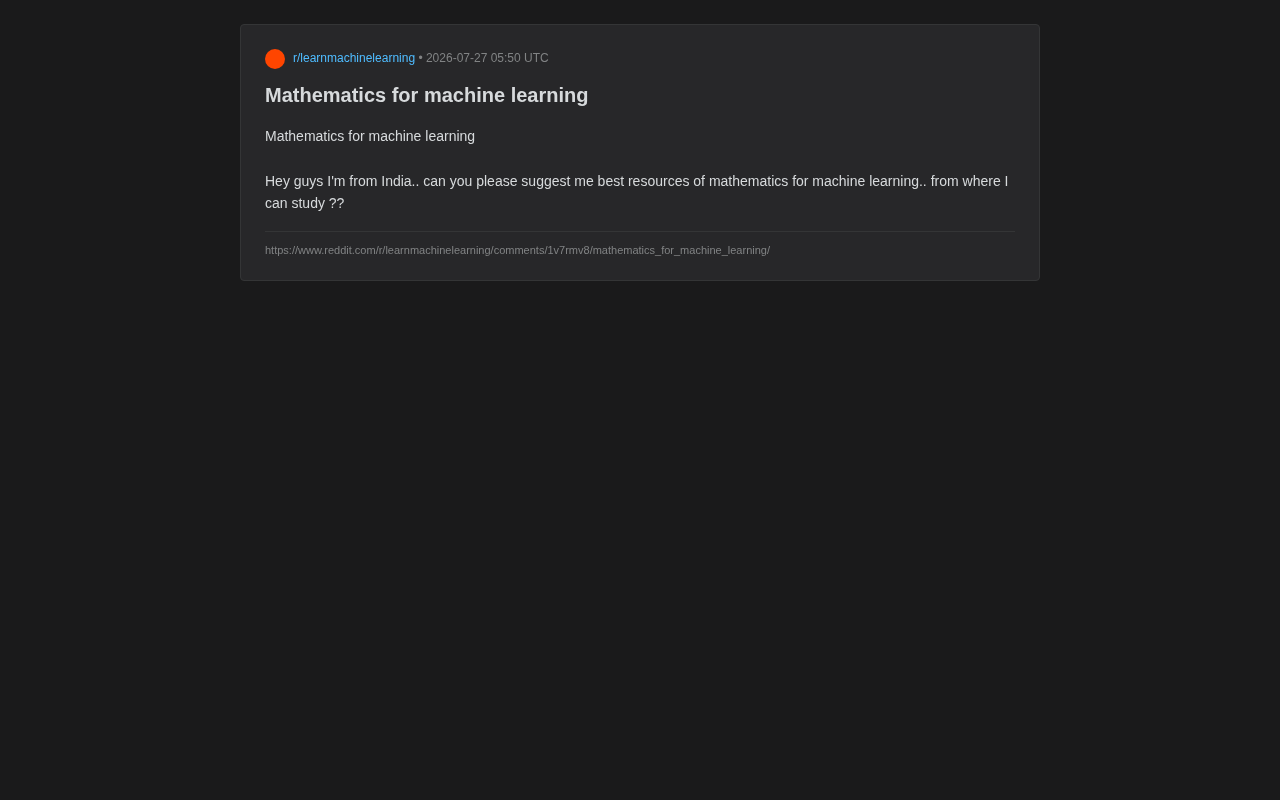
This article systematically outlines the core mathematical knowledge required for machine learning, recommends quality learning resources verified by the community, and helps beginners establish a clear learning path.
What Mathematical Knowledge Does Machine Learning Require
The Three Core Mathematical Pillars
The mathematical foundation of machine learning consists primarily of three domains, each playing an irreplaceable role in algorithms.
Linear Algebra is the most important mathematical tool in machine learning. Data in computers is typically represented as vectors and matrices—from image pixel matrices to neural network weight tensors, all are applications of linear algebra. For example, a 224×224 pixel color image is represented in a computer as a 224×224×3 three-dimensional tensor, where 3 represents the RGB color channels; the computation in each layer of a neural network is essentially matrix multiplication combined with nonlinear activation functions. Core concepts you need to master include: vector operations, matrix multiplication, eigenvalues and eigenvectors, matrix decomposition (such as SVD—Singular Value Decomposition, the principle behind PCA—Principal Component Analysis), and more. SVD is not only the mathematical basis for PCA dimensionality reduction but is also widely applied in recommendation systems (Netflix's early recommendation algorithm was based on matrix factorization) and latent semantic analysis in natural language processing. Eigenvalues and eigenvectors reveal the variance structure of data along different directions, helping us understand which directions in high-dimensional data carry the most important information.
Calculus (especially multivariate calculus) is the key to understanding model optimization. Training a neural network is essentially continuously adjusting parameters through gradient descent to minimize a loss function, and the gradient is precisely the vector form of partial derivatives from calculus. The core idea of gradient descent can be understood through an intuitive analogy: imagine standing on a mountain, wanting to find the lowest point (i.e., the minimum of the loss function), but you can only sense the slope of the terrain beneath your feet. Gradient descent means taking a small step each time in the steepest downhill direction. Mathematically, the gradient is a vector composed of the partial derivatives of the loss function with respect to each parameter, pointing in the direction where the function value increases fastest—therefore, taking the negative gradient direction gives the fastest descent. The learning rate controls the step size—too large and you might overshoot the minimum causing oscillation, too small and convergence becomes extremely slow. Mastering the chain rule is crucial for understanding the backpropagation algorithm. Backpropagation is an efficient implementation of the chain rule on a computational graph: starting from the output layer, it computes backward layer by layer each parameter's contribution to the final loss, completing all gradient calculations in one forward pass and one backward pass, avoiding the enormous overhead of redundant computations.
Probability Theory and Statistics provide the theoretical framework for handling uncertainty in machine learning. From Bayes' theorem and probability distributions to maximum likelihood estimation and hypothesis testing, this knowledge is the foundation for understanding classification models, generative models, and model evaluation metrics. Bayes' theorem P(A|B) = P(B|A)·P(A)/P(B) is ubiquitous in machine learning. The Naive Bayes classifier is directly based on this theorem, making predictions by computing the posterior probability of each class given the features—it remains a classic method for spam filtering to this day. Maximum Likelihood Estimation (MLE) finds parameter values that maximize the probability of observing the data from a frequentist perspective; Maximum A Posteriori estimation (MAP) incorporates prior knowledge, which is equivalent to adding a regularization term to the loss function—this is precisely the probabilistic interpretation of L2 regularization (Ridge regression). Modern generative models such as Generative Adversarial Networks (GANs) and Variational Autoencoders (VAEs) are built on deep probabilistic foundations, and understanding concepts like probability distributions, conditional probability, and KL divergence is a prerequisite for mastering these cutting-edge models.
Recommended Learning Priority
For beginners, there's no need to wait until you've fully mastered all mathematical knowledge before starting machine learning. A more reasonable strategy is: first build basic intuition for linear algebra and calculus, grasp the core concepts of probability theory, and then dive deeper into relevant mathematical details as you encounter specific problems in practice. This "learn as you go" approach is often more efficient than pure theoretical study.
Recommended Authoritative Learning Resources
Classic Textbooks and Free Books
For machine learning mathematical foundations, the community's universally acknowledged top resource is "Mathematics for Machine Learning". Co-authored by Marc Peter Deisenroth, A. Aldo Faisal, and Cheng Soon Ong, this book is specifically written for machine learning needs, and most importantly, it's completely free and open access (downloadable at mml-book.com). The reason it has become the community's top choice is that it bridges the gap between traditional mathematics textbooks and machine learning practice. Traditional linear algebra or calculus textbooks, while comprehensive in their coverage, include extensive content rarely used in machine learning (such as abstract algebraic structures, complex analysis, etc.), while potentially overlooking topics that frequently appear in machine learning like matrix calculus and probabilistic graphical models. The book is divided into two parts:
- The first half systematically covers linear algebra, analytic geometry, matrix decomposition, vector calculus, and probability and statistics
- The second half applies these mathematical tools to specific machine learning problems, demonstrating practical applications through four concrete cases—linear regression, PCA dimensionality reduction, Gaussian mixture models (density estimation), and support vector machines—showing readers exactly how each mathematical concept translates into a working algorithm
For readers who want to systematically study individual mathematical branches, Gilbert Strang's "Introduction to Linear Algebra" is a classic in the linear algebra field, and its accompanying MIT OpenCourseWare lectures are widely praised.
Online Course Platforms
Coursera's "Mathematics for Machine Learning" Specialization is offered by Imperial College London and includes three courses: Linear Algebra, Multivariate Calculus, and PCA. This course series is designed specifically for machine learning, emphasizing practicality and intuitive understanding, making it highly suitable for beginners seeking systematic introduction.
Khan Academy offers free foundational courses in linear algebra, calculus, and statistics with clear, accessible explanations. It's particularly suitable for learners who need to strengthen their high school and undergraduate mathematical foundations. All resources are completely free with no geographic restrictions.
3Blue1Brown's YouTube channel is renowned for its stunning visualization animations. Created by Grant Sanderson, 3Blue1Brown uses the self-developed animation engine Manim to produce beautiful visualizations. Traditional math education often relies on symbolic derivation, yet many learners become proficient in symbol manipulation while lacking geometric intuition. For example, matrix multiplication is algebraically a dot product of rows and columns, but from a geometric perspective, it's actually a linear transformation of space—a combination of rotation, scaling, shearing, and other operations. The "Essence of Linear Algebra" series reinterprets the entire linear algebra system from the perspective of transformations, making the determinant no longer just a computational formula but rather the scaling factor of area (or volume) under transformation. The "Essence of Calculus" series is equally excellent, helping learners build intuitive understanding of abstract mathematical concepts—a perfect complement to theoretical study. This kind of intuitive understanding is extremely important when debugging machine learning models.
Free and Localized Resources
India's NPTEL (National Programme on Technology Enhanced Learning) platform is also worth noting. It offers numerous free mathematics and machine learning courses taught by professors from the Indian Institutes of Technology (IITs), with widely recognized teaching quality.
Effective Learning Strategy: Theory and Code in Parallel
Verify Mathematical Concepts Hands-On with Python
Studying mathematical theory alone can be tedious and hard to sustain. It's recommended to immediately experiment hands-on with Python (NumPy, Matplotlib) after learning each mathematical concept. NumPy is the most fundamental scientific computing library in Python, providing efficient multidimensional array objects and rich matrix operation functions; Matplotlib is the most commonly used data visualization library, capable of transforming abstract mathematical concepts into intuitive graphics. For example:
- When learning matrix operations, implement matrix multiplication with NumPy and visualize the results, observing how different transformation matrices change the shape of figures on a 2D plane
- When learning gradient descent, write a simple optimization algorithm from scratch, plot the contour map of the loss function and trace the parameter update trajectory, intuitively experiencing how different learning rates affect convergence behavior
- When learning probability distributions, simulate Monte Carlo sampling with code and plot distribution graphs, verifying theoretical conclusions like the central limit theorem
This immediate feedback greatly deepens understanding and maintains learning motivation.
Progress Gradually, Avoid Perfectionism
Many learners easily fall into a trap: trying to master every mathematical detail before starting machine learning. In reality, you don't need to be a mathematician to do machine learning. It's recommended to first grasp about 70% of the core concepts, then supplement as needed during project practice. When you encounter a mathematical formula you don't understand while implementing an algorithm, diving deep at that point often leads to much deeper understanding.
Summary
Although the mathematical foundations of machine learning may seem vast, with a clear path and quality resources, any determined learner can progressively conquer them. The key lies in three critical points:
- Solidify the three pillars: Linear algebra, calculus, and probability & statistics are foundations that cannot be bypassed
- Leverage free resources: The "Mathematics for Machine Learning" textbook, 3Blue1Brown visualization videos, Coursera's Imperial College courses, and others are all community-verified quality resources
- Persist in learning by doing: Always combine theoretical study with Python coding practice—learn by doing
Today, quality free learning resources are more abundant than ever. The real challenge isn't finding resources, but choosing a clear path and persevering along it.
Related articles

Disaster and Glory of the Apollo Program: The History We Must Revisit Before Returning to the Moon
From the fatal Apollo 1 fire to Apollo 8's daring lunar orbit to Apollo 11's successful landing—revisiting the disasters, fears, and compromises of the Apollo program and their lessons for today's return to the Moon.

Netflix Trust Exercise Turns Into Firing Trap: Where Are the Boundaries of Corporate Trust?
A Netflix employee was fired after sharing private info in a trust exercise. We analyze the risks of corporate trust exercises and how employees can protect themselves.

AMD CDNA5 Architecture Deep Dive: Technical Evolution and the AI Computing Competition Landscape
Deep analysis of AMD's CDNA5 architecture covering Chiplet packaging upgrades, HBM memory evolution, and low-precision compute optimization, examining how AMD challenges NVIDIA's AI chip dominance.