Matrix Multiplication Complexity Reduced to O(n^2.25)? New Theory Sparks Discussion
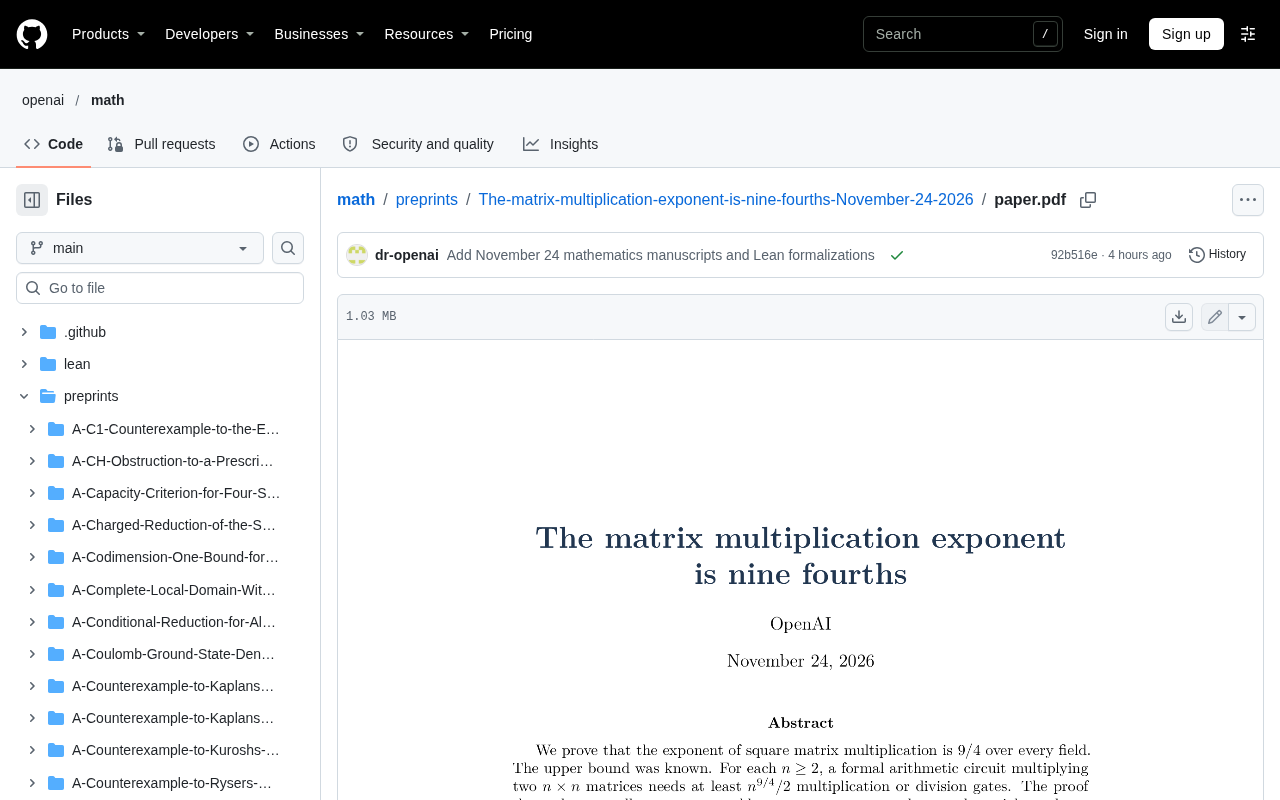
A paper claiming to reduce matrix multiplication complexity to O(n^2.25) sparks discussion, but remains to be verified.
Recently, a paper claiming to reduce matrix multiplication complexity to O(n^2.25) sparked discussion on Hacker News. Matrix multiplication is a cornerstone of computational mathematics; traditional algorithms require O(n^3) time, and the Strassen algorithm first reduced it to O(n^2.81) in 1969, with researchers since approaching the theoretical lower bound of O(n^2). The paper's title directly states the complexity upper bound, suggesting a new algorithm construction or analysis framework, but the original PDF is not publicly detailed. Hacker News commenters are cautious, emphasizing the need to verify derivation details and peer review. If the result holds, it would be a significant advancement in theoretical computer science and could have long-term effects on fields reliant on matrix multiplication, such as deep learning. Currently, the discussion is early and lacks independent verification; following subsequent peer review and reproduction is advised.
Matrix multiplication, as a cornerstone of computational mathematics, has long been a central problem in theoretical computer science with its time complexity. Recently, a paper claiming to reduce the complexity of matrix multiplication to O(n^2.25) has sparked discussion on Hacker News. Although it currently has only 50 upvotes and 9 comments, its potential theoretical breakthrough is worth noting.
Theoretical Background of Matrix Multiplication Complexity
The traditional algorithm for matrix multiplication requires O(n^3) time, and the Strassen algorithm first reduced it to O(n^2.81) in 1969. Since then, researchers have been approaching the theoretical lower bound of O(n^2) by improving algorithms. If the proposed O(n^2.25) holds, it would be a significant advancement in this field.
The paper's title directly gives the complexity upper bound, suggesting a new algorithm construction or analysis framework. However, since the original PDF has not been made public in detail, we can only interpret it at a conceptual level.
The Strassen algorithm, proposed by Volker Strassen in 1969, was the first to break the O(n^3) barrier of naive matrix multiplication. Based on the divide-and-conquer approach, it reduces the 8 scalar multiplications required for multiplying two 2×2 block matrices to 7. Through recursive application, the complexity is reduced to O(n^log2(7)) ≈ O(n^2.81). This result pioneered the research field of the "matrix multiplication exponent." Since then, researchers have continuously improved the exponent through more complex block and tensor decomposition techniques, such as the Coppersmith-Winograd algorithm and its subsequent optimizations, gradually bringing the exponent closer to 2. Currently, the theoretical lower bound is O(n^2), but the optimal upper bound remains unknown. Although the Strassen algorithm is theoretically significant, due to its large constant factor and numerical stability issues, it is only suitable for large matrices in practice.
The theoretical lower bound O(n^2) for matrix multiplication arises because the output matrix has n^2 elements, each of which must be computed, so any algorithm requires at least Ω(n^2) operations. However, whether O(n^2) is achievable remains an open question. The best known upper bound was given by Coppersmith and Winograd in 1990 with an exponent of about 2.376, which has been improved multiple times to about 2.3728639 (as of 2024). If the claimed O(n^2.25) holds, it would be significantly better than the current best upper bound, but note that this result is yet to be verified. In theoretical computer science, the matrix multiplication exponent is related to the complexity of many other problems, such as inversion and determinant computation, so its improvement has broad implications.
Potential Impact and Controversy of the New Algorithm
A reduction in theoretical complexity usually implies more efficient algorithm design, but practical applications also need to consider constant factors and implementation difficulty. Commenters on Hacker News are cautious about this, with some pointing out the need to verify the derivation details of the paper, and others worrying whether such results have undergone peer review.
From multiple sources, the discussion is still in its early stages and lacks independent verification. Nevertheless, this topic has stimulated community interest in the lower bound problem of matrix multiplication and may drive further research.
Community Discussion and Future Directions
Although the number of comments on Hacker News is small, the discussion reflects the dissemination characteristics of theoretical computer science results in the engineering community. For AI practitioners, improvements in matrix multiplication efficiency directly affect the training and inference speed of deep learning models, so any theoretical progress may translate into practical acceleration in the future.
Currently, the full content of the paper has not been widely circulated. It is recommended to follow subsequent peer review and reproduction results. We will continue to track this theoretical development.
One-line Summary
A paper claiming to reduce matrix multiplication complexity to O(n^2.25) sparks discussion, but remains to be verified.
Paragraph Summary
Recently, a paper claiming to reduce the complexity of matrix multiplication to O(n^2.25) has sparked discussion on Hacker News. Matrix multiplication is a cornerstone of computational mathematics; traditional algorithms require O(n^3) time, and the Strassen algorithm first reduced it to O(n^2.81) in 1969. Since then, researchers have been approaching the theoretical lower bound of O(n^2). The paper's title directly gives the complexity upper bound, suggesting a new algorithm construction or analysis framework, but the original PDF has not been made public in detail. Commenters on Hacker News are cautious, emphasizing the need to verify derivation details and peer review. If the result holds, it would be a significant advancement in theoretical computer science and could have long-term effects on fields relying on matrix multiplication, such as deep learning. Currently, the discussion is in its early stages and lacks independent verification; it is recommended to follow subsequent peer review and reproduction results.
Related articles

Nothing CMF Buds 2A Drops to $17.89 on Black Friday: A New Low for ANC Earbuds
Nothing CMF Buds 2A wireless earbuds Black Friday deal: just $17.89 on Amazon, about $11 off retail and a record low. ANC earbuds at an entry-level price.

When AI Creation Gets Accused of "Spitting": Hacker News Heats Up Over the Glaude Controversy
A Hacker News post, "Spitting in the Face of Glaude," sparks debate on AI creation transparency and attribution ethics. This analysis examines the blurred creator identity behind the controversy and offers practical advice for AI content production.

Akai Embraces Custom Firmware: MPC Sample 1.4 Lets Users AI-Program Their Sampler
Akai embraces the modding community with MPC Sample 1.4 firmware, supporting vibe-coded custom firmware and effects. We analyze the impact of this open strategy on music hardware and AI-assisted programming.