Mavi Raises $4M Seed Round, Betting AI Will Create Demand for a New Kind of Accountant

Accounting staffing startup Mavi raises $4M, betting AI will reshape demand for finance talent.
Accounting staffing startup Mavi has officially emerged from stealth with a $4 million seed round. Its core thesis: AI automation is taking over repetitive bookkeeping tasks but won't simply eliminate the accounting profession — instead, it will create demand for a new breed of accountant who can work alongside AI tools and focus on judgment, strategy, and advisory work. Mavi is positioning itself as a high-precision vertical staffing firm to capture the intermediary opportunity in this shifting talent landscape. The strategy pairs an AI narrative with a real industry pain point — companies lack bridge talent who understand both technology and finance. Product details and customer base remain opaque, and the true scale of demand has yet to be validated, but Mavi represents a notable startup archetype: building services around AI-driven organizational change rather than AI itself.
Mavi Emerges from Stealth with $4M Seed Funding
Accounting talent staffing company Mavi has officially emerged from stealth mode, announcing the close of a $4 million funding round. The startup is betting on a forward-looking thesis: as artificial intelligence sweeps across industries, the market will see surging demand for a fundamentally new type of accountant.
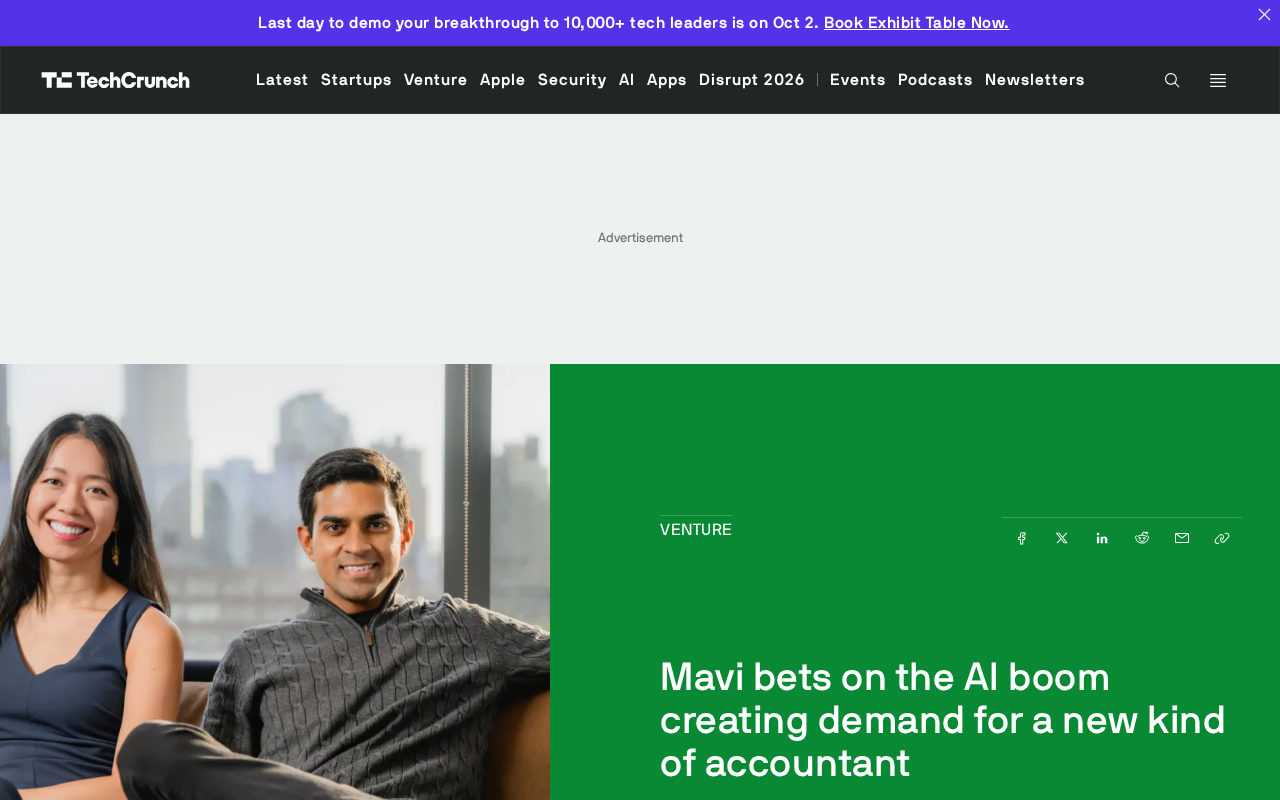
For an early-stage company stepping out of stealth, $4 million is a typical seed-round figure — generally used to validate market assumptions, build a core team, and refine an initial product. The timing of Mavi's public debut, amid peak AI discourse, is itself a clear market positioning signal.
How the AI Wave Is Reshaping the Accounting Industry
Mavi's core logic is built on a shift already underway: the spread of AI technology isn't simply replacing accountants — it's changing the composition of accounting work itself. As automation tools take over repetitive, rule-based bookkeeping and reconciliation tasks, the capability requirements employers place on accounting talent are shifting accordingly.
The "new type of accountant" Mavi envisions likely refers to hybrid professionals who can work alongside AI tools, focusing on judgment, analysis, compliance advisory, and strategic decision-making. These roles are no longer defined by how many journal entries one can process, but by the depth of business and data insight one can bring. As an accounting staffing firm, Mavi is positioning itself to capture the intermediary opportunity created by this structural shift in supply and demand.
The Business Case for Tying a Recruiting Play to the AI Narrative
Anchoring a staffing business to AI trends is a common move among HR-focused startups right now. For Mavi, this positioning serves a dual purpose: it attracts investor attention through the AI storyline, while also pointing to a genuinely real pain point — companies undergoing AI transformation often lack bridge talent who understand both technology and finance.
From a business model perspective, vertically focused talent firms (in this case, accounting) typically deliver higher match quality and stronger domain expertise than generalist recruiting platforms. If Mavi can build a distinctive understanding of what "accounting competency looks like in the AI era" — and use that to screen and develop candidates accordingly — it has a path toward building a defensible moat in a niche market.
The staffing industry generally operates under two models: executive search, which charges on success at roughly 15–30% of the candidate's annual salary, and contract/outsourcing, which bills clients per head or per hour. Vertical staffing firms focused on a specific industry or function have an edge in accumulating proprietary candidate databases and evaluation frameworks, enabling match quality that outpaces generalist platforms like LinkedIn. In the accounting space, established players like Robert Half have been at this for decades. For Mavi to break through, it will need to build a sufficiently high evaluation barrier around "AI adaptability" as a new dimension — one that creates genuine differentiation from incumbent competitors.
Open Questions Worth Watching
Given limited public information at this stage, the specifics of Mavi's product, service model, and customer base remain unclear. How large the demand for "new-type accountants" actually is — and how quickly it's growing — still requires more market data to validate. Furthermore, the net change in accounting talent demand amid deepening AI automation — that is, the balance between displaced roles and newly created ones — is the key variable that will ultimately determine the ceiling of this market.
For observers tracking AI's impact on employment structures, Mavi is a case worth following. It represents an emerging startup archetype: rather than building AI technology directly, it offers support services around the organizational and talent transformations AI triggers. This "sell the shovels" positioning tends to carve out a unique survival space during technology transition cycles.
On the quantitative research side: Oxford University's seminal 2013 paper The Future of Employment classified accountants as highly at risk of automation (roughly 94% probability), but subsequent research has broadly viewed that estimate as too aggressive — it underweighted the portions of accounting work that require social intelligence, creative judgment, and regulatory communication. The World Economic Forum's Future of Jobs Report aligns more closely with Mavi's narrative: even as many tasks are displaced, demand for higher-order skills like data interpretation and financial modeling rises in parallel. This context helps assess whether Mavi's market thesis has macro-level support — though the depth of the supply gap for "new-type accountants," and how many companies are willing to pay a premium to fill it, remains the core commercial proposition the company will need to prove with real data.
Related articles

A Single Prompt Triggers a Global PHP Security Storm: Is AI a Savior or a Hidden Risk?
A single AI prompt triggered a global PHP security crisis affecting Wikipedia and the Internet Archive. This article reviews the incident, analyzes the OpenAI-Amazon controversy, and explores the security paradox of lowered vulnerability discovery barriers in the AI era and developer response strategies.

When AI Is Taken Away: How Reliance on Shortcuts Undermines Your Problem-Solving Resilience
A study of 1,222 people found that after using AI to answer questions, once AI was removed, people gave up on more problems than a control group that never used AI. The article analyzes the impact of AI reliance on learning resilience and metacognition, and explores design implications for AI learning tools.

Carta and NewView Partner to Let Startup Employees Cash Out Equity Early
Carta and NewView Capital partner to simplify startup tender offers, helping employees sell equity early. Analysis of the mechanism, liquidity pain points, and impact.