Maxwell Model: Runtime Binary Rewriting to Accelerate Whisper and LTX-2

Maxwell uses a model to rewrite AI model binaries at runtime to accelerate inference, with formal verification ensuring correctness.
The article introduces Maxwell, discussed on Reddit: a model-driven optimization system that directly rewrites binary files at runtime without modifying source code, claimed to accelerate Whisper and LTX-2. It is likened to JIT, but optimization decisions are made by a model rather than fixed compiler heuristics and can adapt dynamically to hardware and data flow. Most notably, the team uses formal verification to prove behavioral consistency before and after optimization so the system can run unattended. The author is cautious, noting that floating-point and parallel nondeterminism are verification challenges, and that papers, benchmarks, and verification coverage details are lacking; whether Maxwell is open source, commercial, or a research prototype is unclear, making it worth tracking but requiring caution.
Maxwell: Using a Model to Rewrite Binaries and Make Whisper and LTX-2 Run Faster
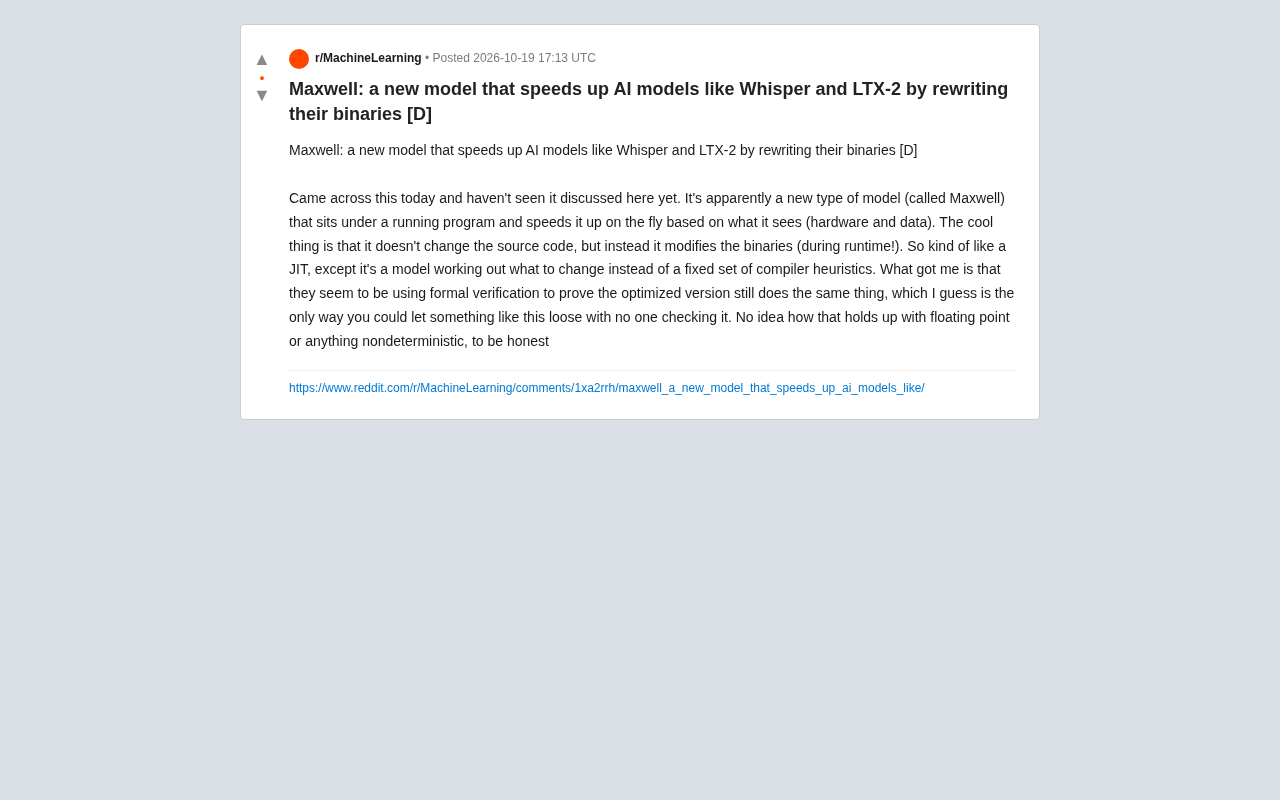
A striking discussion recently appeared on Reddit: a new model called Maxwell claims it can rewrite a program's binary at runtime to accelerate AI models, with Whisper and LTX-2 as examples. According to the poster, this tool "sits underneath the running program" and dynamically optimizes based on observed hardware and data conditions, without modifying source code.
How Maxwell Works: Model-Driven JIT
The poster compares Maxwell to JIT (just-in-time compilation), but with a key difference: traditional JIT relies on fixed compiler heuristics, whereas Maxwell uses a model to decide "what to change." It does not touch the source code; instead, it directly modifies the binary at runtime, making optimization decisions for the current hardware and data flow. This means the same model may take different acceleration paths on different machines, making it more adaptive.
According to the post, Maxwell has already been used on compute-intensive AI models such as Whisper (speech recognition) and LTX-2 (video generation). Both models are sensitive to inference latency, and if runtime binary rewriting can really be achieved, the performance gains are worth watching.
JIT (Just-In-Time compilation) is a technique that dynamically compiles bytecode or intermediate representations into machine code while a program is running; typical examples include Java's HotSpot VM and the V8 engine. Traditional JIT optimization decisions are driven by heuristics pre-written by compiler engineers, such as "prioritize inlining hot loops" or "apply aggressive optimization to frequently called methods." These rules are static and general-purpose, and cannot make fine-grained adjustments for a specific hardware microarchitecture or a specific input data distribution. Maxwell's difference is that it hands the decision of "whether to optimize and how to optimize" to a learned model, enabling it to dynamically choose binary rewriting strategies based on hardware features and data flow patterns observed at runtime. This is similar to traditional profile-guided optimization (PGO), but PGO still relies on a manually designed optimization pipeline, whereas Maxwell's decision space is more open and brings new challenges in guaranteeing correctness.
Formal Verification: Making Unsupervised Optimization Feasible
What surprised the poster most is that the Maxwell team appears to be using formal verification to prove that the optimized version behaves consistently with the original. "This is probably the only way to make it safe to run such a system unattended," the poster wrote. Formal verification uses mathematical methods to prove that a program satisfies specific properties; it has already been applied in compiler optimization (e.g., CompCert), but combining it with model-driven binary rewriting is still radical.
The poster also raised a key question: "Honestly, I'm not sure how this holds up under floating-point arithmetic or any nondeterministic scenario." Floating-point rounding errors and the nondeterminism of parallel execution are classic difficulties in formal verification. If Maxwell is to handle AI workloads, it cannot avoid these issues.
Formal verification refers to the technique of using mathematical logic to prove that a program satisfies a specification; common methods include model checking, theorem proving, and abstract interpretation. In the compiler field, CompCert is a landmark project: it uses the Coq theorem prover to prove that all compilation steps of its C compiler preserve the semantics of the source program, thereby guaranteeing that the generated assembly code behaves consistently with the C source. Applying formal verification to binary rewriting is difficult because one must establish a semantic equivalence relation between the original binary and the rewritten binary, while the binary level lacks high-level type information and structural information. In addition, verification is usually performed against deterministic semantic models, whereas floating-point arithmetic, concurrent execution, and memory models on real hardware all introduce nondeterminism, so the formal definition of "behavioral consistency" itself requires careful consideration.
The difficulty of formal verification of floating-point arithmetic stems from the fact that the IEEE 754 standard allows multiple legal implementation choices, such as the use of fused multiply-add (FMA), rounding modes, handling of denormal numbers, and the possibility that different instruction sets may give different results for the same operation. Transformations common in compiler optimization, such as reassociation and constant folding, are safe in the integer domain but may change numerical results in the floating-point domain. If Maxwell performs binary rewriting for AI workloads, it is very likely to involve vectorization, instruction substitution, or loop transformations, all of which require additional correctness arguments under floating-point semantics. Another approach is to accept bounded error and use interval analysis or error propagation to prove that the deviation between the optimized output and the original output is within an acceptable range, but this provides a different strength of guarantee than strict formal verification of "behavioral consistency."
Potential Impact and Open Questions
If Maxwell's approach holds up, it could change how AI model deployment is optimized: instead of manually tuning for each hardware platform, a model could automatically explore at runtime. However, the community discussion lacks technical details—there are no paper links, no benchmark data, and no explanation of verification coverage. The poster themself only "came across it" and did not verify it in depth.
It is still unclear whether Maxwell is an open-source project, a commercial product, or a research prototype. How its formal verification handles floating-point nondeterminism, and what the safety boundaries of binary rewriting are, are questions that can only be judged with further information. For developers interested in AI inference acceleration, this is undoubtedly a direction worth tracking.
One-line Summary
Maxwell uses a model to rewrite AI model binaries at runtime to accelerate inference, and relies on formal verification to ensure correctness.
Paragraph Summary
The article introduces Maxwell, discussed on Reddit: a model-driven optimization system that directly rewrites binary files while a program is running, without modifying source code, and is claimed to have been used to accelerate Whisper and LTX-2. It is compared to JIT, but the optimization decisions are made by a model rather than fixed compiler heuristics, allowing dynamic adjustment based on hardware and data flow. Most notably, the team uses formal verification to prove that behavior is consistent before and after optimization, so that the system can run unattended. The author is cautious, pointing out that floating-point arithmetic and parallel nondeterminism are verification difficulties, and that details such as papers, benchmark data, and verification coverage are currently lacking. It is still unclear whether Maxwell is open source, commercial, or a research prototype; it is worth tracking but should be viewed with caution.
Related articles

Trump's Request to Rename the Atlantic Rejected by Google; 1Password Lets AI Agents Log In Securely
The Vergecast roundup: Trump's request to rename the Atlantic the 'Trump Ocean' was politely declined by Google's CEO; 1Password's new feature lets AI agents log into accounts without touching passwords; OPPO launches the world's first 200-megapixel phone, the Find X10 Pro Max. All three point to the boundaries of tech authorization and trust.

The Truth About American College Party Culture: The Risks Schools Won't Admit
Behind American college party culture, the administration's "don't ask, don't tell" attitude is amplifying freshman risks. This article analyzes how the pandemic strengthened Greek dominance, freshmen's difficulty accessing safety information, and the chain reactions caused by a culture of denial.

OpenAI Reportedly Raising $30B at $1.25T Valuation Ahead of IPO
OpenAI is planning a $30B funding round at a possible $1.25T valuation, paving the way for an IPO. If completed, it would set a private company valuation record. This article analyzes the funding size, pre-IPO logic, and industry signals.