May 2026 Apple Developer Newsletter: Accessibility Labels and Silicon Migration Essentials

Apple's May 2026 developer newsletter highlights Accessibility Nutrition Labels and Apple Silicon migration.
Apple's May 2026 "Hello Developer" newsletter covers three key areas: introducing Accessibility Nutrition Labels requiring developers to transparently disclose VoiceOver, Dynamic Type, and other accessibility support, elevating accessibility from optional to mandatory disclosure; reemphasizing the urgency of Apple Silicon migration and urging developers to complete Universal Binary compilation; and showcasing diverse developer stories alongside the Infinity Nikki technical adaptation case study.
Overview
Apple recently released its May 2026 issue of the "Hello Developer" newsletter, covering several important topics including accessibility label preparation, Apple Silicon app migration, and developer account management. This newsletter not only demonstrates Apple's continued investment in its developer ecosystem but also reveals key directions for the platform's future development.
Accessibility Nutrition Labels: The Next Compliance Priority for the App Store
What Are Accessibility Nutrition Labels
The most noteworthy content in this issue is the requirement for developers to prepare "Accessibility Nutrition Labels" for their apps. This concept borrows from the food nutrition label model, aiming to give users a clear understanding of an app's accessibility support before downloading it.
This initiative follows a clear institutional evolution. Back in 2020, Apple pioneered Privacy Nutrition Labels on the App Store, requiring developers to disclose their apps' data collection practices, profoundly changing the industry's standards for user privacy transparency. Accessibility Nutrition Labels adopt this same proven framework, extending disclosure from privacy to accessibility capabilities. From a global regulatory perspective, the EU's European Accessibility Act officially took effect in June 2025, requiring digital products and services to meet specific accessibility standards. Apple's move also helps developers proactively adapt to global compliance requirements.
This means Apple is elevating accessibility features from "an optional bonus" to "basic information that must be transparently disclosed." For developers, this isn't just a technical requirement—it represents a fundamental shift in product philosophy. Accessibility is no longer an afterthought but a core element that needs to be considered from the very beginning of the design process.
What Developers Need to Prepare
Drawing from the rollout experience of Privacy Nutrition Labels, developers should assess their apps' support for accessibility features like VoiceOver, Dynamic Type, and color contrast as early as possible, and accurately report this information in App Store Connect.
Understanding the implications of these technical features is crucial. VoiceOver is a screen reader technology Apple introduced with iPhone OS 3.0 in 2009. It remains one of the most mature accessibility features on mobile, helping visually impaired users operate their devices through spoken feedback and haptic responses, supporting over 35 languages. Dynamic Type allows users to customize system-wide font sizes, requiring apps to properly respond to size changes without breaking layouts. Additionally, Apple's accessibility framework encompasses Switch Control (for users with motor impairments), Voice Control, and color filters. When preparing Accessibility Nutrition Labels, developers need to systematically evaluate their apps' depth of support for these features, rather than merely doing surface-level adaptation. Apple's Accessibility Inspector tool can help developers automatically detect potential accessibility issues and is an essential self-audit tool before completing label submissions.
Apple Silicon Migration: The Final Window
The newsletter once again emphasizes the importance of migrating Intel-architecture Mac apps to Apple Silicon. The Apple Silicon architecture transition began at WWDC 2020, when Apple announced the migration of its Mac product line from Intel x86 architecture to its custom ARM-based chips (M-series). The core drivers behind this transition are ARM architecture's significant advantages in power efficiency and Apple's strategic vision for vertical software-hardware integration.
To ensure a smooth transition, Apple introduced Rosetta 2, a dynamic binary translation layer that allows Intel-compiled apps to run on Apple Silicon Macs, albeit with approximately 15–20% performance overhead and some compatibility limitations with certain low-level API calls. For developers, the core migration work involves enabling the "Apple Silicon" target architecture in Xcode and compiling apps as Universal Binaries that support both x86_64 and arm64 instruction sets, enabling native execution on both old and new hardware.
By 2026, some developers still haven't completed the migration, and Apple continues to push this process through its developer newsletter. As Macs with M4 chips roll out across the entire product line, Intel Mac market share continues to decline, and the Rosetta 2 translation layer may be phased out in future versions. Native Apple Silicon support will become a basic requirement for apps to survive on the Mac platform. For developers still maintaining Intel-only versions of their apps, now is the critical time to complete the migration—technical debt must eventually be paid.
Developer Community Spotlight and Infinity Nikki Interview
Diverse Developer Stories
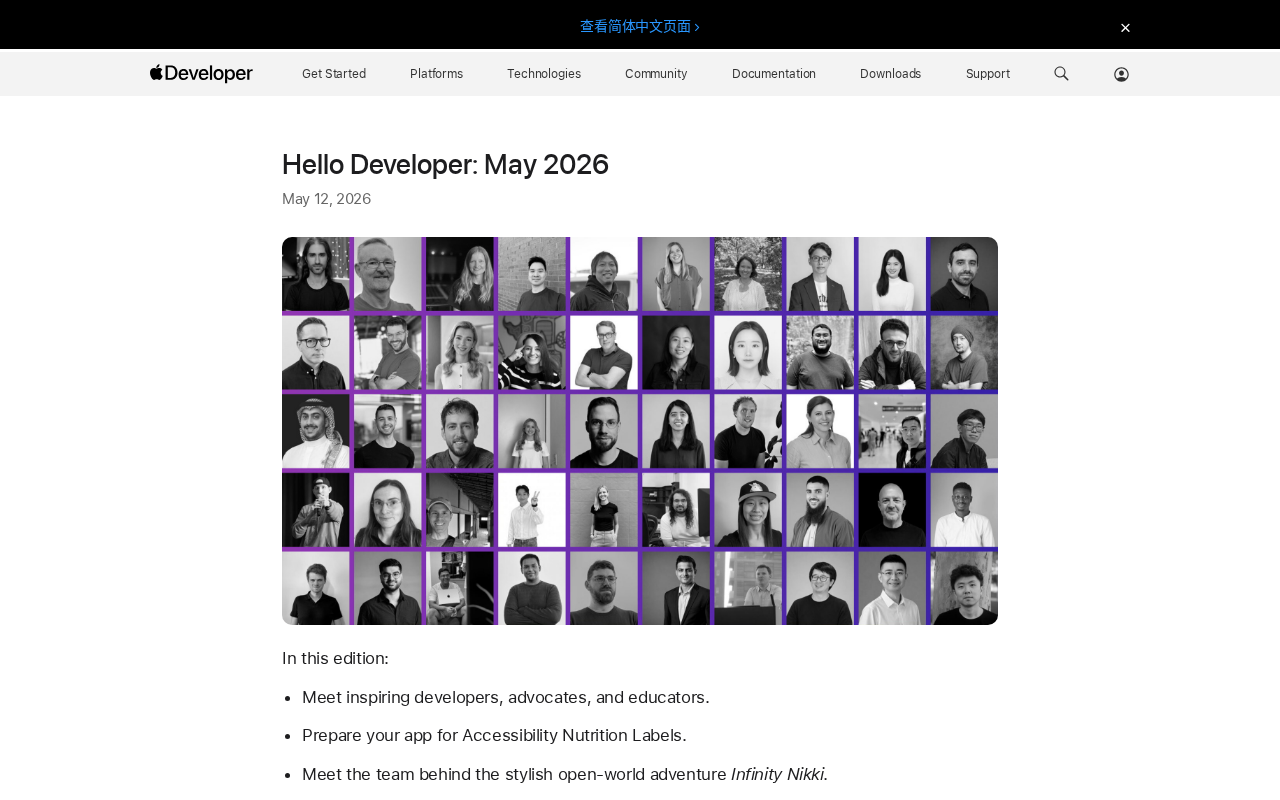
This issue specifically features a group of developers, advocates, and educators from diverse backgrounds. As visible in the accompanying images, this is a diverse group spanning different ages, genders, and ethnicities. By showcasing these personal stories, Apple sends a clear message: a thriving developer ecosystem requires diverse participants.
Infinity Nikki Development Team Interview
The newsletter also includes an interview with the development team behind the open-world adventure game Infinity Nikki. Developed by Chinese game studio Papergames, the game launched globally in late 2024 and represents a significant extension of the "Nikki" IP into the open-world genre. Built on Unreal Engine 5, the game fully leverages next-generation rendering technologies including Nanite virtualized geometry and Lumen global illumination, achieving highly consistent visual quality across mobile and PC platforms.
Adapting the game for Apple platforms presented considerable technical challenges: implementing UE5's advanced rendering features under the Metal graphics API while performing specialized optimizations for Apple Silicon's GPU architecture (based on a unified memory architecture where CPU and GPU share the same memory pool). The game surpassed 40 million registered users in its first month after launch, and its successful adaptation for Apple platforms serves as an important reference case for other large-scale game development teams—a key reason this interview was featured in this issue.
Practical Impact and Action Items for Developers
Short-Term Action Checklist
- Audit your app's accessibility status: Learn about the specific requirements for Accessibility Nutrition Labels as early as possible. Use the Accessibility Inspector tool to evaluate your existing app's accessibility support, focusing on VoiceOver compatibility, Dynamic Type responsiveness, and color contrast compliance.
- Accelerate Apple Silicon migration: If you still have Intel-only Mac apps, prioritize migration work with the goal of compiling Universal Binaries that run natively on both old and new hardware.
- Optimize developer account management: Take advantage of the latest tools and features Apple provides to ensure optimal account configuration.
Long-Term Trend Assessment
The signals Apple is sending through this newsletter are crystal clear: the platform is evolving from "feature-rich" toward "responsible technology." The introduction of accessibility labels indicates that the App Store may impose more requirements around apps' social responsibility dimensions in the future, similar to the previously introduced privacy labels. Combined with global regulatory trends like the EU's European Accessibility Act, accessibility compliance will gradually evolve from platform self-regulation to legal obligation. Developers who plan ahead will gain advantages in both compliance costs and user reputation.
Conclusion
The May 2026 Hello Developer newsletter may be brief, but it's packed with information. The introduction of Accessibility Nutrition Labels marks further institutionalization of inclusive design within the Apple ecosystem, continuing the "transparency as responsibility" philosophy established by privacy labels.
Related articles
 Tech Frontiers
A Rare Quiet Day in AI: Recursive Self-Improvement Stirs Beneath the Surface
A rare quiet day in AI sees multiple sources go silent simultaneously. Behind the calm, Recursive Self-Improvement (RSI) research continues. What this means for the industry.
 Tech Frontiers
Reve 2 vs. Ideogram 4: A Deep Dive into Layout Control in AI Image Generation
A deep comparison of Reve 2 and Ideogram 4's layout control capabilities, covering technical approaches, real-world use cases, and industry trends for designers and creators.
 Tech Frontiers
In the Weights: Check Your Influence Score in the AI World
In the Weights is an AI influence search engine that quantifies your presence in the AI world with a score. Explore how it evaluates practitioners and what it means for digital identity.