MCP Protocol Beginner's Guide: AI Model Context Protocol Architecture & Practical Integration

MCP is Anthropic's open-source standardized protocol for AI model interaction with external tools.
MCP (Model Context Protocol) is an open protocol standard released by Anthropic in November 2024, designed to solve the fragmentation problem of integrating AI models with external tools. It features a three-layer architecture — client, server, and transport — built on the JSON-RPC protocol, supporting both local Stdio and remote SSE transport methods. The MCP ecosystem is already quite mature, with ready-to-use services spanning maps, transportation, office tools, and many other domains.
What Is MCP?
MCP, short for Model Context Protocol, is an open protocol standard open-sourced by Anthropic on November 25, 2024. As an open protocol, MCP's core objective is to connect AI assistants with the systems where data resides, including content repositories, tools, and development environments, helping large language models generate more relevant and precise responses.
The Historical Context Behind MCP
Before MCP came along, integrating AI models with external tools suffered from severe fragmentation. Every AI vendor and tool provider had its own interface specification, forcing developers to write custom adapter code for each "AI model × tool" combination, with maintenance costs growing exponentially. Consider a typical enterprise AI application: if you wanted a model to support file read/write, database queries, and email sending simultaneously, you'd need to write separate integration code for GPT, Claude, Gemini, and other models — an extremely tedious workload.
When Anthropic designed MCP, they drew on the success of internet protocol standardization — just as TCP/IP unified network communication and HTTP unified web interactions, MCP aims to establish the same foundational standard for AI tool invocation. This is why MCP was released as fully open source at the end of 2024, with the goal of driving industry-wide adoption rather than building Anthropic's proprietary ecosystem.
To put it simply, MCP is like the "HTTP protocol" of the AI world — HTTP standardized communication between browsers and servers, while MCP standardizes interactions between AI models and external tools and data sources. With this unified protocol, developers no longer need to write separate adapter code for each AI model and tool combination, dramatically reducing integration costs.
MCP's Three-Layer Architecture in Detail
MCP adopts a clear three-layer architecture. Understanding these three layers is key to mastering the MCP protocol.
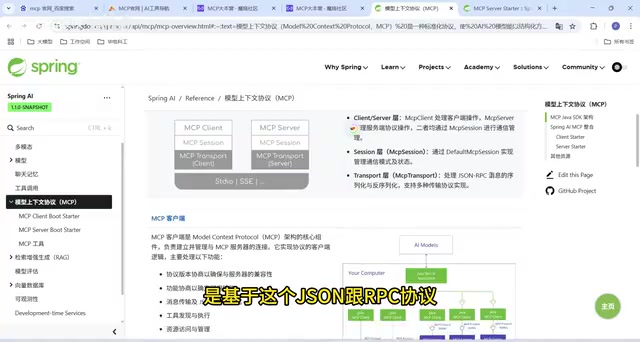
Client Layer (MCP Client)
The MCP Client is the core component of the architecture, responsible for establishing and managing connections with MCP Servers. Its main responsibilities include:
- Protocol version negotiation: Ensuring compatibility between client and server
- Tool discovery and execution: Automatically discovering available server-side tools and invoking them
- Communication management: Maintaining session state with the server
In practice, the MCP Client is typically embedded within AI applications (such as Claude Desktop, IDE plugins, etc.), serving as the "bridge" for AI models to invoke external capabilities. Notably, the MCP Client's "automatic tool discovery" capability is what distinguishes it from traditional SDK calls — the client doesn't need to know in advance which tools the server provides. Instead, it queries dynamically at runtime, enabling AI models to flexibly adapt to different server configurations.
Server Layer (MCP Server)
The MCP Server is the foundational component of the architecture, providing tools, resources, and related capabilities to clients. Its core responsibilities include:
- Tool exposure and discovery: Wrapping capabilities like file systems, databases, and APIs into standardized tools
- Resource access: Providing URI-based resource access capabilities
- Prompt templates: Offering predefined prompt templates for client use
- Concurrency management: Supporting synchronous and asynchronous operations, managing multiple client connections
For example, a file system MCP Server can enable an AI model to read and write local files; a database MCP Server can let an AI model query and manipulate databases — all these capabilities are exposed through the unified MCP protocol. MCP Server design follows the principle of least privilege, where each Server only exposes tools within its scope of responsibility, and AI models cannot access unauthorized resources beyond their permissions.
Transport Layer
The transport layer implements message serialization and deserialization based on the JSON-RPC protocol. JSON-RPC is a lightweight remote procedure call protocol that uses JSON as its data format with an extremely simple design: the client sends a JSON object containing the method name and parameters, and the server returns results or error messages. Compared to heavyweight protocols like SOAP, JSON-RPC has virtually no additional protocol overhead and low parsing costs, making it ideal for AI tool invocation scenarios that require high-frequency, low-latency interactions. MCP extends the JSON-RPC 2.0 specification by adding AI-specific fields such as tool descriptions and resource metadata.
The transport layer supports two main transport methods:
| Transport Method | Characteristics | Use Cases |
|---|---|---|
| Stdio (Standard Input/Output) | Local invocation, low latency | Client and server on the same machine |
| SSE (Server-Sent Events) | HTTP-based, supports remote invocation | Client and server distributed across different machines |
SSE (Server-Sent Events) is part of the HTML5 standard, allowing servers to continuously push data streams to clients through a unidirectional HTTP long-lived connection. Unlike WebSocket's bidirectional communication, SSE's unidirectional nature perfectly matches MCP's usage pattern — the server needs to stream intermediate states and final results of tool execution back to the client, without requiring the client to send data back on the same connection. This design also makes SSE naturally compatible with existing HTTP infrastructure (such as load balancers and reverse proxies), lowering the deployment barrier.
Both client and server manage communication through MCP Sessions, with the Default MCP Session implementing the specific communication patterns and state management.
MCP Ecosystem: Service Marketplace & Ready-to-Use Tools
The MCP ecosystem is already quite rich. Taking ModelScope's MCP Marketplace as an example, a large number of ready-to-use MCP Servers are available for direct use.
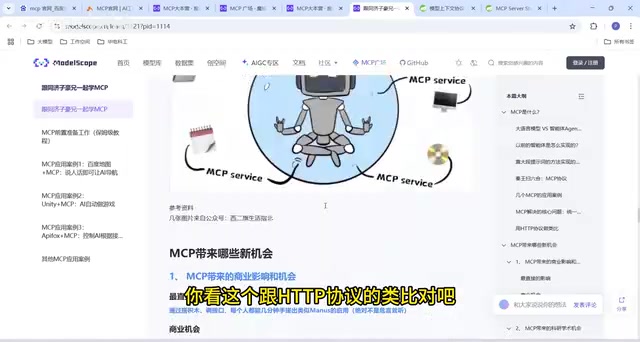
These services cover a wide range of development and daily life needs:
- Amap (Gaode Maps): Geolocation queries, route planning
- 12306: Train ticket queries and booking
- DingTalk: Message notifications, schedule management
- Alipay: Payment-related capabilities
- Baidu Maps: Navigation and geographic information services
The rapid flourishing of the MCP ecosystem is thanks to its positioning as an open protocol. Any developer or enterprise can publish their own Server following the MCP specification without needing authorization from Anthropic. This mirrors the growth trajectory of package management ecosystems like npm and PyPI — standardization lowers the contribution barrier, and network effects accelerate ecosystem expansion. There are already thousands of community-maintained MCP Server projects on GitHub, covering virtually every vertical domain from code execution and browser control to financial data and medical queries.
Developers simply need to integrate the MCP Client into their AI applications to easily invoke these existing services without worrying about underlying implementation details. The community also provides abundant tutorial examples, such as "Baidu Maps + MCP".
Related articles
 Tutorials
ChatGPT Plus Subscription Guide: Are GPT-5.5, image-2, and Codex Worth the Upgrade?
A detailed look at ChatGPT Plus features — GPT-5.5, image-2, and Codex — with a Plus vs Pro comparison and a complete step-by-step subscription guide for users outside the US.
 Tutorials
Harness AI Engineering in Practice: Using Claude Code to Master Enterprise-Level E-Commerce Development
Deep dive into Harness AI Engineering: master enterprise e-commerce development with Claude Code using the Rules, Skills, Wiki, and Changes framework.
 Tutorials
Cursor + Codex Dual-IDE Collaboration: A Practical Methodology for Open-Source Project Customization
A complete methodology for open-source project customization based on real-world experience, detailing the Cursor+Codex dual-IDE workflow, seven-stage process, MVP validation, and AI source code reading techniques.