MCP Protocol Explained: How AI's Universal USB Port Works

MCP protocol creates a universal interface for AI, transforming it from "can talk" to "can do."
Anthropic open-sourced MCP (Model Context Protocol) in November 2024, establishing a universal connection standard between AI applications and external tools—much like USB unified device connections. MCP consists of three roles: Host (user entry point), Server (external capability bridge), and Client (internal middleware), built on JSON-RPC 2.0 with both local and remote transport options. It transforms AI from a "knowledge island" into a digital employee capable of actually operating external resources—integrate once, use everywhere.
Why AI Needs a "Universal Interface"
Today's AI models are impressively knowledgeable—they can write code, translate languages, and analyze data—but there's an awkward reality: they've essentially been trapped in a "glass box." They can see the outside world, but they can't touch it. Without developers specifically writing integration code, AI can't open your local files, query a real-time database, or control local software.
To break through this glass, Anthropic introduced an open standard called MCP (Model Context Protocol). Anthropic is an AI safety company founded in 2021 by former OpenAI core members Dario Amodei and Daniela Amodei, known for its flagship Claude series of large language models that emphasize safety and controllability. In November 2024, Anthropic officially released and open-sourced the MCP protocol, quickly gaining support from developer tool vendors like Cursor, Replit, and Sourcegraph. While the name sounds fancy, its core idea is remarkably simple: give all AI applications and external tools the same universal plug.
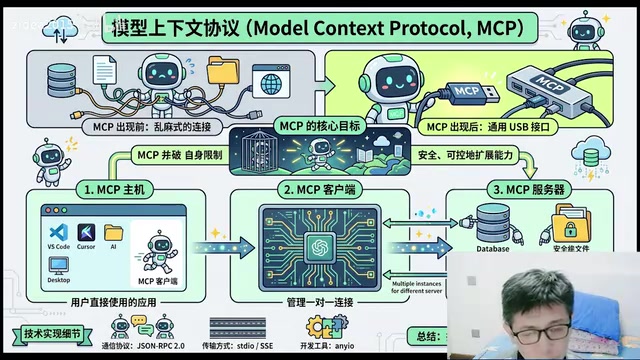
From Proprietary Protocols to Universal Standards: A USB Analogy
Remember the mobile phone market in the early 2000s? Every manufacturer had its own proprietary charger and cable—one for Nokia, another for Motorola, yet another for Sony Ericsson. Switching devices meant switching cables, which was incredibly inefficient. It wasn't until USB standardized the interface that the entire ecosystem truly flourished.
MCP is doing exactly the same thing. Before MCP, if you wanted AI to call GitHub's API, you needed to write a dedicated set of integration code; if you wanted it to read a local database, you'd need to write another. Every tool and every data source was a "proprietary protocol"—high development costs, poor reusability.
It's worth noting that the industry had previously attempted to let AI call external tools. OpenAI's Function Calling mechanism, introduced in 2023, is a typical example—it allows developers to define a set of function signatures, and the model automatically selects and generates call parameters based on user intent. However, Function Calling essentially solves the model-layer problem of "how AI decides which tool to call" without standardizing the infrastructure questions of "how tools are discovered, connected, and managed." MCP establishes standards at a deeper level, defining not only the communication protocol but also the complete lifecycle of tool registration, discovery, and permission control. In other words, Function Calling teaches AI to "pick tools," while MCP teaches tools to "be found"—they are complementary.
The value of MCP is this: as long as everyone follows the protocol, AI can instantly gain the ability to read and write files, call APIs, and even control local software—just like plugging in a USB drive. Integrate once, use everywhere.
The Three Core Roles of MCP Explained
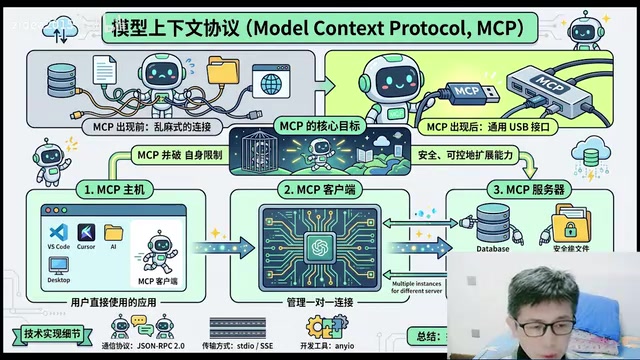
To understand how the MCP protocol works, you only need to know three roles. Each has its own responsibilities, and together they form a complete "AI capability extension system."
MCP Host: The User Interaction Entry Point
The Host is where users directly interact, equivalent to a computer's chassis. Claude Desktop, the Cursor editor, or any other MCP-supported AI application you use—all play the role of Host. It's the entry point for all interactions: users issue commands here and see results here.
MCP Server: The Bridge to the Real World
The MCP Server is the bridge connecting to the real world. Want to check a GitHub repository? There's a corresponding MCP Server. Want to browse local folders? That's another Server. Want to query a database, send an email, or control Slack? Each specific external capability is encapsulated as an independent MCP Server.
The elegance of this design lies in decoupling—each Server is responsible for only one thing, independently developed, deployed, and maintained without interfering with others. This concept directly borrows from the Microservices Architecture philosophy in software engineering. Systematized around 2014 by Martin Fowler and others, the core principle of microservices is to split monolithic applications into multiple independently deployable and scalable small services, each communicating through lightweight protocols. Its advantages include: a single service failure won't crash the entire system, different teams can develop different services in parallel, and each service can choose its most suitable tech stack. MCP applies this mature architectural philosophy to the AI tool ecosystem, enabling community contributors to independently develop and publish MCP Servers without needing to understand other Servers' internal implementations—allowing the MCP ecosystem to grow rapidly.
MCP Client: The Link Between Host and Server
So how do Host and Server connect? That's where the third role comes in—the MCP Client.
The Client runs inside the Host, responsible for handshaking with different Servers, establishing connections, and passing messages. The key point is that a single Host can connect to multiple Clients simultaneously, with each Client interfacing with one Server. This means your AI can "research with one hand and write code with the other"—multiple external capabilities called in parallel without blocking each other.
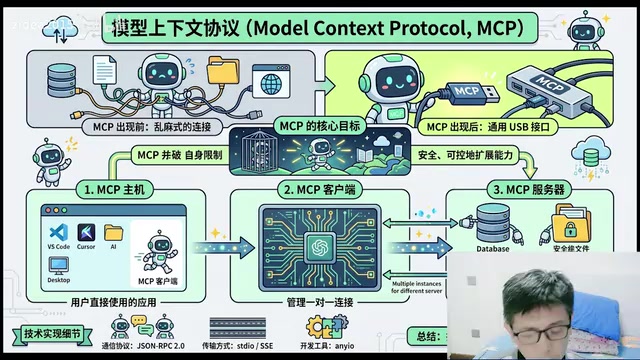
To summarize the relationship in one sentence: The Host is the brain, the Client is the arm, and the Server is the toolbox. The brain uses its arms to grab different tools from the toolbox to complete various tasks.
Underlying Technology: JSON-RPC and Standardized Communication
The MCP protocol doesn't reinvent the wheel. Its underlying communication protocol uses the mature JSON-RPC 2.0, with data transmission via Stdio (Standard Input/Output) or SSE (Server-Sent Events).
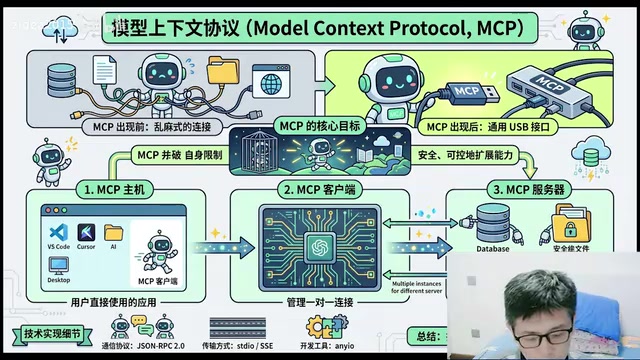
This is like how a USB port may look uniform on the outside, but the electrical signals and data packets inside follow international standards—precise and reliable. Specifically:
- JSON-RPC 2.0 is a lightweight Remote Procedure Call (RPC) protocol, with the 2.0 specification published by the JSON-RPC working group in 2010. Compared to heavier alternatives like gRPC or SOAP, JSON-RPC's advantage lies in its minimal message structure—each request contains only three core fields: method, params, and id, while responses contain either result or error. This simplicity makes it particularly suitable for high-frequency tool calls in AI scenarios, since the call instructions generated by AI models are inherently structured text that naturally aligns with JSON format. MCP's choice of JSON-RPC over a custom protocol also significantly reduces the learning curve for developers.
- Stdio (Standard Input/Output) is an OS-level inter-process communication mechanism where data passes directly between parent and child processes through stdin and stdout pipes without going through the network stack, achieving latencies as low as microseconds. This makes it ideal for local MCP Servers (such as file system operations or local database queries).
- SSE (Server-Sent Events) is a unidirectional push protocol based on HTTP, part of the HTML5 standard, allowing servers to continuously push event streams to clients through a persistent HTTP connection. Compared to WebSocket's bidirectional communication, SSE is simpler to implement and more compatible, making it suitable for remote MCP Servers pushing query results or status updates to clients.
MCP supports both transport methods simultaneously, allowing developers to choose flexibly based on deployment scenarios—Stdio for local tools demanding ultra-low latency, SSE for remote services requiring stable push delivery.
Additionally, to ensure smooth data exchange, developers have incorporated asynchronous frameworks like asyncio, ensuring that AI doesn't block the main thread when calling external tools, so user experience won't stutter while waiting for external responses. asyncio is an asynchronous I/O framework in Python's standard library, implementing non-blocking concurrency through Event Loop and Coroutine mechanisms. In traditional synchronous programming models, when a program initiates a network request or file read operation, the entire thread is blocked until the operation completes before subsequent code can execute. With asyncio's async/await syntax, programs can process other tasks while waiting for I/O operations to complete. For MCP scenarios, this means AI can simultaneously process a file read request from another Server while waiting for a remote MCP Server to return database query results—achieving truly parallel multi-tool invocation. This is the key technical foundation enabling MCP Clients to interface with multiple Servers simultaneously without performance bottlenecks.
The True Significance of MCP: Taking AI from "Can Talk" to "Can Do"
The emergence of MCP isn't fundamentally about making AI smarter—that's the job of the large language model itself. What MCP solves is making AI more "industrious."
Before MCP, AI was more like a "knowledge island": it knew a lot but couldn't do much. Ask it how to modify a configuration file, and it could give you detailed step-by-step instructions—but it couldn't open that file itself. Ask it to query a database, and it could write perfect SQL statements—but it couldn't connect to the database on its own.
With the MCP protocol, AI truly transforms from an "advisor" to an "executor"—a digital employee that can pick up wrenches and screwdrivers, enter systems to modify files, and export data from backends.
MCP's Profound Impact on the Developer Ecosystem
From a broader perspective, the standardization of the MCP protocol means:
- Tool developers only need to package their service once according to MCP specifications to be callable by all MCP-supporting AI applications. This mirrors the App Store logic of the mobile internet era—developers publish apps following platform standards, users download and use them as needed, and the platform handles distribution and management.
- AI application developers no longer need to write separate integration code for each tool; they only need to implement the MCP Client to access the entire tool ecosystem. This liberates developers from tedious "glue code," letting them focus on improving the user experience and intelligence of their AI applications.
- End users get an AI assistant with freely combinable capabilities, "plugging and unplugging" different MCP Servers as needed—as simple as connecting different USB devices to a computer.
Conclusion: How MCP Redefines AI's Capability Boundaries
From proprietary interfaces to universal standards, from chatbots to digital employees, this "small universal interface" called MCP is redefining how AI interacts with the real world. It's not some disruptive black technology, but rather a pragmatic engineering solution—yet it's precisely this pragmatism that may become the critical turning point for AI's evolution from "can talk" to "can do."
When all tools speak the same language, AI's capability boundaries are no longer determined by individual developers' integration code, but by the imagination of the entire community.
Related articles
Deep Dive into AI Agent Skill Design: …
Deep Dive into AI Agent Skill Design: Engineering Practices from Anthropic and Perplexity
A deep dive into Skill design philosophy from Anthropic's Claude Code team and Perplexity's Agent team, covering the Tax Test, Gotchas Flywheel, progressive disclosure, and Eval-First practices for building high-quality AI Agent skill systems.
Deep Dive into OpenAI's Official GPT-5…
Deep Dive into OpenAI's Official GPT-5.6 Prompting Guide: The Shift from Manual to Automatic
A deep dive into OpenAI's official GPT-5.6 Sol prompting guide: conciseness-first, outcome-oriented design, autonomy boundaries, tool routing, and reasoning intensity tuning.
 Deep Dives
Deep Dive into How OpenClaw (Open-Source Crayfish) AI Agent Works
Deep analysis of OpenClaw AI Agent internals: System Prompt, tool calling, SubAgents, Skill system, memory, and Context Engineering explained.