MCP Protocol Explained in 3 Minutes: The USB-C Standard for AI

MCP is the universal standard for AI models to call external tools — the USB-C port of the AI world.
MCP (Model Context Protocol), open-sourced by Anthropic in November 2024, solves the N×M fragmentation problem of AI tool integration by reducing it to N+M. It defines a three-role architecture (Host, Client, Server) and three standard primitives (Tools, Resources, Prompts) for plug-and-play tool access. Now supported by major editors and frameworks, MCP pairs with Google's A2A protocol to form the dual-engine foundation of next-generation AI infrastructure.
In AI development circles, one protocol is being mentioned more and more frequently — MCP (Model Context Protocol). Often described as "the USB-C port of the AI world," it is fundamentally changing how large language models interact with external tools. If you're building AI applications, this is a protocol you simply can't ignore.
Before MCP: The Fragmented Mess of AI Tool Integration
Before MCP existed, getting a large language model to call an external tool meant enduring a lengthy "compatibility marathon."
Take integrating a database query tool as an example. You'd need to: write glue code by hand, define function names and parameter descriptions, write JSON Schema, and map functions to actual execution logic. JSON Schema, for context, is a specification language for describing JSON data structures. In AI tool-calling scenarios, developers use it to precisely define each function's parameter types, required fields, default values, and other metadata — so the LLM can understand how to invoke that function. OpenAI's Function Calling mechanism, introduced in 2023, relies on JSON Schema to describe tool interfaces, but every platform implements it differently — different API docs, different authentication methods, different data formats.
Every new tool meant repeating this entire process. Ten tools meant ten different implementations; a hundred tools meant a hundred. Developers weren't writing business logic — they were writing endless adapter layers.
At its core, this is a classic N×M complexity problem: N AI applications need to integrate with M tools, requiring N×M separate adapter implementations. This fragmented approach to tool integration severely limited both development efficiency and ecosystem growth.
What MCP Is: A Unified Standard for Tool Integration
In November 2024, Anthropic officially open-sourced the MCP protocol. Anthropic is an AI safety company founded in 2021 by former OpenAI research VP Dario Amodei and his sister Daniela Amodei. Their flagship Claude series of large language models is one of GPT's primary competitors. Anthropic's decision to open-source MCP rather than use it as a competitive moat reflects a strategic intent to standardize the AI ecosystem — gaining influence by becoming the author of infrastructure standards. This follows the same logic as Google open-sourcing Android and Meta open-sourcing PyTorch.
MCP's core idea is straightforward: define a unified standard so that all tools can be integrated in a consistent way.
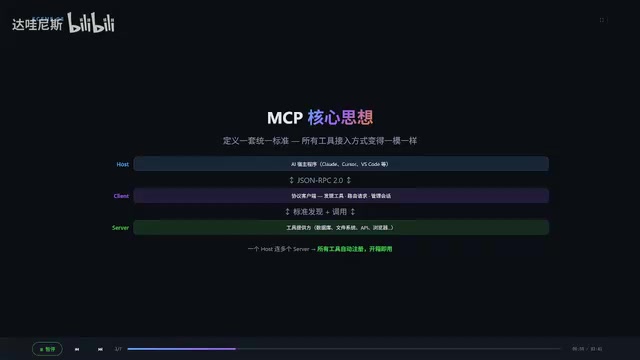
MCP acts like a universal adapter — no matter what tool you are, as long as you follow the MCP protocol, the host application can automatically discover you, understand you, and call you. With this unified standard, the original N×M problem collapses into an N+M problem: each AI application only needs to implement an MCP client once, and each tool only needs to wrap an MCP server once, enabling full interoperability.
MCP's Three-Role Architecture
MCP defines three core roles in its architecture:
- Host: The AI application itself — Cursor, Claude Desktop, etc.
- MCP Server: The server-side component that wraps specific tool capabilities
- MCP Client: The protocol communication layer between Host and Server
A single Host can connect to multiple MCP Servers simultaneously, with all tools auto-registered and ready to use out of the box. This Client-Server architecture draws on mature distributed systems design from the web world — MCP Servers expose tool capability descriptions (including tool names, parameter definitions, and functional descriptions) via a standardized protocol, while MCP Clients handle serialization, deserialization, and transport management at the protocol layer. This separation of concerns means tool developers only need to focus on implementing business logic and wrapping it per MCP spec, while host application developers only need to implement an MCP Client once to connect with all tools — dramatically reducing integration complexity.
At the transport layer, MCP supports two primary communication modes: local inter-process communication via standard I/O (stdio), suited for tool services running on the same machine with fast startup and low latency; and remote communication via HTTP+SSE (Server-Sent Events), suited for cloud-deployed tool services. In early 2025, the MCP spec further introduced Streamable HTTP transport, supporting more flexible stateless and stateful hybrid scenarios, allowing MCP Servers to be deployed on any cloud platform just like ordinary web services.
MCP's Three Standard Primitives Explained
The essence of the MCP protocol lies in its three standard primitives, which together cover the full range of interactions between AI and the external world.
1. Tools — Giving AI the Ability to "Act"
Executable functions that the model can actively invoke. Typical use cases include querying databases, sending emails, and calling third-party APIs. This is MCP's most core capability — giving AI real agency. Technically, each Tool registers its capabilities with the host via a standardized descriptor structure containing a name, functional description, and JSON Schema for input parameters. When a user makes a request, the LLM uses these descriptors to determine whether a tool needs to be called and automatically generates call parameters that conform to the Schema.
2. Resources — Giving AI the Ability to "See" Information
Read-only data resources that agents can access on demand — local file contents, database records, real-time logs, and so on. Resources provide AI with a standardized channel for accessing external information. Unlike Tools, Resource reads are typically initiated by the application (rather than the model) proactively. They function more like a "data pipeline" that supplies context to the AI, allowing the model to reference up-to-date external data during inference rather than relying solely on knowledge from training.
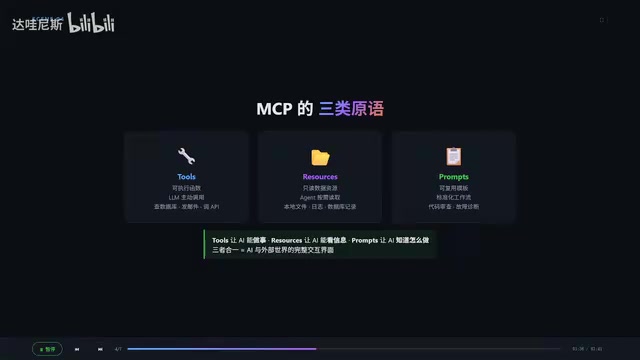
3. Prompts — Telling AI "How to Do It"
Reusable prompt templates — standardized code review templates, fault diagnosis workflows, and the like. Prompts standardize how AI executes specific tasks. The design philosophy behind this primitive comes from prompt engineering best practices — carefully designed and validated prompt templates consistently improve model output quality. By standardizing these templates through MCP and making them reusable, tool developers can package domain expert knowledge directly into MCP Servers, benefiting any AI application that connects to them.
Together, the three primitives define the complete interaction interface between AI and the external world: Tools provide agency, Resources supply information, and Prompts standardize execution. These three primitives cover the complete "perception–decision–execution" loop of an AI Agent workflow.
Practical Comparison: Traditional Approach vs. MCP Approach
Let's use a weather query example to feel the difference MCP makes.
Traditional approach (manual integration):
- Look up the weather API documentation
- Write adapter code and data transformation logic
- Manually register the tool in the host application
- Debug repeatedly when bugs appear
MCP approach (plug and play):
- Install a weather MCP Server
- Configure a single connection parameter
- The host application automatically discovers and registers the weather query tool
- When a user asks about the weather, the LLM sees the tool description, automatically calls it, receives the result, and continues reasoning
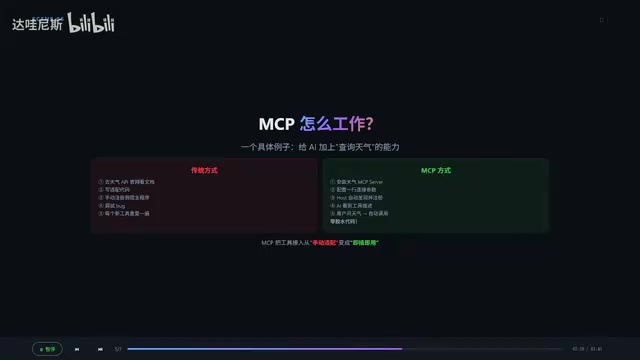
You'll notice that developers barely need to write any glue code at all. From "manual integration" to "plug and play" — that's the paradigm shift MCP delivers. The experience is similar to a smartphone app store: you don't need to understand the underlying communication protocol; you just "install" an MCP Server and the tool capability becomes immediately available.
MCP Ecosystem: Mainstream Platform Adoption
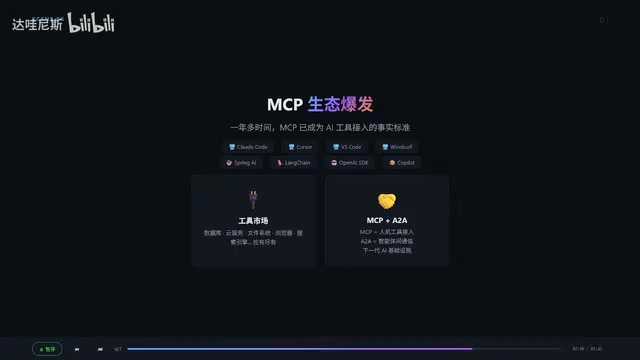
More than a year after MCP's launch, the ecosystem has seen explosive growth.
Code editors: Cursor, Windsurf, and VS Code all have built-in MCP support, letting developers invoke MCP tools directly from their editors. This means AI assistants can query documentation, operate databases, and execute deployment scripts via MCP in real time while you write code — enabling true end-to-end AI augmentation of the development workflow.
Backend frameworks: LangChain's MCP Adapter achieves seamless integration by automatically converting tool descriptions exposed by MCP Servers into LangChain's internal Tool objects — developers simply specify the MCP Server's connection address, and LangChain handles the entire flow of tool discovery, Schema parsing, and call proxying. Spring AI's MCP integration targets the Java ecosystem, making it easy for enterprise backend applications to connect to the MCP tool ecosystem — signaling that MCP has expanded beyond the AI-native community into traditional enterprise development. OpenAI's Agents SDK has also added full MCP protocol support.
Tool marketplaces: From databases to cloud services, from file systems to browser automation, virtually any tool type you can think of has a ready-made MCP Server available. Community-maintained MCP Server directories already cover hundreds of tools, including popular services like GitHub, Slack, PostgreSQL, and Puppeteer browser automation.
MCP + A2A Protocol: The Dual Engines of Next-Generation AI Infrastructure
Worth noting is that Google's A2A Protocol (Agent-to-Agent Protocol), released in April 2025, forms a perfect complement to MCP:
- MCP solves the "human-to-tool integration" problem — how models call external tools
- A2A solves the "agent-to-agent communication" problem — how agents collaborate with each other
A2A focuses on multi-agent discovery, authentication, task delegation, and state synchronization. It introduces an Agent Card mechanism that lets agents publish their capability descriptions in a standardized way, with other agents reading Agent Cards to decide whether to delegate tasks. This design enables collaboration between heterogeneous AI systems — for example, a data analysis agent can delegate a visualization task to a specialized chart-generation agent, with both completing the handoff and result return via A2A.
Together, the two protocols form the dual-engine foundation of next-generation AI applications: MCP gives each agent access to a rich set of external tools, while A2A enables multiple agents to collaborate efficiently on complex tasks.
Conclusion: Why MCP Is Essential Knowledge for AI Developers
MCP's value can be summed up in one sentence: In the past, code called tools. Now, models call tools. And MCP is the universal language between them.
Key takeaways:
- Unified standard: MCP is the USB-C port of the AI world — it solves the standardization problem of model-to-tool integration, reducing N×M adapter complexity to N+M
- Three primitives: Tools, Resources, and Prompts fully cover the "perception–decision–execution" interaction loop between AI and the external world
- Plug and play: The Client-Server architecture combined with flexible transport options (stdio / HTTP+SSE / Streamable HTTP) transforms tool integration from manual adaptation to automatic registration
- Mature ecosystem: Major editors, development frameworks, and tool marketplaces fully support MCP, with the community tool library continuously expanding
- Dual-engine landscape: MCP and A2A complement each other — addressing tool invocation and agent collaboration respectively — together building the infrastructure for next-generation AI applications
If you're working on AI application development, MCP is absolutely a foundational protocol you need to master. The sooner you understand it, the better positioned you'll be to ride the wave of the AI tool ecosystem.
Related articles
Deep Dive into AI Agent Skill Design: …
Deep Dive into AI Agent Skill Design: Engineering Practices from Anthropic and Perplexity
A deep dive into Skill design philosophy from Anthropic's Claude Code team and Perplexity's Agent team, covering the Tax Test, Gotchas Flywheel, progressive disclosure, and Eval-First practices for building high-quality AI Agent skill systems.
Deep Dive into OpenAI's Official GPT-5…
Deep Dive into OpenAI's Official GPT-5.6 Prompting Guide: The Shift from Manual to Automatic
A deep dive into OpenAI's official GPT-5.6 Sol prompting guide: conciseness-first, outcome-oriented design, autonomy boundaries, tool routing, and reasoning intensity tuning.
 Deep Dives
Deep Dive into How OpenClaw (Open-Source Crayfish) AI Agent Works
Deep analysis of OpenClaw AI Agent internals: System Prompt, tool calling, SubAgents, Skill system, memory, and Context Engineering explained.